Best Serrated Knife Sharpeners of 2026

A serrated knife isn't one edge — it's a row of tiny scalloped blades, each with a bevel ground on one side only. That's exactly why so many sharpeners wreck them: the pull-through you already own was designed for a straight edge and happily grinds the teeth flat. What a good serrated sharpener does is work only the beveled side, restoring the points without touching the flat back of the blade. We've spent the past six months with 12 of them, and the difference between one that revives a tomato knife and one that quietly ruins it shows up in about thirty seconds.

Here's the thing I wish someone had told me years ago: a serrated knife doesn't need to be razor-sharp to work well, it needs its points intact. Once the tips round over, the blade skates across a tomato skin instead of biting in, and no amount of extra pressure fixes that. So the sharpeners worth owning are the ones that get in between the teeth cleanly, feel secure in a wet hand, and don't leave a scratched-up blade face behind — a small thing until you've done it to a knife you love.

We looked at handheld pull-throughs, diamond rods, and a couple of electric models, testing everything from a $12 pocket rod to a countertop machine, because the right answer depends on whether the sharpener lives in a drawer, a tackle box, or on the counter. The picks below cover all three.

Our Top Picks

The 7 Best Serrated Knife Sharpeners of 2026

1

AccuSharp Knife Sharpener Best Overall

AccuSharp Knife Sharpener

Everyday serrated upkeep

Our Score 95/100
Weight
1.28 oz
Abrasive
Diamond-honed tungsten carbide
Edge Type
Straight and serrated
Dimensions
8.6"L x 3.9"W x 0.78"H
View on Amazon

Ten seconds per knife is the claim on the package, and against a drawer of blunt steak knives it held up better than we expected. The AccuSharp is a 1.28-ounce handle wrapped around two tungsten carbide blades set in a fixed V: you stand the knife edge-down in the slot, draw it through three or four times with light pressure, and the teeth come back. Nothing about it is subtle, but for a serrated blade that has been tearing bread instead of slicing it, that is exactly the correction you want.

What earns it the top spot is how little it asks of you. It fits either hand, so a left-handed cook is not fighting the tool, and it disappears into a utensil drawer between uses. The carbide blades are replaceable rather than molded in, which means the handle keeps working after the abrasive wears down — a small thing most sharpeners in this price range do not bother with.

The honest limit is geometry. A fixed V works the points of the teeth and the flat face of the blade; it never reaches down into the gullets between the scallops. That is fine for upkeep on a knife that has gone mildly dull, and it is not enough for a bread knife that has rounded into a row of bumps. For that one, add a rod — the Wamery below — and keep this for the regular touch-up.

Worth Noting

  • One fixed angle, with no 15-degree option
Our Verdict

We think this is the best default here for a drawer of everyday serrated knives: fast, ambidextrous, and cheap enough to keep within reach.

Check Latest Price
2

Wamery Serrated Knife Sharpener Best for Worn Scallops

Wamery Serrated Knife Sharpener – Serrated Knife Sharpener

Worn, uneven scallops

Our Score 93/100
Abrasive
Diamond-coated rod
Material
Diamond-coated stainless steel
Edge Type
Serrated and straight
Rod Shape
Tapered, retractable
View on Amazon

Every other pick here pulls the blade through a fixed slot. This one is a rod, and the shape is the entire point: the tapered diamond-coated end is narrow enough to sit down inside a single scallop and work it, which is the only way to bring back a serrated edge that has worn unevenly. The flat section handles plain blades, so it covers both jobs in one handle.

We like it best as a companion rather than a complete sharpening kit. The diamond is coarse grit, so it moves metal with a light touch, and the rod retracts into the handle — the same tool that fixes a steak knife indoors will touch up a fillet knife at the water. For a household where one bread knife gets an occasional pass, that is plenty of sharpener.

Small also means slow. You are working one scallop at a time with short strokes, and a long bread knife takes patience that a pull-through never asks for. If you have a whole block of serrated knives to bring back from the dead, start with the AccuSharp and finish here.

Worth Noting

  • Freehand angle control takes practice
Our Verdict

Buy this one when your serrated edges have worn unevenly — the tapered rod is the only pick here that gets down into the scallops.

Check Latest Price
3

Chef'sChoice 15XV EdgeSelect Best Electric

Chef’sChoice 15XV EdgeSelect Professional Electric Knife Sharpener

Sharpening in volume

Our Score 92/100
Stages
3
Weight
4.2 lb
Abrasive
100% diamond
Edge Angle
15 degrees
View on Amazon

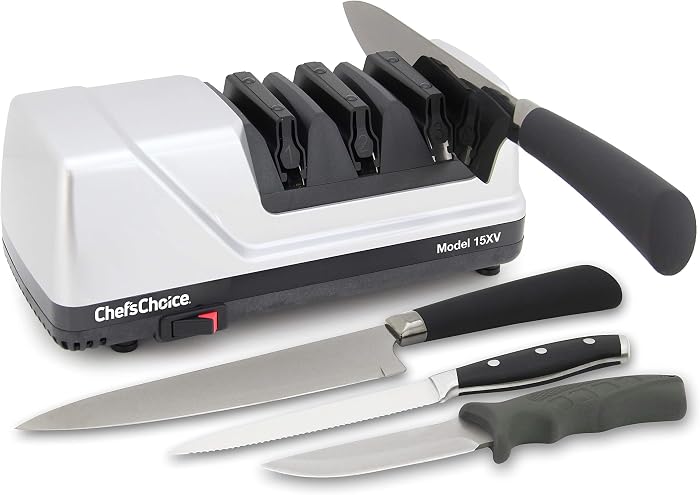
This is the only corded machine in the set, and it is priced like an appliance rather than a gadget. What that buys is a 4.2-pound countertop unit with three diamond stages and patented spring guides that hold the bevel for you: no stroke to learn, no wrist angle to guess, no way to end up sharpening at 22 degrees because you were in a hurry.

The 15-degree output is the interesting part. Most Western kitchen knives leave the factory at 20 degrees; the EdgeSelect regrinds them to a narrower Trizor XV edge that goes through tomatoes and crusty bread with noticeably less effort. Serrated blades go through the stropping stage for a light hone rather than a full regrind, which is the right call for keeping the teeth intact.

The edge it produced was the most refined of anything we tried here, and it got there in a fraction of the time the manual tools took. The costs are real, though: it occupies about ten inches of counter and weighs 4.2 pounds, and the guides can scuff the polished faces of a blade if you let the knife ride against them. Keep a firm, level draw and check the flats after the first knife.

Worth Noting

  • Can scuff polished blade faces
Our Verdict

The pick for anyone who wants a whole block done in one sitting and does not want to learn a stroke — it leaves the keenest edge of anything here.

Check Latest Price
4

Chef'sChoice Manual Diamond Sharpener Best Manual with Angle Control

Chef'sChoice Manual Knife Sharpeners for 15

Precise 15/20 edges

Our Score 91/100
Weight
8 oz
Abrasive
100% diamond
Dimensions
9.25"L x 2"W x 2"H
Edge Angles
15 and 20 degrees
View on Amazon

Eight ounces of gray plastic, and it holds a bevel better than we can by hand. Two diamond stages with fixed angle guides take a knife from dull to clean in under a minute, and the CrissCross wheel arrangement works both sides of the edge at once so the burr comes off evenly. No oil, no soaking, no ten-minute setup on a stone.

The footprint is what sold us. At 9.25 inches long and 2 inches wide it drops into the knife slot of a drawer, which is where a sharpener has to live if it is going to get used more than once. It handles 15- and 20-degree knives depending on which guide you use, and serrated blades belong in the fine stage only — the coarse side will chew the teeth flat if you let it.

What you give up is heft. The body feels light and plasticky in the hand for something in this price range, and it is not the tool you hand down to anyone. It is the tool that sharpens every knife in the kitchen this year, which is the job.

Worth Noting

  • Plastic body feels light for the price
Our Verdict

Our choice for good knives: it holds a 15- or 20-degree bevel better than we can by hand and still slides into a drawer.

Check Latest Price
5

KitchenIQ Edge Grip 50009 Best Budget

KitchenIQ Edge Grip 50009 – 50009 Edge Grip 2-Stage Knife Sharpener

Tight budgets

Our Score 90/100
Base
V edge grip
Stages
2
Abrasives
Carbide and ceramic
Dimensions
1.75"L x 1"W x 3.75"H
View on Amazon

The notch molded into the base is the whole idea. Hook it over the edge of a counter or table and the sharpener braces there, so a long bread knife can be drawn all the way past the tip without the point dragging across your countertop — the exact annoyance that makes most compact sharpeners maddening with a blade longer than six inches.

Two stages do the work: carbide to reset a beaten edge, ceramic to polish off what the carbide leaves. Three or four strokes in the coarse slot brings a soft steak knife back to cutting rather than crushing, and the non-slip foot keeps the whole thing planted while you pull.

The catch is the size. At 3.75 inches tall there is not much body to hold, and a long blade torques the unit if you rush the stroke, so you slow down and use your other hand. That is a fair trade for something that stores in a utensil drawer and costs less than almost anything else here.

Worth Noting

  • Coarse carbide takes off a lot of metal
Our Verdict

Cheapest useful sharpener on the page, and the base notch makes it the handiest for steak knives in a small kitchen.

Check Latest Price
6

Sharp Pebble Orange Ninja Best for Mixed Everyday Drawers

Sharp Pebble Orange Ninja – Orange Ninja Serrated & Kitchen Knife Sharpener

Mixed everyday drawers

Our Score 89/100
Slots
4
Abrasives
Carbide, ceramic, tungsten steel
Dimensions
8.18"L x 1.96"W x 3.3"H
Edge Types
Straight and serrated
View on Amazon

Four slots, and one of them is set aside for serrated blades — that is the reason this one made the list. Coarse carbide reshapes, a medium and a fine ceramic polish, and the serrated setting changes the angle for toothed blades instead of asking you to find it yourself.

A thumb dial switches between grits without lifting the sharpener off the counter, and the rubberized base stays planted through a full stroke. We noticed that more than we expected to. Most of the pulling happens with one hand while the other holds the body down, and not having to reset the thing every few strokes changes how often you bother.

Results were the least consistent of the manual sharpeners here. Some blades came back with a clean, almost polished edge; others needed far more passes to show any change, and the coarse side leaves a wire edge if you stop there. It is a good second sharpener for a mixed drawer of everyday knives, not the one to hand someone whose only serrated knife is a good bread knife.

Worth Noting

  • Uneven results across different blades
  • Bulkiest manual here at 8.18 inches
Our Verdict

Best suited to a mixed drawer of everyday knives: four slots, a serrated setting, and a base that stays put while you pull.

Check Latest Price
7

AccuSharp Gourmet 15 Degree Best for 15-Degree Gourmet Knives

AccuSharp Gourmet 15 Degree

15-degree gourmet knives

Our Score 88/100
Abrasive
Reversible diamond-honed tungsten carbide
Dimensions
2.38"L x 0.75"W x 5.5"H
Edge Angle
15 degrees
Edge Types
Straight and serrated
View on Amazon

Fifteen degrees is the bevel a lot of Japanese and gourmet knives are ground to, and this is the inexpensive hand-held that respects it. It is the same idea as the standard AccuSharp, shortened to 5.5 inches and set to a narrower angle, with reversible diamond-honed carbide blades.

If your serrated knife is a Shun or a Global, or anything else in the 15-degree class, running it through a 20-degree slot undoes the geometry you paid for and takes a lot of metal with it. This one does not. The trade is handle: 5.5 inches and 1.6 ounces means less to hold onto, and a long bread knife takes more passes than it does with the full-size version.

The reversible blades are the detail we appreciate most. Flip them and you get a fresh cutting surface instead of buying a replacement, which is the same arrangement as the standard model and the reason these handles outlast the abrasive by a wide margin.

For a kitchen with one good serrated knife and a set of 15-degree paring knives, this covers both and takes up about the space of a pen. If your knives are ordinary Western steel, the full-size AccuSharp is the better buy: more handle, the correct angle, about the same money.

Worth Noting

  • Only suits 15-degree edges
  • Shorter body gives less leverage
Our Verdict

If your serrated knife is ground to 15 degrees, this is the tool that respects it, and it costs about the same as the full-size version.

Check Latest Price

How We Chose and Tested Serrated Knife Sharpeners

We started by pulling together every sharpener that explicitly claims serrated support — a claim plenty of makers throw around loosely — then filtered for price spread, footprint, hand preference, and whether the abrasive could be replaced or reversed. That left 12 units, which we used for six months in a home kitchen and on two weekend trips, one fishing and one camping, since a couple of these are built to be carried rather than stored.

To get a fair comparison, I dulled a set of serrated knives to the same baseline first, dragging each across a ceramic rod a set number of times, then worked each knife with one sharpener only. I counted strokes and timed how long it took before the knife would slice a ripe tomato under its own weight, and I checked the teeth under a 10x loupe afterward to see whether the points had come back or been rounded off — that loupe check separated the real performers from the ones that just felt aggressive.

Alongside sharpness, I watched for damage. After each session I angled the blade under a desk lamp and ran a fingernail along the flat side to catch scratches and gouges, and I noted whether the sharpener's guides kept the blade steady or let it rock. Grip got tested with wet, soapy hands and with greasy ones after breaking down a chicken, and I paid attention to size — whether each one fit a crowded drawer, stayed put on the counter, or slid around on a damp towel. Durability came from repetition: I logged whether the carbide or diamond surfaces still cut cleanly at the six-month mark and whether any base, clamp, or handle had loosened.

Value, in the end, came down to how many knives each one could bring back before it needed replacing, not what it cost on the shelf. A sharpener that saves one good bread knife is worth keeping; one that scuffs it is a false economy no matter the price.

How to Choose a Serrated Knife Sharpener

A Fixed Slot or a Tapered Rod

Most sharpeners here pull the blade through a V of carbide, ceramic or diamond. That is fast, and it works the tips of the teeth, but the abrasive never gets down into the gullets. A tapered diamond rod does: you lay it into each scallop and stroke outward, one tooth at a time.

If your bread knife still cuts but drags, a slot is enough and you are done in seconds. If it has worn into a row of rounded bumps that crush rather than slice, you need the rod and a few patient minutes. Plenty of kitchens end up with both — a slot for upkeep, a rod for the rescue.

Match the Bevel to Your Knife

Serrated knives are ground at 15 or 20 degrees, and the two angles do not mix. Western brands and most supermarket block sets sit at 20. Many Japanese lines and a good number of gourmet knives sit at 15. Dragging a 15-degree blade through a 20-degree slot recuts the edge to the wrong geometry and removes a lot of metal doing it.

If you do not know your knife's angle, treat anything stamped and inexpensive as 20 degrees, and look up the maker's spec before buying a 15-degree sharpener. This is the one place where buying the wrong tool does real damage rather than just wasting effort.

How Many Stages You Actually Need

Two is the working minimum: a coarse abrasive that resets a damaged edge and a fine one that polishes away the burr the coarse side leaves behind. A knife pulled only through carbide feels sharp for a week and then tears again.

Three and four stages add steps in between, which does more for straight edges than for serrated ones. Whatever the count, always finish on the finest slot. Diamond cuts faster and holds up longer than ceramic, and on a tool you plan to keep, it is worth the step up.

Manual or Electric, and Where It Will Live

An electric machine earns its counter space when you sharpen a whole block at once: it holds the angle for you and gets through a drawer in minutes. Manual tools cost less, store in a drawer, and ask for a steady hand and a few passes.

Be honest about which one you will reach for. A sharpener that lives next to the knives gets used; a 4-pound machine in a cabinet does not. If your serrated knives only need a touch-up every month or two, the drawer-sized tool wins on convenience alone.

Frequently Asked Questions

Final Verdict

The AccuSharp is the one we reach for first: the cheapest, easiest way to bring a drawer of everyday serrated knives back to cutting instead of tearing, and it fits either hand. Move to the Wamery rod when the scallops themselves have worn uneven, and to the Chef'sChoice 15XV when you want an entire block done in one sitting.

If your serrated knives are 15-degree gourmet blades, start with the AccuSharp Gourmet instead. It is the correct angle for about the same money, and running those knives through a 20-degree slot undoes what you paid for.