Best Manual Knife Sharpeners of 2026

A dull knife is more dangerous than a sharp one. It takes real force to push a tired edge through a tomato, and force is exactly what sends the blade into your knuckle. A manual sharpener solves that with nothing but a small piece of abrasive held at a steady angle while you do the work — no cord, no noise, no driving across town to a knife shop that may or may not be open.

I keep one in the kitchen drawer and another in my fishing bag, and after four months with 14 manual sharpeners — pull-throughs, bench stones, pocket-sized models, and a honing rod — the spread between good and frustrating is wider than you'd expect. Two things catch first-time buyers off guard: a honing rod doesn't actually sharpen anything (it realigns an edge that's already in decent shape), and coarse carbide slots will bring a beat-up blade back in about ten strokes but shave off enough steel to shorten that knife's life if you reach for them every week.

The picks below are grouped by where the sharpener lives rather than by grit or geometry, because the one that actually gets used is the one within arm's reach when the blade goes dull.

Our Top Picks

The 8 Best Manual Knife Sharpeners of 2026

1

Work Sharp Guided Field Sharpener Best Overall

Work Sharp Guided Field Sharpener

All-around sharpening

Our Score 97/100
Weight
4.6 oz
Abrasives
220/600 diamond, ceramic, leather strop
Edge Types
Straight, serrated, fish hooks
Angle Guides
20 and 25 degrees
View on Amazon

Five sharpening surfaces and two angle guides fit into a body that weighs 4.6 ounces, and that combination is why this is the manual sharpener we point almost everyone toward. Coarse 220-grit diamond takes down a damaged edge, 600-grit diamond refines it, ceramic rods hone and reach into serrations, and a leather strop cleans up the burr. The built-in 20- and 25-degree ledges hold your stroke steady, so your tenth pass looks like your first even if you have never sharpened anything in your life.

What we did not expect is how much those ledges change the experience. Freehand sharpening is a skill; this is a procedure. You rest the blade against the guide, push away from the edge, and count passes, and the knife gets sharp anyway. The whole kit runs dry, with no water and no cord, and there is a hook groove in the ceramic rod, a broadhead wrench, and a lanyard hole. Ours has ridden in a pack and sat on a kitchen counter, and it looks equally at home in both places.

The edge it leaves is clean and slightly toothy, the kind that bites into a tomato instead of skidding across it, which is what most kitchen work actually asks for. If you are chasing a mirror-polished bevel, that is a stone's job. The limited lifetime warranty covers the body and not the abrasives, so the diamond will eventually wear out on its own dime. Neither point changes our recommendation, because for one tool that handles a chef's knife, a pocket knife, and a serrated bread knife without a learning curve, nothing else here comes close.

Worth Noting

  • Abrasives are excluded from the lifetime warranty
Our Verdict

We recommend the Guided Field Sharpener to anyone who owns more than one kind of knife: it repairs, sharpens, hones, and strops while the guides hold the angle for you.

Check Latest Price
2

Sharp Pebble Whetstone 1000/6000 Best Whetstone

Sharp Pebble Whetstone Knife Sharpener

Razor-sharp kitchen edges

Our Score 96/100
Base
Non-slip bamboo
Grits
1000 / 6000
Weight
2.1 lb
Angle Guide
Included
View on Amazon

A whetstone asks for ten minutes of soaking, a wet counter, and more patience than any pull-through on this list. In exchange you get two grits of real abrasive: 1000 for a dull or nicked edge, 6000 for the polish that makes tomato skin part under the weight of the blade. The stone runs about seven inches long, sits in a bamboo base with non-slip feet, and arrives with an angle guide and a written walkthrough aimed at people who have never used one.

We think that trade is worth making in a kitchen you actually cook in. The angle guide holds the blade at a consistent bevel, which is the part beginners get wrong and then blame on the stone, and the base stays put even on a polished granite counter, so you can work two-handed instead of chasing the stone around. A dull Henckels comes off the 6000 side sharper than it left the factory.

Upkeep is the part nobody mentions at checkout. Any water stone eventually needs flattening, which means a coarse plate or a sheet of wet sandpaper and five minutes of scrubbing. The bamboo base has to dry completely before it goes back in a cabinet, or you are storing a damp block. Neither is difficult, and both are the price of an edge no pull-through can produce.

The habit worth forming is patience at the 1000 grit: work heel to tip in overlapping sections until you feel a burr along the whole length of the edge, then move to the 6000 and polish it off. Rushing that first step is why people decide whetstones do not work. Do it properly once and the knife tells you the difference on the very next onion.

Worth Noting

  • Needs soaking, full drying, and occasional flattening
  • At 2.1 pounds it stays home on the counter
Our Verdict

Buy it if you want the keenest edge in this guide and can spare ten minutes at the sink; the included angle guide does most of what a whetstone normally demands.

Check Latest Price
3

AccuSharp Knife Sharpener Best Budget

AccuSharp Knife Sharpener

Quick drawer touch-ups

Our Score 95/100
Grip
Full-length finger guard
Blades
Reversible and replaceable
Abrasives
Diamond-honed tungsten carbide
Edge Types
Straight and serrated
View on Amazon

This is the least expensive sharpener in our roundup, and it is the one that gets used, because it costs about as much time as opening the drawer. Two or three pulls through the carbide V and a dull paring knife is cutting again. For the knives that live in a block on the counter and get washed in a dishwasher, that trade is easy to make.

Carbide is the trade. Dragging a blade through tungsten carbide cuts a fresh bevel rather than refining the one that is there, so a knife you paid to have sharpened professionally loses that geometry faster than it would on a stone. Keep it for workhorse blades and reach for the stone when the knife is thin, hard, and expensive. The cutting blades reverse and replace when they load up, the handle carries a full-length finger guard, and it fits either hand, which makes it the safest of the cheap options for someone who has never sharpened anything.

Worth Noting

  • Fixed slot cannot match every knife's bevel angle
Our Verdict

We keep one in the kitchen drawer: it is the fastest route back to a usable edge for the least money, and forgiving enough for a first-timer.

Check Latest Price
4

SHARPAL 101N 6-in-1 Best for EDC

SHARPAL 101N 6-in-1 Pocket Knife Sharpener & Survival Tool

EDC and camping

Our Score 94/100
Length
3.54 in
Weight
2.4 oz
Functions
Carbide, ceramic, diamond rod, ferro rod, whistle
Diamond Grit
400
View on Amazon

If the knife you care about most folds, this is the sharpener to clip to a pack. It measures 3.54 inches and 2.4 ounces, and it packs six functions into that: a coarse carbide V, a fine ceramic slot, a tapered 400-grit diamond rod, a ferro fire starter, a whistle, and a lanyard hole.

The diamond rod is the part worth having. Tapered and narrow, it gets into the scallops of a serrated blade and the curve of a gut hook that no slot can reach, which is the reason this earns a place over a plain two-stage puck. The carbide and ceramic slots do what preset slots always do, and a few passes bring an edge back to usable.

The extras are the point as much as the abrasives are: this replaces three things in a pack rather than serving as the sharpener you would choose for a chef's knife. One caution. The ferro rod can arrive with a coating that has to be scraped off before it throws sparks, so test it in the driveway rather than on a wet night in the woods. Ours lives in a glovebox, where it has been quietly useful more than once.

Worth Noting

  • Leaves a working edge rather than a razor edge
  • Fire starter can need its coating scraped first
Our Verdict

We recommend it as the sharpener that lives in a pack: small, versatile, and good enough to bring an edge back when nothing else is within reach.

Check Latest Price
5

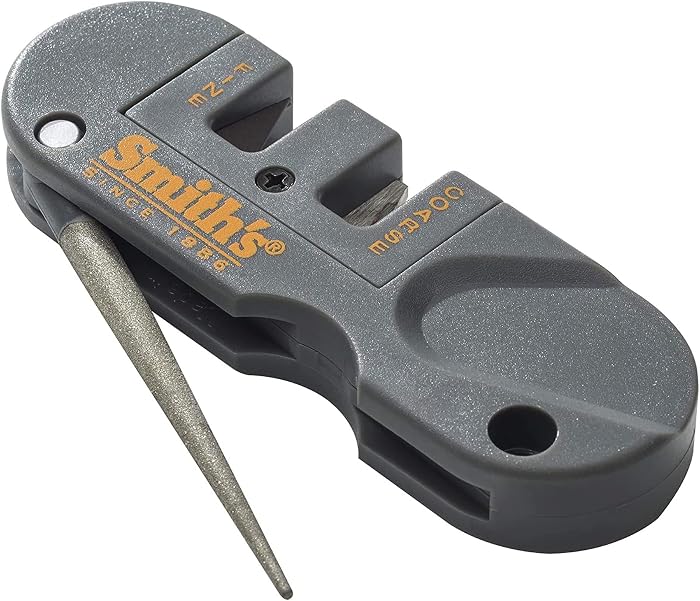
Smith's Pocket Pal PP1 Best for Serrations

Smith's PP1 Pocket Pal Knife Sharpener Preset Carbide & Ceramic Stone

Serrations and hooks

Our Score 93/100
Length
3.5 in
Weight
1 oz
Abrasives
Carbide, ceramic, diamond rod
Replacement
Reversible and replaceable abrasives
View on Amazon

The Pocket Pal and the SHARPAL 101N cost about the same and both disappear into a watch pocket, but only one of them is really a sharpener. The Smith's skips the whistle and the fire starter and spends the space on a fold-out, tapered diamond rod for serrations, gut hooks, and fish hooks, plus carbide and ceramic slots that reverse and replace when they wear.

That trade is the right one for most people. The rod is what reaches the parts of a serrated blade a slot cannot touch, and because it swings out on a hinge you can brace the body in your hand and work one scallop at a time instead of dragging the whole blade through a V. The ceramic slot is the one for a quick touch-up; the carbide is the aggressive one, and it takes off far more steel.

At one ounce it vanishes into a pocket, and the lanyard hole means it can hang off a pack strap or a belt loop. The plastic body is what keeps the price down, and the abrasives are the parts that do the work, so the fact that both can be turned around or replaced matters more than the shell around them. Smith's backs it for three years, which is generous for a tool this small.

Worth Noting

  • Carbide slot is for straight edges only
  • Preset slots leave no angle adjustment
Our Verdict

We hand this to anyone who sharpens serrated or hooked blades away from home: the fold-out diamond rod reaches what a slot cannot.

Check Latest Price
6

Work Sharp Guided Field Sharpener Elite Best Upgrade

Work Sharp Guided Field Sharpener Elite

Repair and polish

Our Score 92/100
Case
Zippered case included
Weight
4.6 oz
Angle Guides
20 and 25 degrees
Diamond Plates
220 / 400 / 600 / 800
View on Amazon

Four diamond plates instead of two, a separate serration rod, and a zippered case: the Elite is the Guided Field Sharpener with the gaps filled in, for a good deal more money. The plates step 220, 400, 600, and 800 grit, so you can take a chipped hunting knife down and then walk it finer instead of jumping straight from repair to hone.

Those extra grits matter more than they sound. On the standard model the finest diamond is 600, which leaves a toothy working edge; the 800 plate gives you one more step before the ceramic and the strop, and on a skinning blade or a fillet knife that shows up as a cleaner cut through sinew. The case is the other quiet upgrade, because loose diamond plates in a pack will scuff whatever they share space with, including a sleeping bag.

Two things surprised us. The serration rod is now its own piece rather than a groove in the ceramic, which makes working a scallop noticeably less fiddly in cold hands. And the warranty is three years, where the cheaper standard Guided Field Sharpener carries a limited lifetime one. A shorter warranty on the more expensive kit is a strange trade, and worth knowing before you pay for the upgrade.

So who is it for? Someone who sharpens several knives a season away from an outlet, or who is repairing edges rather than touching them up, and who wants the finer finish at the end of it. For a kitchen drawer and the occasional pocket knife, the standard model does the same job for a lot less, and it remains the one we recommend to most people.

Worth Noting

  • Costs a good deal more than the standard kit
Our Verdict

We recommend the Elite to people who sharpen often away from home and want a finer finish; everyone else can save the money and take the standard model.

Check Latest Price
7

Smith's CCKS 2-Step Best for Tackle Box Sharpening

Smith's CCKS 2-Step Knife Sharpener

Tackle box sharpening

Our Score 91/100
Floats
Yes
Stages
Coarse carbide, fine ceramic
Weight
Under 2 oz
Footprint
2.33 x 2.71 in
View on Amazon

Two preset slots, just under two ounces of yellow plastic, and no adjustment of any kind: the CCKS is the least sophisticated sharpener on this list. It measures 2.33 by 2.71 inches, has non-slip rubber feet and a lanyard hole, and it floats, which is not a spec you will find on many sharpeners and is exactly the one that matters over water.

What it does, it does in seconds. Crossed tungsten carbide blades reset a dull edge in three or four strokes, crossed ceramic rods smooth it, and both sit at a fixed angle, so there is nothing to hold steady and nothing to learn. Fillet knives are where it makes the most sense: soft steel, a curved blade, and a need for a quick edge in bad light with wet hands.

We keep one in a boat bag, and that is the honest summary. It is a sharpener for the pack, the glovebox, and the tackle box, not for the knives you cook with, because those preset slots grind their own angle into whatever you push through them and a good chef's knife deserves better. What you get is an edge sharp enough to finish the job, in a tool that costs less than nearly anything else here.

Worth Noting

  • Preset slots give you no say in the angle
Our Verdict

We recommend it for a tackle box or a glovebox: it floats, weighs almost nothing, and puts a working edge back on a fillet knife fast.

Check Latest Price
8

Utopia Kitchen Honing Rod Best for Between Sharpenings

Utopia Kitchen Knife Sharpener Rod 12 Inch Honing Rod for Sharpening

Between sharpenings

Our Score 90/100
Handle
Non-slip grip
Length
12 in
Storage
Hanging loop
Material
Nickel-chrome plated carbon steel
View on Amazon

A honing rod is not a sharpener, and knowing that before you buy one saves a lot of disappointment. Steel does not remove enough metal to fix a dull edge; it realigns an edge that has rolled over, which is why a few strokes bring a knife back for a week or two and then stop working entirely.

What this one gives you is reach. At 12 inches the rod clears a long chef's knife without your knuckles meeting the counter, and the nickel-chrome plating over carbon steel is smooth enough that a light stroke glides rather than scrapes. The handle has a rubberized base and there is a hanging loop, so it can live on a wall strip instead of rolling around in a drawer with the utensils.

Technique matters more than the tool. Stand the rod point-up on a folded towel, lay the blade at the angle it was sharpened at, roughly 20 degrees per side for most Western knives, and draw the edge down and across in light strokes, alternating sides. Press hard and you roll the edge the other way, which is worse than where you started.

Buy it if you already own a stone or a guided sharpener and want to stretch the time between sessions, and skip it if the knife in your hand is genuinely dull, because no amount of honing brings that edge back. Two or three light strokes a week is plenty. Like most maintenance, the easy version done often beats the thorough version done once.

Worth Noting

  • Hones an edge but will not remove steel to sharpen
Our Verdict

We keep it for the weeks between sharpenings: 12 inches of steel that keeps a chef's knife honest without taking any metal off.

Check Latest Price

How We Tested Manual Knife Sharpeners

We started with the best-selling and best-reviewed manual sharpeners from brands that specialize in sharpening, then filtered by abrasive type, whether the tool handled serrated blades as well as straight ones, and footprint — anything too bulky for a drawer or a pack pocket was out. That left 14 sharpeners, which we lived with for four months rather than an afternoon.

Every one started on the same deliberately dulled chef's knife. We counted strokes until the blade sliced printer paper cleanly and went through a ripe tomato under its own weight, then checked a week of home cooking later to see how much of that edge survived. In the kitchen we also ran each sharpener over a serrated bread knife and a cheap paring knife, watching whether it caught in the scallops or just polished the tips. A weekend fishing trip did the rest: filleting and touch-ups on a tailgate in the wind, with wet hands, which quietly eliminated the grips that went slick and the models that demanded two hands and a flat surface.

Build quality got checked by feel as much as by eye — whether a rod wobbled in its housing, whether a stone flattened or clogged with steel filings after a dozen knives, whether a preset angle guide shifted mid-stroke. For ease of use, one tester set up each sharpener alone using only the printed instructions and timed it, noting whether the angle was built in or had to be held freehand. For value, we tracked how many knives each went through before the abrasive stopped biting and weighed that against what a professional sharpening costs.

How to Choose a Manual Knife Sharpener

Start With the Job: Honing, Sharpening, or Repair

A honing rod, a pull-through, and a whetstone all get called sharpeners, and they do different work. Honing realigns an edge that has rolled over; sharpening removes steel to cut a new apex; repair takes off more steel to grind out a nick. If the knife drags but the edge looks even under a light, hone it. If it's blunt or chipped, sharpen it, starting at the coarsest grit you own.

This is the most expensive mistake in the category: buying a rod when the knife needed a stone. Our picks divide along those lines. The Utopia rod hones, the AccuSharp and the two Smith's tools sharpen fast, and the Sharp Pebble stone does all three if you're willing to spend the time.

Angle Control Decides the Edge You Get

Every manual sharpener makes one decision for you: the angle. Preset V slots cut whatever bevel the slot was ground at, so a knife built for 15 degrees comes out of a 20-degree slot with a brand-new edge and less steel than it started with. That's fine for a workhorse blade and wrong for a knife you baby.

Guides hand the decision back to you. The Work Sharp sharpeners have 20- and 25-degree ledges built into the body; the Sharp Pebble kit includes an angle guide that holds the blade against the stone. Freehand is the third option, and it's a skill rather than a purchase. Own one good knife and you want a guide; own a drawer of beaters and a preset slot will do.

Speed Costs Steel

The faster a sharpener works, the more metal it takes. Crossed tungsten carbide removes the most per stroke, diamond plates cut fast but under your control because you decide how many passes to make, and a water stone removes the least while leaving the cleanest edge. That's the real trade behind the price tags.

Match the abrasive to the knife rather than to your patience. A thin, hard Japanese blade deserves the stone or a guided diamond plate. A ten-year-old stamped chef's knife is perfectly happy with carbide, and a fillet knife that lives in a boat bag is happy with anything that works in the dark.

Budget for the Upkeep, Not Just the Purchase

Manual sharpeners wear out. Carbide inserts can be reversed and replaced, as on the AccuSharp and the Smith's Pocket Pal; diamond plates and ceramic rods eventually lose their bite; water stones need soaking before use, flattening every so often, and a bamboo base that dries completely before it goes back in a cabinet.

None of that is costly, but it is the difference between a tool you keep for a decade and one that ends up at the back of a drawer. If you already know you won't soak a stone, buy a guided diamond sharpener instead. It works dry, and it will actually get used.

Frequently Asked Questions

Final Verdict

The Work Sharp Guided Field Sharpener is the one we recommend to most people. It is the only manual sharpener here that repairs, sharpens, hones, and strops, and its built-in guides hold the angle for you while it does it, dry, on a counter or in a camp.

If the keenest possible edge matters more than convenience, the Sharp Pebble whetstone gets you there for about the same money, provided you'll soak it and learn the stroke. For a drawer of everyday knives and no patience at all, take the AccuSharp.