Best Knife Sharpeners of 2026

A dull knife doesn't fail loudly. It skids across the tomato skin, crushes the garlic, and turns ten minutes of dinner prep into a wrestling match — so you reach for a sharpener, which is where the real damage starts. A pull-through with a sloppy angle can shave a good chef's knife into a recurve in a season; a coarse stone in unpracticed hands does it faster.

I've sharpened my own knives for years, and the lesson that took me longest is that grit and motor size matter far less than whether the sharpener holds a consistent angle for you. My team and I spent the past eight months running 14 sharpeners, from electric and stone to pocket-sized, through real cooking and real yard work — and the gap between a good edge and a ruined blade showed up fast.

We cared about what shows up after the honeymoon: whether it was easy to grab at 7 p.m. on a Tuesday, whether it scarred the blade, whether it still worked in month seven, and what each edge cost in effort. The picks below split between patience and speed, but they all leave you with a knife that cuts.

Our Top Picks

The 8 Best Knife Sharpeners of 2026

1

Work Sharp MK2 Electric Knife Sharpener Best Overall

Work Sharp MK2 Electric Knife Sharpener

Kitchen and tools

Our Score 98/100
Power
Electric, two speeds
Also Sharpens
Scissors, axes, garden tools
Sharpening Method
Abrasive belts
View on Amazon

Two spinning abrasive belts do the work of a steady hand, which is the short version of why the Work Sharp MK2 leads this list. A chef's knife that has been dragging through onions comes back slicing in a couple of minutes, and you never have to hold an angle, because the edge guide holds it for you. We ran kitchen knives, a pocket knife, and a pair of scissors through it, and the belt wrapped each curve without the flat-spot risk of a rigid stone.

The two-speed motor matters more than it sounds. Low speed gives you time to feel what the belt is doing to a thin paring knife or a fillet blade. High speed grinds a mower blade or an axe back into shape without bogging down. That range is what makes the MK2 useful beyond the knife block: shears, pruners, and shop tools all fall inside it.

Speed cuts both ways, and this is the one place to slow down. The belts take metal off quickly, and a blade that only needed a touch-up can lose its tip to a heavy hand. Use the finest belt and a light pass on anything you care about, and let the machine do the work instead of leaning into it.

What settles it for us is coverage. Nothing else here moves from a paring knife to a lawnmower blade without a change of equipment, and the three-year warranty covers the housing rather than the abrasives, which tells you where the long-term cost sits. If your sharpening is all chef's knives all the time, a stone will give you a more refined edge. If it is everything in the house, this is the machine.

Worth Noting

  • Belts are consumable and wear out
Our Verdict

We recommend it as the one sharpener for a household that needs kitchen knives, scissors, and garden tools back in working order without learning a skill.

Check Latest Price
2

Chef'sChoice 15XV Electric Knife Sharpener Best Premium Electric

Chef’sChoice 15XV EdgeSelect Professional Electric Knife Sharpener

Hands-off results

Our Score 97/100
Power
Electric
Weight
4.2 lb
Edge Angle
15 degrees
Sharpening Method
3-stage diamond
View on Amazon

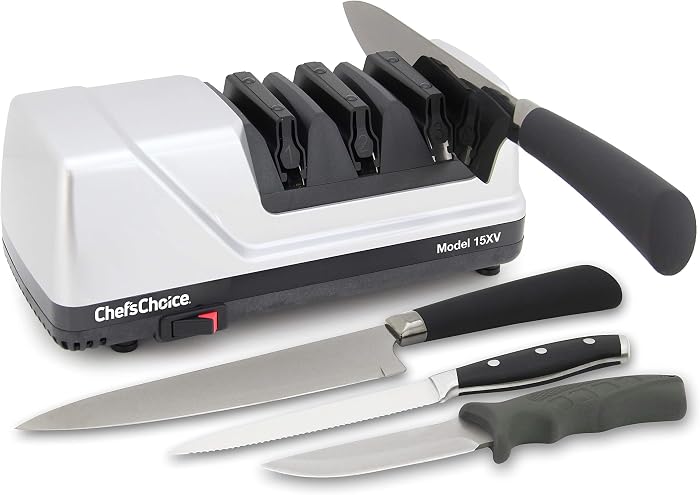
Nobody spends this kind of money on a sharpener without wanting the best edge in the house, and the 15XV makes a strong case for it. Three stages, two of them diamond and one a stropping pass, hand a knife back with a polished and genuinely aggressive edge. The flexible spring guides adjust to the blade and hold the angle automatically, so the result does not depend on how steady your hands are. Follow the manual and the whole block takes under half an hour.

The trade-off is that it draws the blade across diamond wheels with real force, and the flat of a knife can pick up scratches on the way through. On a drawer of everyday knives we shrug at that. On a knife you saved for, it is disqualifying, and it is the single reason this sits behind our top pick rather than in front of it.

If the scratches do not trouble you, this is the closest thing here to a professional sharpening at home. It also reprofiles standard 20-degree factory edges to 15 degrees over a few sessions, which changes how a knife releases through an onion. It is a substantial machine, though, at four pounds and about the size of a small toaster, so plan on shelf or counter space for it.

Worth Noting

  • Can scratch the flat of a blade
  • Costs more than any other pick here
Our Verdict

We tell anyone with a drawer of everyday knives and no interest in technique to buy it, as long as they can live with a scratch on the blade face.

Check Latest Price
3

Sharp Pebble Whetstone Knife Sharpener Best Whetstone

Sharp Pebble Whetstone Knife Sharpener

Patient perfectionists

Our Score 96/100
Grit
1000 / 6000
Weight
2.1 lb
Includes
Angle guide, bamboo base, instructions
Sharpening Method
Water whetstone
View on Amazon

Most people who buy a whetstone and give up do it for the same reason: holding a steady 15 or 20 degrees freehand is a skill, and a knife sharpened at a wobbling angle is worse than one you left alone. The angle guide that clips onto the blade removes that variable. Set it, keep the stone wet, and work the 1000-grit side until you feel the burr run the length of the edge.

The 6000-grit side is the payoff, a polish no carbide pull-through can produce and the reason a stone-sharpened knife glides rather than grabs. The bamboo base with its rubber feet stayed put on a granite counter while we worked, which matters more than it sounds when you are making long, even strokes. Water only, and dry the block completely before it goes back in the drawer, because stored damp the wood suffers.

This is the pick for the cook who wants the finest edge here and does not mind ten minutes and some practice to get it. It is slower than anything powered, and the first few knives will be your worst. The stone is also the only thing in this article that improves as your hands do, which is either the appeal or the dealbreaker depending on the person holding it.

Worth Noting

  • Takes time and practice to learn
  • Wooden base must dry fully before storage
Our Verdict

We point cooks who want the sharpest edge on this page and don't mind practicing for it at this stone.

Check Latest Price
4

Work Sharp Guided Field Sharpener Best for Hunting and Field Use

Work Sharp Guided Field Sharpener

Hunting, fishing, camping

Our Score 95/100
Weight
4.6 oz
Edge Angles
20 and 25 degrees
Diamond Grits
220 and 600
Sharpening Method
Diamond plates, ceramic rod, leather strop
View on Amazon

A dull knife at the tailgate is a different problem from a dull knife at the cutting board. There is no counter to brace against, no water, and no patience. Work Sharp built this for that moment: two diamond plates, a three-position ceramic rod, and a leather strop packed into a 4.6-ounce tool that runs on nothing but your hands.

The 20- and 25-degree guides are what make it work. Rest the blade in the guide and the bevel stays consistent through every stroke, which is the difference between a field touch-up and a rounded edge. Coarse 220 diamond handles a nicked blade, 600 refines it, and the ceramic rods take it to a finished edge.

The extras are not filler. The ceramic rod carries a groove for fish hooks, there is a broadhead wrench built into the body, and the leather strop puts on a polish a diamond plate cannot. We have used the strop more than we expected, because a few passes on leather is often all a working knife needs between trips.

Where it earns its place in the bag rather than the drawer: the plates are short, and taking a full set of chef's knives through them is slow, fussy work. For anything with a handle that leaves the house, hunting knives, fillets, axes, and pocket knives, it is the most complete sharpener here for the weight, and the limited lifetime warranty covers the body rather than the abrasives.

Worth Noting

  • Short plates make a full kitchen set slow
Our Verdict

We keep it for the pack, the tackle box, and the truck rather than the kitchen, where its small plates make a full knife block tedious.

Check Latest Price
5

AccuSharp Knife Sharpener Best Budget

AccuSharp Knife Sharpener

Quick drawer touch-ups

Our Score 94/100
Power
Manual
Serrated Edges
Yes
Sharpening Method
Tungsten carbide pull-through
View on Amazon

Nothing here is faster, and nothing here is cruder. Two or three pulls through the carbide V and a dull knife cuts again; ten seconds a knife is about right for a blade that only needs its edge back. Compare that with the setup, the belt changes, and the counter space an electric machine asks for, and the appeal of a sharpener that lives in the utensil drawer is obvious.

What you give up is refinement. Carbide scraping an edge leaves a slightly toothy, working finish, great for tomatoes and rope and wrong for a sashimi knife. The handle fits either hand and the full-length finger guard sits between your knuckles and the blade, which is more safety engineering than most pull-throughs bother with. The blades are double-beveled and replaceable, so the tool outlives its cutting edges.

We keep one in the kitchen drawer, one in the camp box, and use it when a knife is actually dull rather than as a daily habit. Carbide removes real metal, and a good knife put through it every week loses more steel than it needs to. On the knives you bought for a housewarming and never loved, that is not a concern worth a second thought.

Worth Noting

  • Carbide leaves a coarse, toothy edge
Our Verdict

We hand it to anyone with a drawer of cheap knives and no patience, since three pulls make a dull blade usable again.

Check Latest Price
6

SHARPAL 101N 6-in-1 Pocket Knife Sharpener Best for Pocket and Pack

SHARPAL 101N 6-in-1 Pocket Knife Sharpener & Survival Tool

Pocket and pack

Our Score 93/100
Extras
Ferro rod, whistle, lanyard hole
Weight
2.4 oz
Diamond Grit
400
Sharpening Method
Carbide, ceramic, diamond rod
View on Amazon

At three and a half inches and just over two ounces, this is the sharpener that goes where the others do not: a watch pocket, a fly box, the pouch on a life jacket. We treat it as a field tool first and a gadget second, and that framing tells you most of what you need to know. It will put a working edge back on a dull blade in the middle of nowhere, and it will not give you a polished one.

The layout is sensible. A carbide V sets a new edge in a few strokes, a ceramic slot hones it smooth, and a tapered 400-grit diamond rod handles serrations, fish hooks, and anything with a curve. The angles are preset, so there is nothing to adjust, which is the right call at this size and the reason it works when your hands are cold.

The fire starter and whistle are the weak link. Both work for some and not for others, and the ferro rod carries a coating that has to be scraped off before it sparks at all. Treat those as a bonus rather than a reason to buy, and what is left is a lot of sharpener for the money and about the size of a lighter.

Worth Noting

  • Fire starter and whistle give inconsistent results
  • Produces a working edge, not a polished one
Our Verdict

We treat it as a pocket backup for packs and glove boxes, not as the sharpener a kitchen depends on.

Check Latest Price
7

Rada Quick Edge Knife Sharpener Best for Fast Touch-Ups

Rada Cutlery Quick Edge Knife Sharpener (R119)

Fast touch-ups

Our Score 92/100
Pack
2 sharpeners
Wheel Size
3.5" x 2"
Sharpening Method
Dual stainless steel wheels
View on Amazon

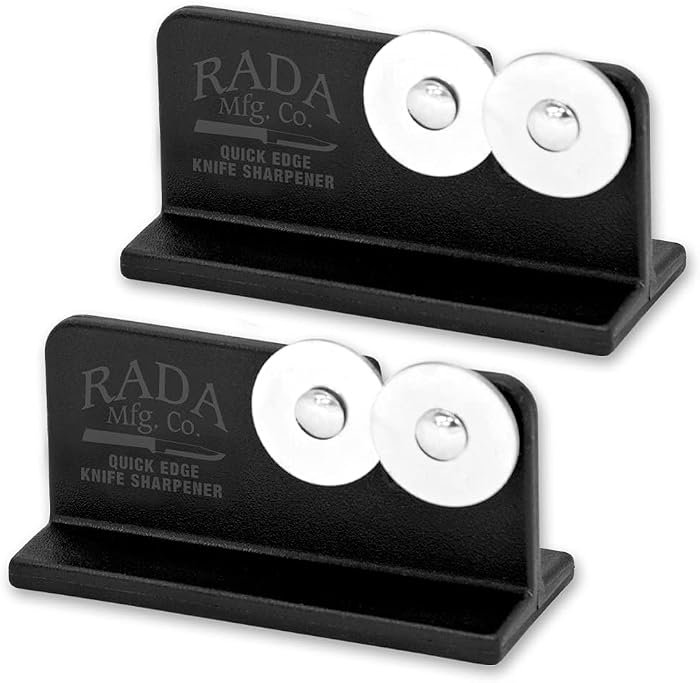
Two hardened steel wheels set in a V do the work here, and the motion is almost frictionless: draw the blade through and a few pulls later it is cutting again. We like it for how little ceremony it involves. No soaking, no angle to hold, no setup at all, and it is small enough to disappear into a drawer until the moment you need it.

It is a touch-up tool rather than a repair shop. Chips, a broken tip, or an edge that has been blunt for a year all need coarser work before these wheels have anything to work with. On a sound edge, though, it is quick and surprisingly effective, and the two-pack means one can live in the kitchen and one in the boat box or the range bag.

The American manufacturing is a genuine part of the appeal if that matters to you, and the nylon base is sturdier than the size suggests. It is also the simplest sharpener here to hand to someone who has never sharpened a knife, which is why one lives in our own kitchen rather than in the drawer with the neglected gadgets.

Worth Noting

  • Pull direction favors right-handed users
  • Won't fix chips or a badly damaged edge
Our Verdict

We like it for anyone who wants an edge back in seconds and will not miss the polish a stone provides.

Check Latest Price
8

Utopia Kitchen Honing Rod Best for Between Sharpenings

Utopia Kitchen Knife Sharpener Rod 12 Inch Honing Rod for Sharpening

Between sharpenings

Our Score 91/100
Handle
Non-slip with hanging loop
Length
12 inches
Material
Nickel-chrome plated carbon steel
View on Amazon

A honing rod does not sharpen. It realigns the fine edge that is still there, which is why a cook who steels a knife before every dinner can go months between real sharpenings and why the same rod does nothing for a knife that has gone genuinely dull. Get that straight and this one earns its place beside the block.

Twelve inches is the right length for a chef's knife, enough rod to run the whole blade in one stroke without your knuckles crowding the bolster. The nickel-chrome plating over carbon steel gives the edge something to bite against, and we like the heft, which feels more substantial than the price suggests. The non-slip handle and hanging loop are the sort of details you only notice when they are missing.

Use it before the edge fails rather than after: five or ten strokes at the same angle as the bevel, both sides, then back in the block. Wipe it with an oiled cloth rather than leaving it wet and it will outlast most of the knives in the drawer, which is more than can be said for the plastic-handled rod it replaces.

Worth Noting

  • Hones rather than sharpens; won't rescue a dull knife
Our Verdict

We recommend it to someone whose knives are already sharp and who wants to keep them that way between real sharpenings.

Check Latest Price

What Eight Months of Sharpening Taught Us

We started with research, not knives: pulling every sharpener with a real following — diamond-plate electrics, ceramic rods, Japanese-style whetstones, belt-driven shop units, and hardware-store pull-throughs — then filtering by whether the angle was fixed or freehand, what each one claimed to handle (straight edge, serrated, scissors, garden tools), and how many sharpenings you'd realistically get before the abrasive quit. That left 14 units, all bought at retail, and eight months of testing.

Testing happened where knives actually live: my kitchen counter on weeknights, a friend's catering prep, my garage bench with pruners, a hatchet and kitchen shears, and one wet weekend at a campsite for the pocket tools. We dulled a rotation of chef's knives, paring knives, a serrated bread knife, and two thrift-store beaters on purpose, then counted passes on the manual models and seconds on the electrics until each one shaved paper again.

We kept notes on the things that only surface in use: whether the grip held when hands were slick with onion juice, whether a stone stayed flat or hollowed out after 20 knives, and whether the housing walked across the counter mid-stroke. Every blade got a bright-light inspection before and after, because a sharpener that scores the flat of the knife is a net loss no matter how sharp the edge gets — the pull-throughs separated on exactly that.

The survival-style pocket tool got its own trial: soaked, struck with cold hands to test the ferro rod, and blown across a lake to see whether the whistle carried. In month seven we went back to every unit and checked for cracked housings, loose angle guides, dished stones, and bases that had stopped gripping. Value came down to strokes per edge and how long the abrasive lasted, not what the box promised.

How to Choose a Knife Sharpener

Restoring versus maintaining

Two jobs get folded into one word. Honing, with a steel rod and a few passes before dinner, straightens an edge that is still there. Sharpening grinds fresh steel to form a new edge, and it is the only thing that helps a knife that has been dull for months. If your blades are merely tired, a rod or a pull-through is enough. If they crush tomato skins, you need a belt, a stone, or a diamond plate.

Buying a honing rod to fix a dull knife is the most common mismatch in this category. Buy the rod to keep a good edge good, and buy an abrasive to bring one back.

How much steel each method takes

Every sharpener removes metal; how much is the real difference between them. Carbide pull-throughs scrape a new edge in seconds and take the most steel per session. Diamond plates and belts cut fast too but leave a cleaner bevel. A whetstone removes the least and polishes the most.

On a set of inexpensive knives, that hardly matters. On a good knife, a carbide V used weekly will noticeably shorten the blade's life, so save it for the beaters and the camp knife.

Angle: what your knife was ground at

Most Western kitchen knives leave the factory around 20 degrees per side; most Japanese knives are thinner, at roughly 15. A sharpener with preset guides only helps if the angle matches the blade in your hand.

The Chef'sChoice 15XV will actually reprofile a 20-degree knife to 15 over a few sessions, which is a real change in how it cuts and worth knowing before you run a favorite knife through it. A guided tool with both 20- and 25-degree slots, like the Work Sharp field sharpener, covers everything from a paring knife to an axe.

Power, time, and what you spend after you buy

Electric machines trade money and counter space for speed and consistency, and every one of them carries a running cost: belts to replace, wheels that wear, a stone that eventually dishes and needs flattening. Budget for that the way you budget for vacuum bags.

Manual sharpeners cost less up front and take longer per knife, a couple of minutes instead of a few seconds. That is fine for a household that sharpens four times a year and irritating for one that sharpens weekly.

Serrated edges, scissors, and the rest of the drawer

A serrated knife wants a rod or a tapered diamond file run along each scallop, not a V-slot; a pull-through will flatten the teeth. Scissors, pruners, and axe blades want a coarser abrasive and a tool that supports the blade, which is where a belt machine or a field sharpener beats a kitchen gadget.

If your drawer holds more than knives, weight versatility accordingly. It is the difference between a tool you use twice a year and one you reach for whenever something stops cutting.

Frequently Asked Questions

Final Verdict

For a house with a knife block and a toolbox, the Work Sharp MK2 is the one to buy. It is fast, it does not depend on steady hands, and it moves from a paring knife to a pair of pruners without a change of technique.

Choose the Sharp Pebble whetstone instead if the finest possible edge matters more than convenience and you are willing to spend a few evenings learning it. Choose the AccuSharp if the knives are inexpensive and you want them cutting again today.