Best Japanese Knife Sharpeners of 2026

The first sign your knife is dull usually isn't a dramatic slip — it's a tomato that bruises instead of slicing. A sharpener is the cheapest fix in the kitchen, turning the knife you already own back into the knife you thought you bought. The catch is that "sharpener" covers a lot of very different tools, and the wrong one either frustrates you into quitting or grinds away half your blade.

Whetstones are the old answer and still the best edge for the money, but they ask you to hold a steady angle by hand, which is exactly the skill most of us never developed. Guided systems — fixed-angle clamps, rolling sharpeners, angle-guide blocks — take that variable out of the equation. My team and I have spent eight months with 12 sharpeners across all of those formats, working through the same tired block of kitchen knives plus a few pocket knives and a serrated bread knife.

One thing worth knowing before you buy: grit numbers are a progression, not a score. A 1000-grit finish is plenty for tomatoes and chicken, and the 6000- to 8000-grit side is polishing most of us will use twice. Below are the ones we'd hand to a friend.

Our Top Picks

The 7 Best Japanese Knife Sharpeners of 2026

1

Sharp Pebble Whetstone 1000/6000 Best Overall

Sharp Pebble Whetstone Knife Sharpener

Beginners with a stone

Our Score 95/100
Base
Non-slip bamboo
Grits
1,000 / 6,000
Stone Size
7.25 x 2.25 x 1 in
Angle Guide
Clip-on
View on Amazon

Holding a steady 15 degrees by hand is the part of water-stone sharpening that keeps most people from starting, and it's the part this kit solves. A small angle guide rests on the blade and holds the tilt while you draw the edge across the stone. We like that it works as a teaching aid rather than a permanent crutch, because after a few sessions your hands know where 15 degrees sits and the guide becomes optional.

The 1,000-grit side does the real work, cutting a fresh edge into a blade that has gone dull or rolled over. The 6,000 side polishes that edge into a clean, keen finish that a hard Japanese blade holds onto. Going from one to the other is the standard maintenance progression, and it's why this pairing suits a knife you're keeping sharp rather than rebuilding from scratch.

The stone sits in a bamboo base with a non-slip foot and stays put on a countertop, which matters more than it sounds: a stone that walks while you're pushing a blade is how edges get rounded over. At 7.25 by 2.25 inches the working face is short for a 210mm gyuto, so plan on overlapping passes rather than one long stroke from heel to tip.

The written guide covers the basics and the maker's video walkthrough fills in what it skips, which is worth ten minutes before your first knife. Then leave the bamboo block out to dry completely before it goes back in a drawer. That one habit is what keeps it from turning musty between sessions.

Worth Noting

  • No coarse grit for chips or repair work
Our Verdict

We recommend this as the first whetstone for a Japanese knife: two useful grits, a guide that teaches the 15-degree tilt, and a base that stays put while you learn.

Check Latest Price
2

Intelitopia Complete Sharpening Set Best Complete Kit

Intelitopia Complete Sharpening Set – Complete Knife Sharpening Stone Set

Repair and polish

Our Score 94/100
Base
Bamboo with rubber pads
Grits
400/1,000 and 3,000/8,000
Kit Size
9 x 8 x 3 in
Also Includes
Flattening stone and leather strop
View on Amazon

Open the box and you get two double-sided stones covering 400, 1,000, 3,000 and 8,000 grit, plus a flattening stone, a leather strop, a bamboo base, three rubber grip pads, and an angle guide. It's enough that a beginner never has to stop halfway through a job and order the piece they're missing.

The grit spread is why it earns a place. The 400 side takes steel off fast enough to deal with a chip or reset a worn bevel; 1,000 does the everyday work; 3,000 and 8,000 refine a Japanese edge to a polish a two-grit stone can't reach. The flattening stone is the piece most kits leave out, and it's the one that keeps the surface true so the stone keeps cutting instead of skating.

What we don't love is the paperwork. The printed instructions are thin and the plastic angle guide is the flimsiest thing in the box, so watch a sharpening video before the first session and treat the wedge as a rough starting point. Do that, and the rest of the set does what we want a sharpening kit to do: carry a chipped blade all the way to a polished edge without a second purchase.

Worth Noting

  • Bulky five-pound kit takes up storage
Our Verdict

Our pick when one purchase has to cover repair, sharpening, and polishing, as long as you're willing to learn from video rather than the insert.

Check Latest Price
3

Work Sharp Precision Adjust Best for Repeatable Angles

Work Sharp Precision Adjust Knife Sharpener Kit

Repeatable angles

Our Score 93/100
Power
Manual, no cord
Angles
15 to 30 degrees
Weight
7.58 oz
Abrasives
320 and 600 diamond, fine ceramic
View on Amazon

A knob on the back of the chassis sets the sharpening angle anywhere from 15 to 30 degrees, so a Japanese gyuto, a German chef's knife, and a hunting blade each get the geometry they were ground with. Clamp the blade, sweep the hone along the edge, and the rod holds the angle for every stroke.

That repeatability is what sells us on it. The abrasive is a single triangular rod, with 320 and 600 diamond on two faces and fine ceramic on the third, and it rotates to change grits without unclamping the knife. The bevel comes up even along its whole length instead of rounded over the way a freehand stone can leave it.

The clamp pivots 180 degrees, so you flip the blade to work the other side rather than releasing and repositioning it, and that symmetry is most of why the edge comes out uniform. It's a deliberate process rather than a quick one, and it's the opposite of dragging a blade through a pull-through.

At 215 grams it folds into a drawer and needs no cord, which makes it the sharpener here that can travel to a rental kitchen or a friend's house. Setup is the one chore: the sharpening tower and the base are separate pieces, so there's a minute of squaring up before the first knife.

Worth Noting

  • Clamp lets long, heavy blades shift
Our Verdict

For repeatable 15-degree edges without freehand skill, we haven't found anything here as consistent, as long as you keep it to shorter blades.

Check Latest Price
4

HORL 3 Cruise Rolling Sharpener Best Rolling Sharpener

HORL®3 Cruise Rolling Knife Sharpener

No-skill rolling

Our Score 92/100
Discs
Diamond and stainless steel
Angles
15 and 20 degrees
Weight
1.48 lb
Blade Holder
Magnetic angle support
View on Amazon

You lay the blade on a magnetic ramp, click on one of two angle supports, and roll a diamond disc back and forth across the edge. That's the entire technique. For a household where nobody wants to soak a stone or learn to hold a wrist steady, this is the closest thing here to sharpening without learning to sharpen, and we were struck by how quickly the motion stops feeling like a procedure.

Two discs do the work: a fixed diamond disc cuts the bevel, then a stainless steel disc hones off the burr and polishes the edge, which is the step that separates a sharp edge from a clean one. The 15-degree support is the one that matches Japanese blades; the 20-degree support covers European knives and outdoor blades. The magnetic pad is silicone-backed, so a polished blade face doesn't pick up scratches while you work.

What you're buying into is a consumable. The diamond disc wears with use, and replacement discs are a running cost a stone doesn't have. There are also only two angles, so a knife ground at 17 degrees gets nudged to 15 or 20 whether or not that's what the maker intended. Neither has kept us from reaching for it on a weeknight.

Worth Noting

  • Diamond disc wears and needs replacing
  • Only two fixed angles
Our Verdict

We recommend it to anyone who wants a clean Japanese edge without learning to hold an angle, and who can live with a wear disc now and then.

Check Latest Price
5

KEENBEST 400/1000 Whetstone Best Budget

KEENBEST 400/1000 Whetstone – 400 1000 Premium Material Whetstone Sharpening Stone Set 2 Side Kitchen Knife

Budget learning

Our Score 91/100
Base
Non-slip rubber
Grits
400 / 1,000
Weight
16 oz
Stone Size
7 x 2.2 x 1.1 in
View on Amazon

This is the least expensive way onto a whetstone in this group, and it does the two jobs that matter: a 400 side of silicon carbide that cuts quickly into a dull or lightly damaged edge, and a 1,000 side of white corundum for the working bevel. Soak it for ten to fifteen minutes, keep splashing water on while you work, and the rubber base keeps it from skating across the counter.

The stone measures 7 by 2.2 inches, which is short against a 210mm gyuto, so plan on overlapping passes rather than one long stroke. We keep coming back to it as the stone to buy first, learn on, and hand to a friend who has just picked up their first Japanese knife, and as the coarse stone that keeps heavy repair work off a good 6,000-grit surface.

Worth Noting

  • No polishing grit above 1,000
Our Verdict

The cheapest honest way onto a whetstone, and the one we hand to anyone learning: fine for practice and for knives you don't baby.

Check Latest Price
6

Amazon Basics 1000/6000 Whetstone Best for Longer Blades

Amazon Basics Whetstone Knife Sharpening Stone

Longer blades

Our Score 90/100
Base
Silicone in bamboo
Grits
1,000 / 6,000
Warranty
1-year limited
Stone Size
8.4 x 3.6 x 1.8 in
View on Amazon

Same two grits as our top pick, 1,000 to sharpen and 6,000 to polish, on a longer, wider stone, for less money. The face measures 8.4 by 3.6 inches, and that extra length is the difference between working a long gyuto in sections and drawing it across in one pass.

It's a water stone, so it soaks, and it sits in a silicone pad held by a non-slip bamboo base, two layers that keep the stone from walking on the counter. A clip-on angle guide and a one-year warranty come with it.

Where it gives ground to our top pick is guidance. The included directions cover the mechanics, but there's no video walkthrough and no coaching, and the angle guide is the same basic wedge every kit ships. If you already know what 15 degrees feels like, that costs you nothing and the extra stone length is a straight upgrade. If you don't, the hand-holding is worth paying for.

Worth Noting

  • Nothing coarser than 1,000 for repairs
Our Verdict

We recommend it as the value version of our top pick's formula: a longer stone, the same two grits, and less hand-holding.

Check Latest Price
7

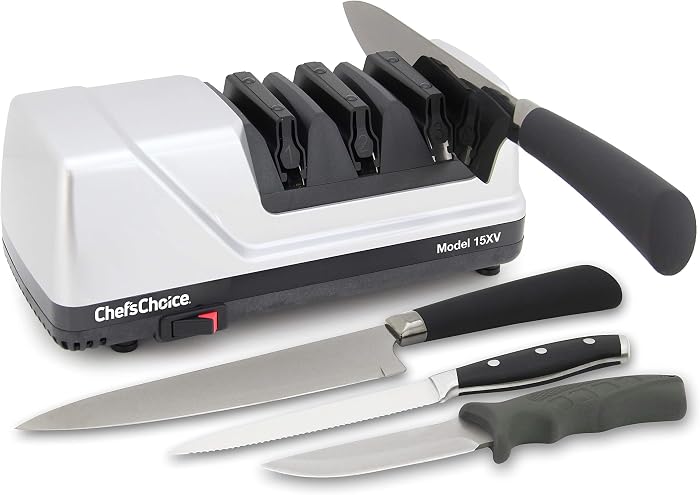
Chef'sChoice 15XV Electric Sharpener Best for Fast Touch-Ups

Chef’sChoice 15XV EdgeSelect Professional Electric Knife Sharpener

Fast touch-ups

Our Score 89/100
Angles
15 degrees
Stages
3
Weight
4.2 lb
Abrasives
100% diamond
View on Amazon

Three stages, diamond abrasives in the first two, and a spring guide in each slot that holds the blade at a fixed angle while you draw it through. Run the knife through stages one and two to cut the bevel, then stage three to strop it, and what comes out carries a 15-degree edge even if the knife left the factory at 20.

On speed, nothing else here is close. A neglected blade comes back sharp after a couple of passes, and the machine doesn't care whether it's carbon steel, stainless, or serrated. That's exactly what you want when a whole block has gone dull and nobody wants to spend an evening at a stone.

Speed costs steel. A machine that cuts this fast takes more metal off the edge per session than any stone here, and on a thin, hard Japanese blade that steel doesn't come back. Run the good knives through it rarely, and the everyday ones as often as you like.

So the trade is speed against steel, and for a lot of households the speed wins. If your Japanese knives are daily tools and you want them sharp on a Sunday morning without soaking anything, this is the fastest route here, and the fixed 15-degree setting means you aren't fighting the machine's geometry.

Worth Noting

  • Can scuff polished blade faces
Our Verdict

Buy it to get a whole drawer of knives sharp in a hurry; we keep our thin Japanese blades away from it.

Check Latest Price

How We Chose and Tested the Best Japanese Knife Sharpeners

We started by pulling every sharpener that kept showing up in best-seller lists, knife-forum threads, and the spec sheets of brands we already trust, then sorted them by format: bare two-sided stones, stones with an angle guide, fixed-angle clamp systems, rolling sharpeners, and electric multi-stage machines. We kept the price spread wide, from a plain stone to a three-stage electric, and cut anything with no clear grit rating or a base that looked like it would skate across a counter. Twelve made the final cut.

Testing ran eight months, mostly on Saturday mornings at my kitchen counter, plus a couple of long afternoons rehabbing a drawer of neglected knives. We dulled the same chef's knife, paring knife, pocket knife, and serrated bread knife the same way each round, then counted how many passes each sharpener needed to get back to slicing printer paper cleanly and cutting a tomato without bruising it. We also set each one up cold, without reading the instructions first, and noted exactly where we got stuck.

Stability and control got their own checks: we worked on a wooden board and on bare granite to see whether a base or clamp crept mid-stroke, switched the guided models between 15 and 20 degrees to see whether the setting actually held through a whole blade, and watched for blades shifting in a clamp or drifting under an angle guide — that's where tips get rounded and blade faces pick up scratches. We judged grit jumps by what they did to a tomato rather than by the number on the box, and we counted whether a kit's extras, like a strop or flattening stone, were things we'd have bought anyway. After eight months we went back through every stone for dishing and every moving part for slop, since a sharpener that needs flattening weekly or stops holding its angle isn't a bargain at any price.

How to Choose a Japanese Knife Sharpener

Stone, Guided System, or Rolling Sharpener

The three formats answer different questions. A water stone gives you the most control and the gentlest cut, which is what a thin, hard Japanese blade wants, but it asks you to hold an angle, so it rewards a little practice. A clamp-and-rod system takes the angle out of your hands and gives you a repeatable bevel. A rolling sharpener does the same with even less setup. Pick the format you'll actually reach for on a weeknight; a sharpener that stays in the cupboard sharpens nothing.

Match the Angle the Knife Already Has

Most Japanese kitchen knives are ground at about 15 degrees per side; most European knives at 20. Sharpening at the maker's angle maintains the edge you paid for, while forcing a different one grinds away a lot of steel to change the geometry. If you don't know the number, the bevel tells you: a Japanese knife that has never been resharpened looks noticeably thinner behind the edge than a German one. On an adjustable system, set the angle once and stop fiddling with it.

Buy the Grit You Need, Not the Highest Number

Grits below 1,000 repair. They take out chips and reset a worn bevel, and they leave scratches that the next stone has to erase. Around 1,000 is the workhorse that establishes the edge. Anything from 3,000 up polishes, and it only works on top of the steps before it, so jumping from a 400 straight to an 8,000 leaves an edge that looks refined and cuts badly. If your knives are in decent shape, 1,000 plus a finishing stone covers almost everything.

Length and Flatness Matter More Than You Think

A stone has to be long enough to draw a blade across without running off the end. Seven inches is common and workable, but on a 210mm gyuto you're better off working in overlapping sections than attempting one heroic pass. Flatness is the other half: a whetstone hollowed in the middle stops touching the edge, and a flattening stone is the cheap fix. Check a stone against a straightedge every few months.

The Cost After You Buy

Stones are consumable, just slowly: a water stone that gets flattened and dries out properly lasts years. Rolling sharpeners are the opposite, because the abrasive disc is a wear item and replacement discs are a running cost that shapes what the tool really costs. Electric machines grind fastest and remove the most steel per session, which is a cost paid in blade life rather than in accessories. If you own one good Japanese knife, a stone and the patience to learn it is the cheapest route over time.

Frequently Asked Questions

Final Verdict

The Sharp Pebble kit is the one we point most people to. Two grits cover maintenance on a Japanese blade, the guide teaches the angle while you learn, and the base stays put. If your knives have chips, the Intelitopia set adds the coarse grits and the flattening stone that repair work needs. And if you know you won't practice freehand, the HORL 3 gives you a clean 15-degree edge by rolling.