Best Diamond Knife Sharpeners of 2026

A dull knife doesn't announce itself; it just starts crushing tomatoes and sliding off onions. I noticed it most with a cheap paring knife that had gone from eager to useless, and a diamond sharpener was the fix—provided the stone stayed flat and the base didn't skate across the counter. Diamond abrasives cut faster than most people expect, but the difference between a good sharpener and a frustrating one is usually grip, grit consistency, and whether it can hold a steady angle without gouging the blade.

We tested 12 diamond sharpeners over six months—manual bench stones, handheld pull-throughs, an electric model, and compact field sharpeners—on kitchen knives, serrated bread knives, pocket knives, and garden shears. We paid attention to the things that show up after the first week: whether the surface stayed flat and didn't shed grit or scratch blade faces, whether bases gripped a wet counter, how much sharpening performance you get for the money, and whether each one was small enough to stash nearby. The picks below are the ones that kept their bite.

Our Top Picks

The 8 Best Diamond Knife Sharpeners of 2026

1

SHARPAL 162N Diamond Stone Best Overall

SHARPAL 162N Double-sided Diamond Sharpening Stone

Kitchen knife sharpening

Our Score 96/100
Base
Case with non-slip pad
Grits
325 / 1200
Stone Size
8 x 3 in.
Angle Guide
Four preset angles
View on Amazon

An 8-by-3-inch diamond surface is the reason this is our top pick. A chef's knife has room to travel, the 325 side has enough real estate to reset a tired edge, and the 1200 side leaves a finish that slices cleanly. The case is not just packaging: its non-slip rubber pad works as a stone base, which makes the whole setup feel more stable than a bare plate on a counter.

The included angle guide is useful as a reference, not a clamp. We like that it gives four universal angles to check against, but you still control the stroke; if you want the stone to hold the angle for you, this is the wrong format. What we appreciate is the feedback: the diamond cuts quickly and the surface stays flat, so a few light passes tell you whether you are actually hitting the edge.

The 1.4 kg body feels substantial, and the case protects the surface between sessions. We keep it on the counter because it is ready in seconds: set the case down, choose a side, and go. The case has become part of the tool, not something we store in a closet.

Worth Noting

  • Fine side can wear with heavy pressure
Our Verdict

Our default for most home cooks is this full-size diamond stone: stable in its case, simple to keep flat, and coarse enough to reset a neglected edge.

Check Latest Price
2

Chef'sChoice 15XV Electric Best Electric

Chef’sChoice 15XV EdgeSelect Professional Electric Knife Sharpener

Electric kitchen edges

Our Score 95/100
Power
Electric
Stages
3
Abrasives
100% diamond
Edge Angle
15 degrees
View on Amazon

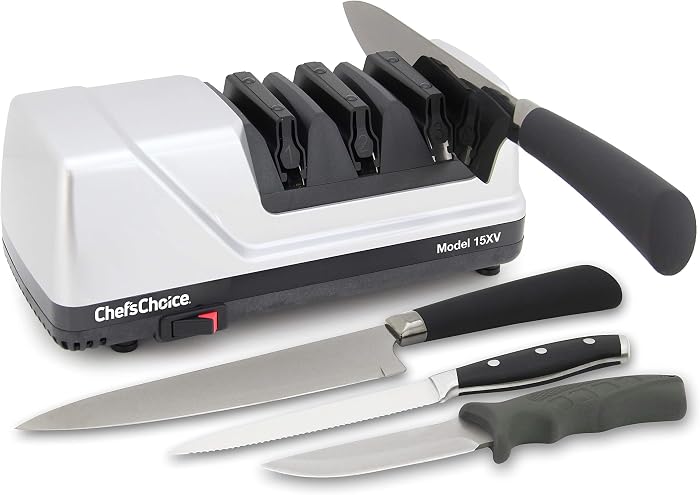
A 15-degree edge is the promise here, and the machine delivers it without asking you to hold an angle. The three-stage system uses diamond abrasives in the first two stages and a stropping stage to finish; you pull the knife through spring guides and the machine controls the bevel. For a household with a drawer full of ordinary kitchen knives, that is a real convenience.

We recommend it to cooks who know they will not practice freehand sharpening. The 15-degree conversion is the big draw: it turns a conventional 20-degree factory edge into a thinner, more aggressive slicer, and we like that for tomatoes and other soft produce. It is a kitchen machine, and we treat it as one.

The cost is the hurdle. This is the priciest pick here, and that only makes sense if you will use the 15-degree edge often enough to notice. For a few knives and occasional touch-ups, a manual stone gives you more control for less. The machine is also heavy enough to stay put on the counter, which matters when you are pulling a blade toward you.

Worth Noting

  • Can scratch polished blade faces
Our Verdict

The Chef'sChoice 15XV is the electric pick we favor when repeatable 15-degree kitchen edges matter more than learning to hold an angle; keep polished blades away from it.

Check Latest Price
3

Work Sharp Guided Field Sharpener Best Portable

Work Sharp Guided Field Sharpener

Field and travel

Our Score 94/100
Grits
220 / 600
Weight
4.6 oz
Abrasives
Diamond, ceramic, leather
Angle Guides
20° and 25°
View on Amazon

At 4.6 ounces, this is the sharpener that disappears into a pack until a blade goes dull. The five-surface setup is unusually complete for the size: 220 and 600 diamond plates, ceramic rods, and a leather strop, plus 20- and 25-degree guides built into the body. We like that it gives you a full progression without a separate base, stone, or power cord.

The built-in guides are the part that makes it usable in the field. You set the blade against the guide and make a few controlled passes; the ceramic rod handles hooks and tight detail work, and the strop puts a cleaner finish on the edge. The size is aimed at pocket knives, fillet knives, and hunting blades, and the 20- and 25-degree guides keep the bevel honest.

What we value most is the redundancy: coarse diamond for a damaged edge, fine diamond to refine, ceramic to hone, leather to finish. That is a lot of capability in a package that fits a tackle box, and it is the one we keep in a daypack. The leather strop is the detail that makes the fine side worth using in the field.

Worth Noting

  • Short plates are slow on long chef's knives
Our Verdict

We take this 4.6-ounce kit into the field because it packs a full diamond-to-strop progression, with guides that keep a pocket knife on track.

Check Latest Price
4

KitchenIQ 50825 Edge Grip Best Budget

KitchenIQ 50825 Edge Grip – 50825

Quick kitchen touch-ups

Our Score 93/100
Base
Edge-grip V notch
Stages
2
Weight
2.08 oz
Abrasives
Diamond and ceramic
View on Amazon

The edge-grip notch is the clever part: it hangs the sharpener over the edge of a counter so the tip of a long knife clears the surface instead of dragging. At 2.08 ounces, it also disappears into a drawer, which is why it ends up being used for quick touch-ups rather than a planned sharpening session.

We recommend it as the budget pick because it does the one thing most households need: a couple of light pulls through diamond and ceramic slots bring a tired knife back to usable. The preset angles take the guesswork out, and the non-slip base helps it stay put. It will not reprofile a chipped edge or leave a polished finish; this is a maintenance tool, not a repair station.

The edge-grip notch is also the reason we trust it with a longer blade: the tip has somewhere to go. Keep the pressure light and let the slots do the work; pushing harder does not make the edge better, it just wears the sharpener faster. For a drawer that needs a fast reset before dinner, that is enough.

Worth Noting

  • Small body is less secure for large hands
Our Verdict

This is our budget pick for quick kitchen touch-ups: tiny, simple, and easier to use than its size suggests.

Check Latest Price
5

Work Sharp Benchstone Best for Angle Control

Work Sharp Benchstone Knife Sharpener

Learning angle control

Our Score 92/100
Grits
400 / 800
Abrasives
Diamond and ceramic
Angle Guides
20° and 25°
Extra Guides
15° and 17° available
View on Amazon

Three abrasive faces and a pair of removable angle guides make this the most approachable manual bench stone in the group. The 400 and 800 diamond surfaces do the cutting, the fine ceramic face refines, and the 20- and 25-degree guides give you a physical reference instead of asking you to guess. We like that the guide can come off once the angle starts to feel natural.

The pivot-response base is the feature that separates it from a flat plate. It lets the abrasive follow the curve of a blade instead of forcing you to lift and reset, and it can be locked out when you want a rigid surface. For a home cook learning to sharpen, that is useful feedback; for a pocket knife, it is a quick way to keep the bevel consistent.

This is a bench tool, not a travel kit: the three surfaces are easier to use when you can leave them set up. If you sharpen at the kitchen counter and want to learn the angle by feel, it is the one we hand to a beginner. The ceramic face is the bonus that makes the finish feel deliberate rather than rough.

Worth Noting

  • Plastic base can wobble on smooth counters
  • Ceramic plate can chip if dropped
Our Verdict

Beginners who want a physical angle reference get the most from this three-sided benchstone; we hand it over and let them practice.

Check Latest Price
6

SHARPAL 181N Diamond File Best for Garden and Outdoor Tools

SHARPAL 181N Dual-Grit Diamond Sharpening Stone File

Garden tool edges

Our Score 91/100
Grits
325 / 1200
Extras
Leather strop and paracord
Length
8.66 in.
Weight
5.64 oz
View on Amazon

The narrow profile is the point: at 8.66 inches long and 1.65 inches wide, this diamond file reaches into loppers, hedge shears, and mower blades where a wide bench stone cannot go. The 325 side takes off damage, the 1200 side refines, and the leather sheath doubles as a strop. We like it as a tool-blade sharpener first and a knife sharpener second.

The paracord wrap is more useful than it sounds. It gives the file a grip when your hands are wet or gloved, and the 6.6-foot length can be unwrapped for field repairs. On a hatchet, a pair of shears, or a mower blade, the shape is an advantage: the file follows the edge instead of asking you to fit the tool onto a bench stone.

The diamond surfaces are the same monocrystalline style SHARPAL uses on its bench stones, and they cut fast and stay ready. The file is light enough to carry in a tool bag, and the sheath protects the surface when it is rattling around. What we appreciate most is that it is built around the tool in your hand: the narrow file and strop make sense for a shed or a pack.

For gardeners, hunters, and anyone who keeps a mower or axe in the shed, that focus is exactly right. We reach for it when the edge is on a tool we can hold in one hand and the stone needs to follow the shape, not the other way around. The leather strop is the bonus that makes the fine side worth using.

Worth Noting

  • Narrow surface is slow on wide chef's knives
Our Verdict

We recommend the SHARPAL 181N for garden tools, axes, and field blades because its narrow diamond file reaches shapes a bench stone cannot.

Check Latest Price
7

Smith's Pocket Pal

Smith's PP1 Pocket Pal Knife Sharpener Preset Carbide & Ceramic Stone

Pocket EDC

Our Score 90/100
Length
3.5 in.
Weight
1 oz
Abrasives
Carbide, ceramic, diamond rod
Diamond Rod
Fold-out, tapered
View on Amazon

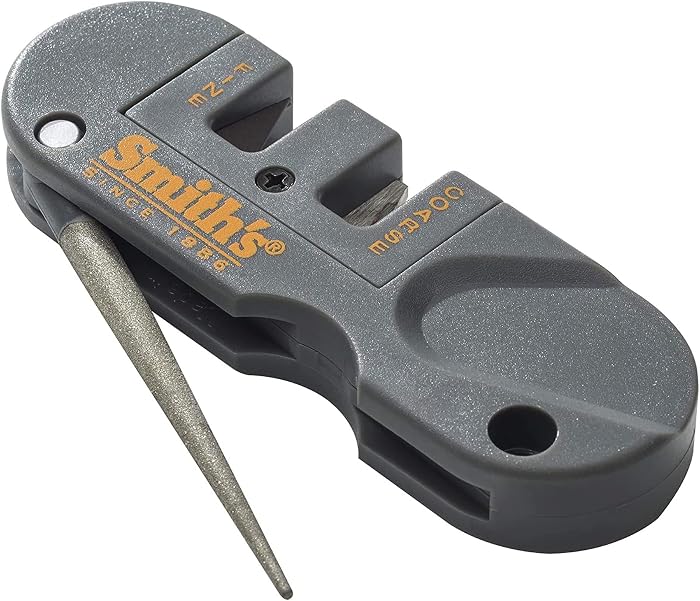
At one ounce and 3.5 inches long, the Pocket Pal is the sharpener that lives on a keychain or in a tackle box and gets used because it is there. The pull-through slots are carbide and ceramic, while the fold-out rod is diamond-coated and tapered for hooks and tight curves. It is a multi-tool approach rather than a single high-performance stone.

The ceramic slot is the better everyday choice, and the diamond rod is the part we value most because it reaches into hooks and tight curves without needing a flat stone. The short rod takes patience on a long blade, so we think of it as a detail tool rather than a chef's-knife solution. That is the right trade for something that weighs almost nothing.

We recommend it as an emergency tool, not a primary sharpener. It is the one we leave in a glove box or fishing bag because it does not need power or a separate stone. The fold-out diamond rod is the part that earns its keep; the pull-through slots are there for the day you don't have anything better.

Worth Noting

  • Carbide slot removes metal quickly
Our Verdict

The Pocket Pal is the one-ounce backup we keep for pocket knives, fish hooks, and glove-box rescues; just keep the carbide slot away from good kitchen knives.

Check Latest Price
8

S SATC 400/1000 Diamond Plate Best for Budget Bench Work

S SATC 400/1000 Diamond Plate – Diamond Sharpening Stone 2 Side Grit 400/1000 Diamond Plate Honing Stone 8-inch

Budget bench work

Our Score 89/100
Size
8 in.
Grits
400 / 1000
Weight
1.9 lb
Material
Diamond-plated steel
View on Amazon

The 1000-grit side is the surprise: it cuts more like a coarser stone, leaving a scratch pattern that needs a light final pass before a knife feels refined. That is not a dealbreaker at this price, but it changes how you use the plate. The 400 side is the real workhorse for dull kitchen knives, chisels, and plane irons, and the 8-inch length gives you room to make a full stroke.

The plate is heavy enough to stay put on a bench without a holder, and the diamond surface does not need flattening like a water stone. We like that it is ready to use out of the package and easy to wipe clean. The 8-inch surface gives you room for a kitchen knife or a chisel, and the steel backing feels solid in the hand.

For a budget diamond plate, the value is clear. It handles coarse work quickly and has enough surface for a kitchen knife or a chisel, and the 400 side can do most of the job. The plate is also simple to maintain, which matters if it lives in a shop rather than a knife drawer.

We recommend it to someone who wants a full-size diamond plate for rough work and does not need a mirror finish. It is the budget bench option in this group, and it earns that role by cutting fast and asking for little maintenance. If you want a finer, more predictable finish, the SHARPAL 162N is the step up; if you mostly maintain pocket knives, a compact rod is easier to live with.

Worth Noting

  • Flatness can vary between plates
Our Verdict

We pick this budget diamond plate for coarse work on kitchen knives and shop tools; expect the 1000-grit side to finish coarser than the number suggests.

Check Latest Price

How We Tested Diamond Knife Sharpeners

To build the shortlist, we sorted diamond sharpeners into bench stones, handheld pull-throughs, electric sharpeners, and compact field models, then narrowed to 12 that covered different grit pairings, sizes, and ways of holding an angle. We skipped anything that didn't state its grit or that made vague claims about a diamond surface. For six months, we used each one on the same kinds of blades: kitchen chef's and paring knives, serrated bread knives, pocket knives, and garden shears.

In the kitchen, I sharpened before dinner, noting how quickly a dull edge came back, whether the abrasive cut evenly from heel to tip, and whether the stone or slot scratched the blade face. On weekends, we took the compact models to pocket knives, pruners, and hedge shears, checking whether the grip held with damp hands and whether the unit stayed put on a wet counter or tailgate. We ran a straightedge across every stone before and after use to catch dishing, and we watched for uneven diamond clusters that left deep scratches instead of a clean edge.

We also packed each one into a drawer and a knife roll to judge real-world size, then checked durability after repeated sessions: loose diamonds, scored platens, cracked cases, flexing handles. Sharpness was judged by slicing tomatoes and printer paper, not by counting strokes. At the end, value came down to the edge each sharpener produced against the time, setup, and maintenance it demanded.

How to Choose a Diamond Knife Sharpener

Start With the Edge, Not the Grit Number

Diamond cuts fast, so the coarse side is for damaged edges and the fine side is for refinement. A 220 to 400 grit surface resets a bevel or removes a chip; a 600 to 1200 grit surface maintains an edge that is already in shape. If your knives are merely tired, a fine diamond stone and a light touch are enough. If the edge is visibly rounded or chipped, start coarse and finish fine. The SHARPAL 162N covers both ends with 325 and 1200 grits, which is why it is our default.

Decide How Much Angle Control You Want

An angle guide is a reference, not a clamp. It helps you check that the blade is sitting at 20 or 25 degrees, but your hand still controls the stroke. A guided clamp or an electric machine removes more of that guesswork. The Work Sharp Benchstone uses removable 20- and 25-degree guides and a pivoting base, while the Chef'sChoice 15XV sets a 15-degree edge with spring guides. Choose the manual route if you want control and don't mind practice; choose electric if consistency matters more than learning the feel.

Match the Format to the Blade and the Place

A bench stone wants a stable counter and enough length for a full stroke; an 8-inch surface suits most chef's knives, while a short stone makes you stop halfway. A compact field sharpener belongs in a pack or tackle box, where its angle guides and small plates are more useful than a heavy base. For loppers, mower blades, and axes, a narrow diamond file reaches where a wide stone cannot. Pick the format around the longest blade you sharpen most often, not the smallest one you own.

Look for a Stable Base and a Useful Case

A diamond stone that slides is a safety problem and a bad sharpening surface. Look for a non-slip base or a case that doubles as one; the SHARPAL 162N's case has a rubber pad, and the KitchenIQ's edge-grip notch holds it against the counter. Store the stone where the diamond face is protected, and keep the base clean so it sits flat. If the base still walks on your counter, set it on a damp towel before you start.

Frequently Asked Questions

Final Verdict

Our default is the SHARPAL 162N. Its full-size 325/1200 surface gives you room to sharpen a chef's knife, the case doubles as a stable base, and the coarse side can reset a neglected edge without a power cord. If you know you will not practice a freehand stroke, the Chef'sChoice 15XV is the electric alternative we recommend; if the sharpener lives in a pack, the Work Sharp Guided Field Sharpener is the better companion.