Best Fillet Knives for Saltwater Fish of 2026

Saltwater is where fillet knives go to die. A blade that glides through a mahi on Saturday can be spotted and dragging by the end of the season, and a handle that felt secure at the dock turns slick the moment your hands are wet. The right knife is one you can rinse, dry, and grab again next weekend — still sharp, still steady in your grip.

I've cleaned fish on dock tables, tailgates, and a cutting board balanced on a cooler, and what separates a knife that works from one that fights you isn't fancy steel — it's whether the edge survives a dozen fish, whether the handle still feels right on the last one, and whether the sheath protects the blade rolling around in a gear bucket. Over six months we put 12 fillet knives through real saltwater trips.

One thing worth knowing before you buy: flex is a preference, not a ranking. A limber blade is lovely for following a backbone and a nuisance when you're skinning, so match it to how you actually clean fish. The picks below are the ones that earned a permanent spot in the boat bag.

Our Top Picks

The 8 Best Fillet Knives for Saltwater Fish of 2026

1

KastKing Speed Demon Pro Fillet Knife Best Overall

KastKing Speed Demon Pro Fillet Knife with Protective Sheath

Big saltwater fish

Our Score 97/100
Handle
Non-slip super polymer
Sheath
Included
Blade Steel
G4116 German stainless
Blade Length
9 inches
View on Amazon

Nine inches of blade sounds like a lot until you are running a knife down the spine of a fish that will not fit on a cutting board. That reach is exactly why the Speed Demon Pro is our top pick for saltwater: one long draw from collar to tail gives a cleaner fillet than three short ones, and the thin G4116 German stainless has enough give to ride over a rib cage instead of digging in.

The grip is where most boat knives give themselves away. KastKing molds this one from a super polymer with a pronounced trigger for the index finger, and it stays usable once your hands are covered in slime and spray, which is the only condition that matters when you are working over a fish box.

The black coating on the blade is the other saltwater-specific detail. It buys you time against the spotting that shows up on any knife living on a boat, and the sheath that comes with it is light enough to clip on a bag and rigid enough to keep the edge off everything else in there.

The one thing to know before you buy is length. On flounder, whiting and small snapper, nine inches is more knife than the job needs, and you lose some feel out at the tip. Everything else about this knife is built for the fish that do not fit on a board.

Worth Noting

  • Flex is moderate rather than soft
Our Verdict

We point anyone filleting fish bigger than a dinner plate at this one: long, thin, coated against salt, and sure in a wet hand.

Check Latest Price
2

Bubba 7-Inch Tapered Flex Fillet Knife Best 7-Inch Flex

Bubba 7 Inch Tapered Flex Fillet Fishing Knife

Mid-size saltwater fish

Our Score 96/100
Weight
9.6 oz
Blade Steel
8Cr13MoV stainless
Blade Length
7 inches
Overall Length
13 inches
View on Amazon

Where the Speed Demon Pro goes long, the Bubba goes precise. Seven inches of very thin 8Cr13MoV is the right amount of knife for flounder, pompano and slot-size redfish, and the tapered profile lets the tip do the delicate work while the spine keeps some backbone behind it.

The case for it over the longer blades here is the cuts that go wrong with a stiff knife. Following a rib line or lifting a skin flap, this blade bends with the contour of the fish instead of sawing through it, and the trigger grip gives your thumb somewhere to sit when you need pressure.

Weight is the cost. At 9.6 ounces it is the heaviest manual knife in this group, and after an hour at the table you feel the difference between it and the Morakniv. The handle is big and blocky with guards in front of the blade, reassuring with wet hands and less so if yours are small.

Where it earns its reputation is the skinning stage. The taper lets you keep the blade flat against the skin and still feel what is happening underneath, and the heel is stiff enough to finish a cut you started at the tip.

Worth Noting

  • Edge needs frequent honing
  • Large handle suits big hands better
Our Verdict

If your fish run mid-size and your cuts are fussy, this is the knife we reach for; nothing else here bends to a rib line so easily.

Check Latest Price
3

HOSHANHO 7-Inch Fillet Knife Best for Kitchen Filleting

HOSHANHO Fillet Knife 7 Inch

Kitchen counter filleting

Our Score 95/100
Handle
Pakkawood
Weight
10.6 oz
Blade Steel
10Cr15CoMoV high-carbon stainless
Blade Length
7 inches
View on Amazon

The HOSHANHO is the fillet knife for someone who cleans fish at the kitchen sink rather than on a dock. The 7-inch blade is forged from 10Cr15CoMoV, the pakkawood handle is shaped to fill your palm, and the fit and finish is a step above everything else in this group. We kept picking it up for reasons that had nothing to do with filleting.

It is a high-carbon stainless, and that shows in the edge. It arrives sharper than most and holds a fine, almost aggressive bite through a session of trimming and skinning. The trade is care: this is the knife here we baby most, rinsing and drying it right away rather than leaving it in a sink or a cooler.

It is also a heavy knife by fillet standards, and that weight is why it stays on the board rather than coming out on the boat with us. The mass sits back toward the hand, so it feels steady rather than nose-heavy, but steady is a kitchen virtue.

What we appreciated most was the seam, or the lack of one. The blade and handle meet tightly enough that there is nowhere for fish to collect, which is the difference between a quick rinse and picking at it with a sponge.

Worth Noting

  • Heavy for a fillet knife at 300 g
Our Verdict

We keep this one at the counter rather than the boat: the most comfortable handle here for a long session, and the best-looking knife in the group.

Check Latest Price
4

Cutluxe 7-Inch Fillet Knife Best Forged Blade

Cutluxe Fillet Knife for Fish & Meat

Skinning and trimming

Our Score 94/100
Handle
Triple-riveted pakkawood
Blade Steel
High-carbon German steel
Blade Length
7 inches
Construction
Forged, full tang
View on Amazon

Forged, full tang, triple-riveted: the Cutluxe is built like a chef's knife that happens to be shaped like a fillet knife, and it is the only pick here with a lifetime warranty behind the blade.

The construction shows up in the cut. German high-carbon steel at 56-plus Rockwell, hand-sharpened to 14 to 16 degrees per side, and thin enough through the middle that it still travels along a fillet rather than pushing it around. It is stiffer through the spine than the Bubba, with most of the give coming from the edge itself.

This is the best-built knife of the eight here, and the one we trust for skinning a big fish where a wandering tip costs meat. The edge holds through a session and comes back with a few passes on a rod, and the taper gives you enough feel to sense a rib before the tip is into it.

The pakkawood handle is the part that asks for attention. It is polished and handsome and it gets slick once it is covered in blood and slime, which is a small annoyance on a board and a real one on a boat.

Worth Noting

  • Heavier than the flex blades at 0.42 kg
Our Verdict

Buy it for the forged blade and the lifetime warranty; we think it is the best-built knife here for someone who wants one knife to last.

Check Latest Price
5

BUBBA Li-Ion Cordless Electric Fillet Knife Best Electric

BUBBA Li-Ion Cordless Electric Fillet Knife with Non-Slip Grip Handle

High-volume cleaning

Our Score 93/100
Weight
1.11 lb
Blade Length
7 inches
Power Source
Rechargeable Li-ion
Blades Included
Four Ti-nitride coated
View on Amazon

An electric fillet knife only makes sense at one end of the scale: the cooler that takes two people an hour to work through. That is the job the BUBBA Li-Ion was built for, and if your fishing is a couple of fish on a Saturday, it is more tool than you need.

The kit is a cordless handle with an LED charge indicator, four Ti-nitride coated reciprocating blades that pull out for cleaning, a charger, and a zippered case that holds the lot. The non-slip grip and the trigger guard are there for obvious reasons: a reciprocating blade in a fish-covered hand is no place to be casual.

We think it earns its keep for a guide, a charter cook, or anyone cleaning a limit most weekends, where the speed changes the shape of the evening. Plan to touch up a new blade before your first fish: they do not arrive consistently sharp, and a dull reciprocating blade tears a fillet instead of slicing one.

What it does not do is finesse. There is no feeling a rib through a reciprocating blade, so the knife that shines on a hundred fish is the wrong one for the butterfly cut you want on a single trophy. You trade the delicacy of the Bubba 7-inch for speed, and the trade is worth it only when the pile is deep.

Worth Noting

  • Bulky handle and trigger guard
Our Verdict

We recommend it for volume: if you clean fish by the cooler, the battery and four blades pay for themselves; for two fish a week, stay manual.

Check Latest Price
6

FLISSA 4-Piece Fillet Knife Set Best Set for Boats

FLISSA 4PCS Fillet Knife Set with Knife Sharpener and Portable Roll Bag

Boat and kayak

Our Score 92/100
Handle
PP and TPR
Included
Sharpener and roll bag
Blade Steel
8Cr13MoV with PTFE coating
Blade Lengths
5", 6", 7", 9"
View on Amazon

Four knives, four sheaths, a two-stage sharpener and a roll bag: the FLISSA set answers the question of which length you need by handing you all of them, in 5, 6, 7 and 9 inches of 8Cr13MoV.

The saltwater part is the coating. A PTFE non-stick finish on each blade sheds water, wipes clean, and slides through a fillet with less drag than bare steel. The 5-inch knife has a serrated spine for sawing through bait or a stubborn patch of skin, and the longer blades are thin enough to follow a fillet.

The details are the surprise. Handles are textured PP and TPR with a shape that fills the hand, the sheaths are vented so a rinsed blade can dry, and the sharpener has a tungsten carbide side for resetting an edge and a ceramic side for finishing it.

We think it is the set to keep in the truck or the kayak: a blade for croakers, a blade for kings, and the sharpener in the same roll, so nobody is improvising with a dull knife at the cleaning table.

Worth Noting

  • Blades spot if stored in the bag wet
Our Verdict

Our pick when one bag has to cover every fish you will catch: four coated blades, a sharpener and a roll, and nothing to think about.

Check Latest Price
7

Morakniv Fishing Comfort Fillet Knife Best Ultralight

Morakniv Fishing Comfort Fillet Knife with Sandvik Stainless Steel Blade

Wading and backpacking

Our Score 91/100
Sheath
Polymer with belt clip
Blade Steel
Sandvik 12C27 stainless
Blade Length
6.1 inches
Weight With Sheath
3.5 ounces (99 g)
View on Amazon

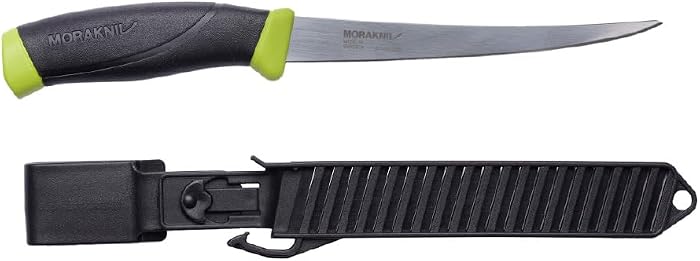
Three and a half ounces, sheath included, explains this knife better than any other number. Morakniv hangs a 6.1-inch Sandvik 12C27 blade off a polymer handle with a full finger guard, and the whole package disappears on a belt or in a pack.

The steel is the best part of the package. 12C27 takes a very fine edge, holds it well, and is unusually tough for a blade only 0.07 inches thick. There is just enough flex to skin with and enough stiffness to make a straight cut when you need one, which is the balance most budget fillet knives miss.

The sheath is plain plastic with a detachable belt clip, and it does what a fishing sheath has to do: it locks the knife in, it drains, and it keeps the edge off your leg in the dark. It is not the handsomest thing here, and nobody is buying this knife for its looks.

We take it wading and backpacking because there is no penalty for carrying it. It clips to a belt, it dries while you walk, and the finger guard is the part your hand finds in the dark. For trout, flounder, slot reds and panfish, the Morakniv is the lightest credible knife in this group.

Worth Noting

  • Rusts if it goes back in the bag damp
  • Runs short at 6.1 inches on big fish
Our Verdict

We carry this one when we are wading: 3.5 ounces on the belt beats a heavier knife left in the truck, and the guard keeps your hand where it belongs.

Check Latest Price
8

KastKing Folding Fillet Knife Best for Tackle-Box Storage

KastKing Folding Fillet/Fishing/Camping/Hunting Knife

Tackle-box storage

Our Score 90/100
Blade Steel
G4116 German stainless
Blade Length
6.5 inches
Folded Length
7.5 inches
View on Amazon

The KastKing folding knife solves a problem none of the fixed blades here can: 13.5 inches open, 7.5 inches folded, it fits in a tackle box, a glove compartment or the hatch of a kayak. The blade is 6.5 inches of G4116 German stainless with a titanium-bonded non-stick finish, and it carries in its own sheath.

We think of it as the knife that is actually there when you need it. A fixed blade left in the garage is worth less than a folding one in the box, and this one is coated for salt, built on a glass-reinforced polypropylene frame, and light enough to leave in the boat bag all season.

The 6.5-inch blade is the practical middle: long enough for a decent fillet on a midsize fish, short enough to control in a tight space. It is not the knife for a 30-pound yellowtail, and a fixed blade is faster to deploy when fish are coming over the rail, but as the one that lives in the box it does more work than a knife that stays home.

Worth Noting

  • Hinge and frame need rinsing
Our Verdict

We like it as the knife that lives in the tackle box: it folds small, the coating shrugs off salt spray, and there is no sheath to remember.

Check Latest Price

How We Tested Saltwater Fillet Knives

We started with research: a few dozen listings, their spec sheets, and the customer reviews underneath them. Three things narrowed the field — blade steel marketed as corrosion-resistant, a handle that claims to stay grippy when wet, and a sheath in the box, since a fillet knife without one ends up wrapped in a rag at the bottom of a bucket. That left 12 knives, from budget sets to a forged full-tang model and one cordless electric.

Each one went on real trips over six months, spring through fall. We filleted at a dock cleaning station with the hose running, broke fish down on a cutting board balanced on a cooler, and finished the job on the kitchen counter where the light is better. We paid attention to how much pressure it took to start a cut behind the gill plate, whether the tip stayed in contact with the backbone through one long pull, and how cleanly the edge separated skin from flesh.

Salt water was the deciding factor. After every trip each knife got rinsed in the bay, shaken out, and left damp in the sun, and we watched for spotting on the blade and rust bleeding out around the rivets. Grips were judged with slime-covered hands — did the handle stay put or rotate mid-cut — and sheaths were checked for drainage, retention, and whether they let water pool against the edge.

At the end we touched each edge up on a sharpener to see how quickly it came back, and weighed what each knife cost against how it looked and cut by then. The ones that held an edge, stayed grippy through a full session, and came with a sheath that actually protected them are the ones still in our bags.

How to Choose a Fillet Knife for Saltwater Fish

Match Blade Length and Flex to Your Fish

Six to seven inches covers flounder, snapper, schoolie stripers and most of what a weekend angler brings aboard. Nine inches is for fish that need a single long pass: tuna, mahi, big striped bass, salmon. The trap is buying the longest filet knife you can find, because a 9-inch blade on a 14-inch fish is unwieldy and you lose the feel that tells you where the ribs sit.

Flex matters just as much. A soft blade bends with the contour of the fish, which is what you want for skinning; a stiffer one gives you control for steaking and cutting through ribs. Decide which cut you make most and buy for that.

Steel and Coating Are About Salt, Not Bragging Rights

In salt water we put corrosion resistance ahead of edge retention, because a knife that spots and pits is a knife you stop carrying. The steels in this group — 8Cr13MoV, G4116, Sandvik 12C27, 10Cr15CoMoV and German high-carbon — all take a good edge. What separates them is how much attention they ask for between trips.

Coatings help. Titanium-nitride, PTFE and titanium-bonded finishes slow spotting and make a blade wipe clean, which matters when you are working in the dark with cold hands. A coating supports a corrosion-resistant steel; it does not rescue a blade that is not.

Handles Have to Work When They Are Wet

You will hold this knife with hands covered in slime, blood and spray, so grip security beats looks every time. We look for textured polymer or rubber with a trigger for the index finger or a guard in front of the blade: those hold when wet and do not absorb what you are cutting.

Pakkawood is comfortable and handsome in a kitchen, and it is slicker than polymer once it is coated in fish. At the counter that trade is easy to accept. On a boat, take the plain handle.

Decide How the Knife Travels

A fillet knife spends most of its life in a sheath, a roll or a pocket, and that is where a good blade gets ruined. A vented plastic sheath lets a rinsed knife dry; a leather sheath that goes back into a closed tackle box wet holds water against the steel until the next trip out.

Roll bags keep several lengths apart and make room for a sharpener, which is why sets appeal on boats and kayaks. If space is the constraint, a folding fillet knife packs to about seven and a half inches, at the cost of a hinge you have to rinse.

Manual or Electric Comes Down to Volume

Electric fillet knives are not better or worse, they are for a different evening. If you clean a limit most weekends, or you are feeding a crowd at the cleaning station, a cordless electric halves the time and saves your wrist. If you fillet two or three fish after a morning out, a sharp manual knife gives you more feel and less to charge, clean and carry.

Our advice: buy the manual knife first, and add the electric when the pile, not the tool, becomes the problem.

Frequently Asked Questions

Final Verdict

For most people heading out for saltwater fish, we point at the KastKing Speed Demon Pro. Nine inches of coated German stainless, a grip that holds when your hands do not, and a sheath in the box make it the knife that covers the widest range of fish with the least fuss.

If your fish run smaller and your cuts are fussy, the Bubba 7-Inch Tapered Flex bends where the KastKing stays straight. And if the cooler is the problem rather than the fillet, the BUBBA Li-Ion is the one tool here that changes how long the job takes.