Best Bread Knives for Sourdough of 2026

The worst thing a bread knife can do isn't fail to cut — it's cut badly. A loaf you waited a day for comes out of the oven, and a dull or badly shaped edge saws through the crust and crushes the crumb into ragged slices. A good one does the opposite: the teeth catch the crust, the scallops clear the crumbs, and the slice falls away clean.

Sourdough is the hardest job in the kitchen for a serrated blade — glassy crust, tender open crumb, a loaf that won't sit still. My team and I spent the past six months cutting into 14 bread knives, and the price tag turned out to be a poor predictor of value. Serration shape, blade length, and how the steel held its bite over weeks of baking decided it.

Worth knowing before you buy: serrated edges are hard to sharpen at home, so the edge a knife arrives with is close to the edge you keep. The picks below are ranked by what they actually do well — long blades for wide boules, shorter ones for bagels and tight crumb.

Our Top Picks

The 10 Best Bread Knives for Sourdough of 2026

1

Mercer Culinary Millennia Bread Knife Best Overall

Mercer Culinary M23210 Millennia Black Handle

Everyday sourdough slicing

Our Score 99/100
Edge
Wide wavy serrations
Weight
4.8 oz
Blade Length
10 inches
Construction
Stamped, one-piece steel
View on Amazon

Ten inches is the number that decides this knife. A boule baked in a 10-inch Dutch oven is wider than most bread knives can cover in a single stroke, and the moment you have to reset the blade mid-slice, you get a step in the cut and a ragged face. The Millennia's blade runs the full width of the loaf, so one long draw takes you from crust to board. We keep coming back to it for exactly that.

The teeth are where it earns its place. They are wide and gently wavy rather than fine and pointed, and that spacing changes what happens at the crust: broad gullets bite and clear instead of grabbing and tearing, so the soft interior follows the blade down rather than compressing ahead of it. The blade is also stiff for a stamped knife — thin enough to stay light, rigid enough that the cut stays vertical instead of wandering toward the heel.

At 4.8 ounces it is the lightest of the 10-inch knives here, which is not a small thing when you are taking a whole loaf down to a dozen slices. The molded handle has textured finger points that keep your hand from creeping forward onto the blade, and the whole thing sits in the palm like a tool that was designed on purpose rather than assembled from a catalog.

What you give up is feel. This is a stamped blade with a molded handle, and it does not have the heft or the finish of the forged Japanese knives further down this list. That is the trade, and it is one we are happy to make. Ours has taken a loaf a week for months and still bites through the crust on the first pass.

Worth Noting

  • No blade guard included
  • Hand washing only to protect edge and warranty
Our Verdict

We keep this one on the board: a 10-inch blade and wide teeth take a whole boule in one draw, for less than any other 10-inch knife here.

Check Latest Price
2

Victorinox Fibrox Bread Knife Best Non-Slip Grip

Victorinox Swiss Army 8" Serrated Bread Knife with Fibrox Handle

Grippy control

Our Score 98/100
Handle
Textured Fibrox
Weight
3.52 oz
Blade Length
8.3 inches
Construction
Stamped, bolsterless
View on Amazon

The Fibrox handle is the whole argument for this knife. It is a textured thermoplastic rubber that stays put in a wet or floury hand, it carries NSF approval for commercial kitchens, and it keeps its grip in a way that smooth metal handles do not.

We put it at the front of the list for anyone who slices with flour on their hands. The 8.3-inch blade is a deliberate compromise — short enough to steer on a sandwich loaf, long enough for most boules, though a wide one takes a second pass. It is ice-tempered high-carbon steel with a bolsterless edge, so the full length is usable and can be sharpened end to end. The blade is thin, and against a very hard crust it can flex if you lean on it; a long, light draw keeps it straight.

At 3.52 ounces it disappears in the hand over a long session, and the Swiss-made build carries a lifetime warranty against manufacturing defects. It is the knife we hand to someone else in the kitchen, because the grip forgives a bad hold better than anything else on this list.

Worth Noting

  • 8.3-inch blade needs a second pass on wide boules
Our Verdict

We reach for this one when our hands are floury: the Fibrox grip is the surest here, and the 8.3-inch blade steers easily on smaller loaves.

Check Latest Price
3

KUTLER 14-Inch Bread Knife Best for Very Large Loaves

KUTLER Professional 14-Inch Bread Knife and Cake Slicer with Serrated Edge

Oversized loaves

Our Score 97/100
Edge
Wavy serrations
Weight
9.6 oz
Blade Length
14 inches
Construction
Forged high-carbon stainless
View on Amazon

Fourteen inches of serrated blade is more knife than most kitchens need, and that is exactly who this is for: anyone carving a 12-inch miche, a sheet of focaccia, or a three-layer cake. If your bread comes out of a standard 9-by-5 pan, the extra length is simply weight to aim.

The blade is forged high-carbon stainless with a wavy tooth edge, and at 9.6 ounces it has enough mass to drive through a hard crust without a running start. On a seeded boule it produced clean, square slices with very little shredding at the cut face. It is also the one knife here long enough to sit in a countertop bread slicer without the frame fighting the handle.

Balance is the part we did not expect to like as much as we did. The textured handle holds its grip even when flour works its way onto your palm, and a single confident stroke does what a shorter knife needs three of. It tortes a layer cake in one pass, which is the second reason it stays in our drawer.

Worth Noting

  • Too long for small loaves and shallow drawers
Our Verdict

We keep it for loaves wider than the board; on standard pan bread, its length mostly gets in the way.

Check Latest Price
4

Piklohas Resharpenable Bread Knife Best Resharpenable Edge

Piklohas Resharpenable Bread Knife – Resharpenable Bread Knife for Homemade Bread

Home resharpening

Our Score 96/100
Edge
Resharpenable wavy serrations
Handle
Offset ABS
Weight
15.8 oz
Blade Length
10 inches
View on Amazon

Serrated edges are the hardest edges in the kitchen to bring back, which is why most bread knives get replaced instead of sharpened. The Piklohas is the only knife here designed around that problem: the teeth are shaped so a standard honing rod can restore them, and the included manual walks you through the stroke.

We think that alone justifies it for anyone who bakes weekly, because a knife you can maintain is a knife you keep. The rest of the design aims at the same practical ground. The handle is offset, lifting your hand above the cutting board so your knuckles clear the last inch of the slice, and the blade carries hollow grooves on both sides so a moist crumb releases instead of clinging.

The wavy edge handles crusty sourdough and soft sandwich bread alike, and the 10-inch blade spans a boule in a single pass. It arrives in a gift box with a manual, which matters a great deal if you are buying for a baker and not at all if you are buying for yourself.

Worth Noting

  • Nearly a pound in the hand over a whole loaf
Our Verdict

We think it is worth it if you plan to keep one knife for years: the teeth take a honing rod, and the offset handle keeps knuckles clear.

Check Latest Price
5

HOSHANHO 10-Inch Bread Knife Best Upgrade

HOSHANHO Bread Knife 10 inch

A long-term upgrade

Our Score 95/100
Steel
Japanese 10Cr15CoMoV
Handle
Engineered wood
Weight
8 oz
Blade Length
10 inches
View on Amazon

This is the most expensive knife here, and the money goes into steel you can feel. The blade is Japanese 10Cr15CoMoV high-carbon stainless, vacuum heat treated, forged rather than stamped, and sharpened to 15 degrees, with an engineered wood handle that is shaped rather than molded.

We rate it a real upgrade for frequent bakers. The 8-ounce forged blade carries momentum into the crust instead of bouncing off it, and the 10-inch length spans a Dutch-oven boule without a second pass. What the extra money does not buy is a visibly cleaner slice than the Mercer — the cut faces are comparable, and that is the honest case for this knife.

The handle is what will decide it for you: engineered wood looks far better than black plastic on a board and needs the same hand washing either way. It is the one here that looks right on a magnetic strip in an open kitchen, which counts if the knife is going to live in view.

Worth Noting

  • Highest price in this group
Our Verdict

We rate it a genuine step up in steel and balance for anyone who bakes often and wants the knife to feel like the best tool in the drawer.

Check Latest Price
6

Omesata 8-Inch Bread Knife Best Budget

Omesata 8-Inch Bread Knife – Bread Knife

Tight budgets

Our Score 94/100
Handle
ABS
Weight
3.2 oz
Blade Length
8 inches
Construction
Full tang, 304 stainless
View on Amazon

The cheapest knife here is also one of the lightest, at 3.2 ounces on an 8-inch full-tang blade of 304 stainless. There is no bolster and no rivets, and the slim profile slips into a crowded drawer without a fight.

It cuts. Homemade sandwich bread and small sourdough boules come apart cleanly without the squeeze you get from a dull chef's knife, and the slim blade is easy to control for someone who does not slice bread often. For a household that bakes a pan loaf a week, that is most of what a bread knife is asked to do.

Here is the honest arithmetic: an 8-inch blade is shorter than the width of a full boule, so anything baked in a Dutch oven takes two passes, and the second pass is where slices go crooked. We think it is the right first bread knife for a household that mostly bakes pan loaves and wants to spend as little as possible, and the wrong one for a weekly sourdough habit.

Worth Noting

  • 8-inch blade needs two passes on wide boules
Our Verdict

We think it is the right first bread knife if your loaves stay under the width of an 8-inch blade; it slices sandwich bread cleanly.

Check Latest Price
7

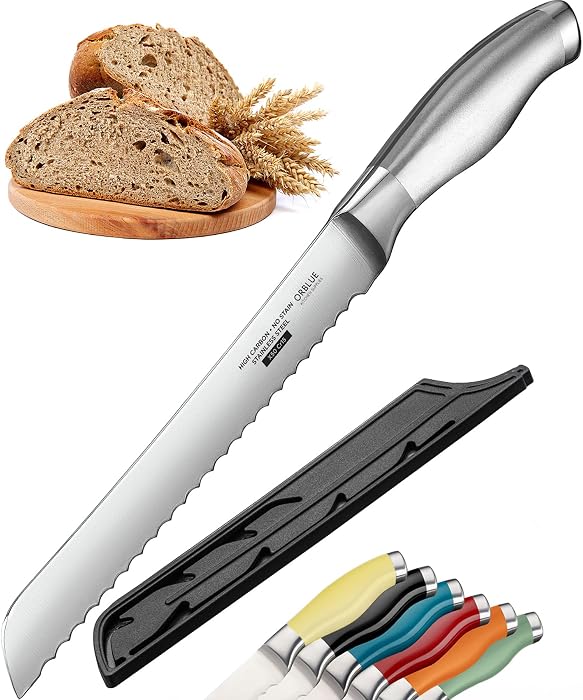
Orblue Serrated Bread Knife

Orblue Serrated Bread Knife with Upgraded Stainless Steel Razor Sharp Wavy Edge

Second-knife duty

Our Score 93/100
Edge
Serrated wavy
Handle
Stainless steel
Blade Length
8 inches
Construction
One-piece stainless steel
View on Amazon

One piece of stainless steel, from the tip of the blade to the end of the handle. There are no rivets to loosen, no scales to trap crumbs, and no seam where a handle can work free of a tang. In a drawer full of assembled knives, that simplicity is the appeal.

The 8-inch blade is sharp out of the box and the balance sits closer to the hand than you expect from an all-metal knife. It is a knife we simply do not think about, which is a compliment: it comes out, it cuts, it goes back.

Where it lands is a good second knife, and a very good first one if the budget is tight. An 8-inch blade will not span a wide boule, so plan on two passes and a steady hand for anything out of a Dutch oven. Otherwise there is nothing here to manage or maintain beyond a wash and a dry.

Worth Noting

  • Smooth all-steel handle offers little grip texture
Our Verdict

We like it as a sharp, seamless 8-inch knife that asks for nothing but a wash — a good second knife or a first one on a tight budget.

Check Latest Price
8

Tojiro F-737 Bread Knife Best for Thin, Delicate Slices

Tojiro Japan Hand Made Bread Knife Slicer Cutter

Thin, delicate slices

Our Score 92/100
Handle
Natural wood
Weight
3.88 oz
Blade Length
23.5 centimeters
Construction
Forged
View on Amazon

The first thing you notice is how little knife there is. The blade runs 23.5 centimeters and the whole thing weighs 110 grams, so it feels like a slicing tool rather than a saw, and the natural wood handle is the plainest and most traditional-looking here.

Thin and very sharp is a good combination for delicate work. It takes sixteenth-inch slices off a light country loaf with almost no pressure and leaves very little crumb on the board, which is the kind of cut that makes a loaf look bakery-made.

Push it into a dense whole wheat and the same thinness works against you: the blade can flex and wander, and the slice comes out wedged instead of square. The wood handle also wants to be washed and dried by hand rather than left in a rack. We like it for a baker who slices a light loaf a few times a week and enjoys the feel of a Japanese blade; for the weekly brick, the Mercer's stiffness is the better bet.

Worth Noting

  • Thin blade can wander in dense loaves
  • Wood handle needs hand washing and drying
Our Verdict

We recommend it for delicate, thin slices and the pleasure of a light blade, not for dense whole-grain loaves.

Check Latest Price
9

PAUDIN 10-Inch Bread Knife Best for Style and Value

PAUDIN 10-Inch Bread Knife

Style and value

Our Score 91/100
Steel
German high-carbon, 56+ Rockwell
Handle
Pakkawood
Weight
8 oz
Blade Length
10 inches
View on Amazon

The pakkawood handle and the etched blade are the first things anyone notices, and that is part of the pitch: this is a bread knife that looks better than its price bracket.

Underneath the finish it is a 10-inch stamped blade in German high-carbon stainless at 56+ Rockwell, with an 8-ounce build and a handle that fills the palm. That is enough blade to span a boule in one pass and enough hardness to hold an edge through a few months of loaves.

In use it cuts squarely, and we noticed the extra stiffness on a seeded crust, where the slice stayed vertical instead of drifting. The spine is a touch thicker than most bread knives here, which is what steadies it.

Where it lands is a step behind the best of this group for sourdough duty. The Mercer spans the same loaf for less, and the Piklohas brings an edge you can bring back. What the PAUDIN brings instead is the look — a knife that sits on the board at a dinner party without apology.

Worth Noting

  • Pakkawood handle can crack with use
Our Verdict

We found it a handsome 10-inch knife that cuts square slices; keep the pakkawood handle dry and it serves a casual baker well.

Check Latest Price
10

RAPSAKEMOH Bow Bread Knife Best for Identical Sandwich Slices

RAPSAKEMOH Bow Bread Knife – Sourdough bread knife

Identical sandwich slices

Our Score 90/100
Edge
Serrated stainless
Frame
Wood bow
Blade Length
10.6 inches
Overall Length
15.6 inches
View on Amazon

A bow knife puts the blade in a frame and lets the frame set the slice. You set the loaf on the board, drop the bow over it, and draw back and forth; the blade stays at a fixed height, so thickness comes from how far you advance the loaf rather than from how steady your hand is.

The frame is wood, the blade is 304 stainless at 10.6 inches inside a 15.6-inch frame, and there is a blade cover, a screwdriver, spare screws, and a manual in the box. The blade can be flipped for left-handed use with that screwdriver, which none of the straight knives here can offer.

On crusty sourdough it does what it promises: even slices without a guide, baguettes included, and a cover that means it can hang on a hook without endangering anyone reaching past it. Very sharp out of the box, and the wood frame feels sturdier in the hand than the price suggests.

We think it is the right tool for a household that bakes on a schedule and wants every slice the same thickness for sandwiches and toast. If you also want one knife for tomatoes, herbs, and cake, buy a straight serrated blade instead.

Worth Noting

  • Frame only takes loaves that fit between the uprights
Our Verdict

We found the frame the fastest route to identical slices without a separate slicer, provided your loaves fit inside it.

Check Latest Price

How We Tested 14 Bread Knives on Real Sourdough

We built the shortlist from bakery supply catalogs, kitchen shops, and the knives that keep coming up among home bakers, then filtered by blade length, tooth pattern (rounded waves versus pointed serrations), steel type, handle shape, and price. That left 14 knives representing how people actually buy: 8-inch all-purpose slicers, 10-inch workhorses, and a couple of long blades built for wide, high-hydration boules.

All of it happened in home kitchens on real loaves. Every knife went through the same rotation — a Sunday sourdough baked in a Dutch oven and cooled on a rack, a day-old boule, a baguette, bagels, tomatoes, and a pineapple. We counted strokes to get through the crust, checked whether the crust shattered or the crumb tore, and lifted each slice to see if it stayed even instead of tapering into a wedge. One pass per knife was done while the loaf was still slightly warm, since gummy crumb is the hardest thing to slice cleanly.

Durability got its own cycle: each knife stayed in weekly rotation for the full six months and cut at least ten loaves apiece, and we ran a ripe tomato test at the start and again at the end to see how much bite the teeth had lost. We also checked whether the serrations could be touched up at home with a honing rod or would need a professional. Handles were judged over back-to-back loaves with floury, wet hands, noting slipping, hot spots, and wrist fatigue — and every knife got the same value question: what it does well, and whether a cheaper blade does the same job.

How to Choose a Bread Knife for Sourdough

Match Blade Length to the Loaves You Bake

Eight inches is right for pan loaves, baguettes, and small boules, and it steers easily in a crowded drawer. A boule from a 10-inch Dutch oven is wider than that, and a short blade forces a second pass, which is where slices go stepped and ragged. Go to 9 or 10 inches if you bake those regularly.

The 14-inch KUTLER is a specialist: it covers a miche or a sheet of focaccia in one stroke, but on a sandwich loaf that much blade is clumsy to aim and awkward to store. Buy the length your widest loaf needs and nothing beyond it.

Look at Tooth Spacing, Not Tooth Count

Fine, closely packed teeth are built for cake and pastry. On a crackling crust they grab and tear, and the crumb compresses before the edge gets through. Wide, gently wavy teeth bite into the crust, clear it, and let the soft interior follow the blade down; that shape is why the Mercer and the KUTLER cut sourdough so cleanly.

Technique matters as much as the tooth pattern. Use one long draw that engages most of the edge and let the teeth do the cutting — pressing down is what squashes bread. Start the cut at a shallow angle on the corner of the loaf and level the blade as the crust gives way.

Stiffness, Weight, and Handle Shape Decide Your Slices

A thin blade flexes, and on a dense whole-grain loaf that flex turns into a wandering cut, so the slice comes out wedged instead of square. The Tojiro is featherlight and lovely on a light country loaf, and it is the wrong tool for a wet, heavy rye. Weight helps, up to a point: 8 to 10 ounces steadies the stroke, while the Piklohas at nearly a pound tires your wrist before the loaf is finished.

Handle shape is just as decisive. An offset or raised handle lifts your knuckles clear of the board on the last inch of the slice, and a textured grip keeps a floury hand from sliding forward toward the teeth.

Buy an Edge You Can Maintain

Serrated edges are the hardest in the kitchen to bring back, and most bread knives get replaced rather than sharpened. A knife whose teeth are shaped for a honing rod — the Piklohas is the one here built for that — buys you years instead of a single season.

Otherwise, protect the edge and accept that the knife has a lifespan. Hand wash and dry immediately, because dishwasher heat and detergent dull teeth and can crack wood or pakkawood handles, and store the blade in a guard or on a magnetic strip rather than loose in a drawer where the teeth knock against everything else.

Frequently Asked Questions

Final Verdict

The Mercer Culinary Millennia is our pick for most sourdough bakers. Ten inches of stiff, wide-toothed blade spans a Dutch-oven boule and finishes the slice in one pass, and nothing else here pairs that length with so little cost. The Victorinox is the better buy if you want a shorter blade and the surest grip in a floury hand, and the HOSHANHO is worth the extra if you bake often enough to care how the knife feels.

If you already know your loaves run wide and you want slices that match every time, the RAPSAKEMOH bow knife does that job without a separate slicer — as long as the loaf fits inside its frame.