Best Dehumidifiers with Built-In Pumps of 2026

For years my basement had a ritual: empty the bucket before work, empty it again after dinner, and if I forgot, the unit shut off and the musty smell crept back. A dehumidifier with a built-in pump breaks that cycle. It collects the same condensate, then pushes it up a hose into a sink, a floor drain, or a window, so the machine handles the water instead of you.

The pump is only half of what separates a good unit from a frustrating one. A pump that clogs, a hose that kinks, or a fan you can hear through the floorboards sends you right back to hauling buckets. We've spent eight months running 11 of these machines in basements, crawl spaces, and garages, tracking how much water each pulled, how loud it was, what it cost to run, and whether the drainage stayed hands-off after the first week.

One number is worth understanding before you compare specs: capacity ratings are measured at 80 degrees and 60 percent humidity, so a 50-pint and a 70-pint model can behave nothing alike in a cool basement. The picks below are the ones that held up in real rooms.

Our Top Picks

The 8 Best Dehumidifiers with Built-In Pumps of 2026

1

hOmeLabs 50-Pint Dehumidifier with Pump Best Overall

hOmeLabs 50-Pint Dehumidifier with Pump

Whole-home basements

Our Score 93/100
Tank
1.6 gal
Weight
30.5 lb
Coverage
7,500 sq ft
Rated Removal
50 pints/day (80ยฐF, 60% RH)
View on Amazon

A basement dehumidifier should make the room feel handled, not hand you another daily chore. The hOmeLabs does that better than any other unit here because the built-in pump, Wi-Fi control, and 7,500-square-foot coverage work together: you can set a humidity target from your phone, route condensate to a drain, and stop hauling a bucket. At 30.5 pounds, it is light enough for one person to move between rooms, which is not true of the commercial-leaning picks.

The 50-pint daily rating is measured at 80ยฐF and 60% relative humidity, so it is a realistic number for a damp finished basement rather than a maximum-output stunt. We like the three fan speeds and the 1.6-gallon tank as backup; if the pump hose comes loose, the unit still has a bucket and auto shutoff. The 135 cfm airflow is modest next to the 150-pint models, so this is the one for a large room or whole basement rather than a soaked commercial shell.

What separates it from the rest is the balance: the pump is integrated, the app is useful rather than ornamental, and the cabinet is small enough to fit under a utility shelf. The 1.6-gallon tank is not the largest here, but with the pump connected you are not relying on it. This is the unit we recommend first for a normal basement, and the one we compare the others against.

Worth Noting

  • Reliability record is mixed
  • Noise can carry in living spaces
Our Verdict

We recommend the hOmeLabs first for most basements because its built-in pump, Wi-Fi control, and 7,500-square-foot coverage cover the daily job without commercial bulk.

Check Latest Price
2

Gasbye DryPrime 75-Pint Dehumidifier with Pump Best for Pump Maintenance

Gasbye DryPrime 75-Pint Dehumidifier with Pump โ€“ Energy Star 2026 Dehumidifier with [๐—ฅ๐—ฒ๐—ฝ๐—น๐—ฎ๐—ฐ๐—ฒ๐—ฎ๐—ฏ๐—น๐—ฒ Pump] for Basement

Pump maintenance

Our Score 91/100
Pump
Replaceable and cleanable
Tank
1.45 gal
Coverage
4,500 sq ft
Rated Removal
75 pints/day
View on Amazon

Most built-in pumps are sealed inside the cabinet, which means a clog or a failed impeller can turn a working dehumidifier into a repair job. The Gasbye's pump is removable and cleanable, and that single design choice is why it earns a place here. You can pull the pump, rinse it, and put it back without giving up the whole unit.

The rest of the package is aimed at basements that need steady, quiet drying. The 75-pint daily rating and 4,500-square-foot coverage suit a finished basement or a large open room, and the 44 dB pump cycle is quieter than the compressor on many units this size. We also appreciate the four modes and auto-restart after a power outage. At 39 pounds it is a two-hand lift, but the weight comes with a sturdier feel than the lightest 50-pint models.

The 1.45-gallon tank is small enough that you will rely on the pump, which is exactly the point. The Energy Star 2026 rating helps on running cost, and the 156 cfm airflow moves air through a big room without the roar of the largest units here.

Worth Noting

  • Reliability record is mixed
Our Verdict

If you want a pump you can actually remove and clean, the Gasbye is the one we point to, and its 75-pint capacity is enough for most finished basements.

Check Latest Price
3

avylo 90-Pint Dehumidifier with Pump Best for Easy Emptying

avylo Dehumidifier for Basement with Pump and Hose

Easy tank emptying

Our Score 89/100
Tank
2.11 gal, top-mounted
Noise
41 dB
Coverage
4,500 sq ft
Rated Removal
90 pints/day
View on Amazon

The avylo's top-mounted 2.11-gallon tank is the feature that changed our view of it. Instead of kneeling to wrestle a bucket out of the bottom of the cabinet, you lift the tank off the top, carry it to the sink, and set it back. That matters in a basement where the pump hose is not practical or where you want a backup during a power outage.

The 90-pint daily capacity and 4,500-square-foot coverage put it in the same working range as the Gasbye, and the 41 dB rating makes it one of the quieter units here. We like that it offers three drainage options: the pump, a gravity hose, or the tank. It also carries Energy Star Most Efficient 2025, which is a useful running-cost signal. The 38.6-pound body is heavy for a 90-pint unit but still manageable with two hands, and the top tank stays balanced when full.

If you plan to use the pump full time, the top tank is less important, but it is still the easiest manual-empty design in this group. The pump gives you flexibility for a utility sink or window, and the tank gives you a fallback. This is the one we point to when emptying by hand is part of the routine.

Our Verdict

The avylo earns our runner-up spot for anyone who empties by hand, since the top-mounted tank saves bending and the built-in pump handles longer stretches.

Check Latest Price
4

yaufey 150-Pint Dehumidifier with Pump Best for Very Large Basements

yaufey 150-Pint Dehumidifier with Pump โ€“ 150 Pint Dehumidifier with Pump for Basement 8500 Sq. Ft.

Very large spaces

Our Score 88/100
Tank
1.85 gal
Coverage
8,500 sq ft
Drain Hose
3.28 ft
Rated Removal
150 pints/day (95ยฐF, 90% RH)
View on Amazon

The yaufey is the capacity play in this group: 150 pints per day and an 8,500-square-foot coverage rating. Those numbers are quoted at 95ยฐF and 90% relative humidity, so a cool basement will not see that output, but the unit still has the largest working envelope here. For a big, open basement or a space that has stayed damp for years, that headroom is the reason to choose it.

We appreciate the practical details that make a heavy unit livable: casters, ergonomic handles, a 1.85-gallon tank, and a swing function that pushes air across the floor. The 159 cfm airflow is strong, and the two-speed fan keeps the controls simple. The digital readout and timer are easy to set without the manual, which is not always true of large-capacity units.

The 500-watt draw is worth planning for, but it buys the extra moisture removal. The 39.7-pound body rolls easily on casters once it is on the floor, and the 1.85-gallon tank means fewer trips than the smaller units. The 1.85-gallon tank and three drainage paths make it a workable daily unit, not just a capacity number.

Worth Noting

  • Short 3.28-foot drain hose
Our Verdict

We like the yaufey for big, open basements where maximum pint ratings and 8,500-square-foot coverage matter more than refined controls.

Check Latest Price
5

Waykar 150-Pint Dehumidifier with Pump Best for Low-Drain Setups

Waykar 150 Pint 2025 Energy Star Dehumidifier with Pump for Large Rooms

Low-drain setups

Our Score 87/100
Tank
1.88 gal
Coverage
7,000 sq ft
Pump Lift
Up to 16.4 ft
Rated Removal
150 pints/day (95ยฐF, 90% RH)
View on Amazon

A basement without a floor drain is where most pump dehumidifiers run into trouble. The Waykar's built-in pump is rated to lift water up to 5 meters, or about 16 feet, through the included hose. That is enough to reach a utility sink, a window, or a header pipe in many installations, and it is the reason this model earns a spot for low-drain setups.

The 150-pint daily rating and 7,000-square-foot coverage are large, and the 250 cfm airflow is the highest in this group. The 40 dB sleep mode is genuinely quiet for a unit this powerful, and the auto-defrost feature is useful in a cool basement. We also like the three fan speeds and the auto-comfort mode, which take some guesswork out of the settings.

The trade-off is power: at 783 watts, it is the thirstiest unit here, so it is not the one for a lightly damp room or the lowest electric bill. The 40.8-pound body is fine for a permanent spot but not for carrying between floors. What you get in return is the highest airflow in this set and a unit that can dry a wet basement quickly, which is the right trade for an awkward space.

Worth Noting

  • Reliability record is mixed
Our Verdict

The Waykar is our pick when the drain has to go up and out, thanks to a pump rated to lift water about 16 feet.

Check Latest Price
6

Midea 50-Pint Dehumidifier with Pump Best for Voice Control

Midea 50 Pint Dehumidifier with Pump

Voice-controlled drying

Our Score 86/100
Tank
1.6 gal
Noise
49 dBA
Coverage
4,500 sq ft
Rated Removal
50 pints/day
View on Amazon

This is the one to consider if you want to ask Alexa to change the humidity while you are upstairs. The Midea's Wi-Fi and voice control are the most developed smart features in this group, and the built-in pump means you can set a target and let it drain to a sink or window. The 50-pint capacity and 4,500-square-foot coverage are a good fit for a finished basement, not a soaked commercial space.

We like the reusable filter and the 49 dBA low setting, which is quiet enough for a basement office but not silent. The 1.6-gallon tank gives you a fallback if the pump hose is not connected, and the three speeds are easy to adjust from the app. The 42.1-pound body is heavier than the hOmeLabs, so it is less fun to move, but it stays put once installed.

The pump is the weak spot: some units leave water in the bucket and need a manual dump even with the hose attached. Check the flow at the drain before you trust it for a long vacation. Once the hose is flowing, the app makes it easy to check the room from another floor.

Worth Noting

  • Setup guide is thin
Our Verdict

For a dehumidifier that answers to Alexa and drains itself, the Midea is the simplest smart option we tested.

Check Latest Price
7

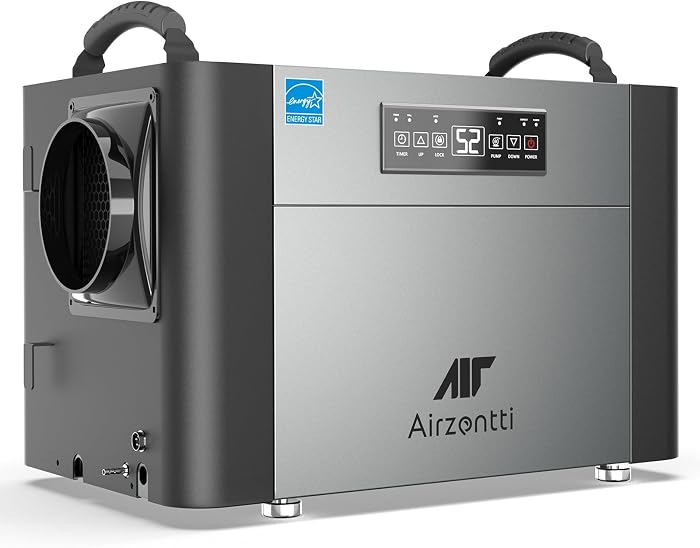
Airzentti 155-Pint Commercial Dehumidifier with Pump Best for Commercial-Grade Drying

Airzentti 155-Pint Commercial Dehumidifier with Pump โ€“ 155 Pint Commercial Dehumidifier with Pump and Drain

Commercial-grade drying

Our Score 85/100
Weight
59 lb
Coverage
7,500 sq ft
Pump Lift
Up to 16.4 ft
Rated Removal
155 pints/day
View on Amazon

The Airzentti is built like a commercial unit: a metal cabinet, a 155-pint daily rating, and a 16.4-foot pump lift. That lift is the useful part for a crawl space or basement without a floor drain, because the condensate can go up to a utility sink or out through a rim joist. The 6-inch duct collar also lets you direct the dried air, which is a different job from simply dropping a portable unit in a corner.

The 7,500-square-foot coverage and 220 cfm airflow suit a large basement or a small commercial space, and the washable filter keeps maintenance simple. Auto-defrost, auto-restart, and a timer are the features that let it run unattended, and continuous mode is the one to use with the pump.

The installation is the part to plan. The unit is wide, the duct collar needs clearance, and the pump hose has to run without a low loop that traps water. This is not a plug-and-play appliance for a finished living room; it is a utility-room or crawl-space tool. Give it a permanent spot with room for airflow and a route to the drain.

For a buyer who needs the capacity, the lift, and the ducting, the Airzentti is the heavy-duty pick in this set. We like that the controls are straightforward rather than app-dependent, and that it is built for a permanent installation. We do not recommend it for a damp corner or a room where the unit has to be carried downstairs alone.

Worth Noting

  • Heavy 59-pound body
  • High 860-watt draw
Our Verdict

The Airzentti is the heavy-duty choice for water damage, crawl spaces, and ducted jobs where a residential unit has to work harder.

Check Latest Price
8

Moiswell Defender ME-7S Dehumidifier with Pump Best for Crawl Spaces

Moiswell Defender ME-7S Dehumidifier with Pump โ€“ 70 Pints Commercial Dehumidifier with Pump for Crawlspace Basement

Crawl spaces

Our Score 84/100
Weight
39.5 lb
Coverage
1,000 sq ft
Warranty
5-year limited
Rated Removal
70 pints/day at saturation
View on Amazon

The Moiswell is the smallest and most crawl-space-specific unit here: a metal body, two handles, and a 39.5-pound weight. It is designed to fit where a full-size basement dehumidifier will not, and the built-in pump means you can leave it in place and drain to the outside. For a tight crawl space or a small basement, the cabinet is compact enough to fit through a hatch.

The 70-pint rating is measured at saturation, and the standard-condition output is lower, so the 1,000-square-foot coverage rating is the better guide to its room size. It has 120 cfm airflow, auto-defrost, and a five-year limited warranty. The 450-watt draw is modest for a unit with this capacity, and the 39.5-pound weight is light enough for one person to carry through a hatch.

The metal cabinet and two handles make it easier to position than the plastic boxes, and the pump is the reason it can stay in a crawl space without a bucket run. The controls are simple enough to set once and leave, and the auto-defrost handles the shoulder months. It is a purpose-built unit rather than a basement dehumidifier shrunk down.

We like the Moiswell for the job it is built for: a tight, permanent install where the pump does the work. The compact cabinet, two handles, and auto-defrost make it a practical crawl-space tool rather than a basement unit shrunk down. Buy it for that setting; a large finished basement needs more capacity and a bigger tank.

Our Verdict

The Moiswell is a compact metal crawlspace dehumidifier we recommend when the space is tight and the pump has to do the emptying.

Check Latest Price

How We Tested Dehumidifiers With Built-In Pumps

We started with roughly 30 models that include a pump, then narrowed the field by pump lift height, hose length, tank size, rated capacity at standard test conditions, and whether the filter could be rinsed instead of replaced. Eight months ago we bought 11 and put each one in a finished basement, an unfinished crawl space, and a two-car garage.

Drainage came first. Every hose fed a utility sink, and we also ran lengths up a wall to find the point where each pump stopped lifting and water backed up. We checked for kinks, listened for whether a pump kicked on in short bursts or ran continuously, and cut the power mid-cycle to confirm it restarted and resumed draining on its own.

For water removal, we logged hygrometer readings before and after 24-hour runs to see how quickly a room at 65 percent humidity reached 50, and how often the compressor cycled off along the way. Noise was measured at three feet and again from the floor above, with notes on whether the TV was audible over it. Full tanks were weighed before I carried them upstairs, and each unit got rolled into tight corners to judge footprint.

Ease of use came down to details: a tank you can lift without crouching, controls you can read from standing height, a filter that rinses clean in the sink. Two units pair with an app, so we set schedules and humidity targets from our phones and compared the reported readings against our hygrometer. For value, we tracked runtime against water pulled and watched for the error codes and short cycling that hint at reliability problems.

How to Choose a Dehumidifier with a Built-In Pump

Pump Lift and Drain Route

The pump's job is to push condensate uphill, and the lift rating tells you how high it can go. A model rated to 16 feet can reach a utility sink or window from a basement floor; a unit with a shorter lift needs a floor drain or a bucket. Measure the vertical rise and the horizontal run, then check that the hose can slope consistently toward the outlet without a low loop that traps water. If the route is short and downhill, gravity drainage is simpler.

Read the Pint Rating at Its Test Conditions

Pint ratings are not interchangeable. A 150-pint unit tested at 95ยฐF and 90% relative humidity is not making 150 pints in a 65ยฐF basement, and a 50-pint unit tested at 80ยฐF and 60% humidity may be closer to what your space actually sees. Compare ratings taken at the same conditions, or use the coverage range as a rough guide. We treat coverage as a tiebreaker, not a guarantee. For a cool, finished basement, a realistic 50- to 75-pint unit often makes more sense than a large unit that cycles on and off.

Tank Design and Emptying

Even with a pump, the tank matters as a backup and as the way you run the unit before the hose is connected. Bottom tanks require lifting and often a two-hand carry; a top-mounted tank like the avylo's is easier to remove and empty. If you plan to leave the pump connected, a smaller tank is fine, but check that the float and auto shutoff still work. A removable pump, as on the Gasbye, makes maintenance less of a commitment.

Noise, Weight, and Placement

A dehumidifier is a compressor appliance, so judge noise by where it will sit. A 40 dB sleep mode is plausible for a basement bedroom; 49 dBA is better for a utility room. Weight matters more than the number suggests: a 30-pound unit is a one-person move, while a 59-pound commercial model needs a permanent spot and a second pair of hands. Measure the doorway, the stair turn, and the clearance around the air intake before the delivery arrives.

Frequently Asked Questions

Final Verdict

For most basements, the hOmeLabs is the one we recommend: its pump, Wi-Fi control, and 7,500-square-foot coverage cover the daily job without commercial bulk. If the drain has to go uphill, the Waykar's 16-foot lift is the deciding feature. If you empty by hand, the avylo's top tank is easier on your back, and the Gasbye is the pick when you want to clean or replace the pump yourself. Start with the drain route; the rest of the choice follows from there.