Best Dehumidifiers of 2026

The first warm, rainy week of spring is usually when it hits you: the basement smells like wet laundry, the bathroom mirror stays fogged long after a shower, and every surface feels clammy. A dehumidifier pulls that moisture out of the air before it settles into walls and furniture. We tested 12 dehumidifiers over eight months in basements, bathrooms, a laundry room, and an RV, and the difference between a unit that works and one that just hums is bigger than the specs suggest.

The biggest fork is compressor versus thermoelectric: compressor models pull more water and handle a whole basement, but they're heavier and louder; thermoelectric units are quiet enough for a bedroom but collect less and need emptying more often. Drainage matters too—a tank is fine until you forget it, and a drain hose is great until you don't have a floor drain nearby. We paid attention to noise, moisture removal, and how often we had to haul a tank to the sink. The picks below are the ones that balance those tradeoffs for their size.

Our Top Picks

The 6 Best Dehumidifiers of 2026

1

hOmeLabs 4,500 Sq Ft Dehumidifier Best Overall

hOmeLabs 4,500 Sq Ft Dehumidifier

Typical basements

Our Score 93/100
Tank Size
1 gallon
Floor Area
4,500 sq ft
Smart Control
Wi-Fi and Alexa
Max Moisture Removal
80 pints/day
View on Amazon

A musty basement is the kind of problem you notice in the air before you see it on a wall, and the hOmeLabs is the unit we reach for when the goal is to fix a normal damp basement without turning it into a project. It is rated for up to 4,500 square feet, with 32 pints a day at 80°F and 60% humidity and a maximum of 80 pints in hot, saturated conditions. That everyday number is the one that matters; the 80-pint figure is a ceiling, not what you get in a cool basement.

What makes it our top pick is how little fuss it adds. The Wi-Fi control is genuinely useful if the unit lives in a crawl space or a basement you do not visit every day, and the included drain hose means you can skip the bucket once you have a floor drain or sump pump. We also like that the one-gallon tank has auto shutoff, so it will not overflow if you do run it manually. At 40 pounds, it is manageable for one person to move, though it is not the kind of thing you want to carry up and down stairs often.

The one-gallon tank is the main practical limitation: in a wet basement you will empty it often unless you connect the hose. We like that hOmeLabs includes the hose rather than making it an extra, and the auto shutoff means a full tank is an inconvenience rather than a mess. For most basements, this is the easiest recommendation in the group; if you need more capacity, the Gasbye is the better choice.

Worth Noting

  • Durability record is mixed over multiple seasons
Our Verdict

We recommend the hOmeLabs as the best all-around dehumidifier for a typical basement because it balances strong moisture removal, quiet operation, Wi-Fi control, and a drain hose.

Check Latest Price
2

Gasbye DryPrime Dehumidifier Best for Large Basements

Gasbye DryPrime Dehumidifier – 6000 Sq.Ft 2026 Energy Star Dehumidifier for Basement Max 115Pints/D

Large wet basements

Our Score 91/100
Tank Size
1.7 gallons
Floor Area
6,000 sq ft
Noise Level
45 dB
Max Moisture Removal
115 pints/day
View on Amazon

More capacity than our top pick is the reason the Gasbye earns a place, but the useful number is not the 115-pint maximum. That figure is measured at 86°F and 80% humidity. The number we care about is 73 pints at 80°F and 60% humidity, which is more than twice the hOmeLabs' everyday rating. In a basement that stays damp even when the weather is mild, that extra capacity is the difference between a unit that keeps up and one that runs all day.

We also like the 45 dB rating and the four operating modes, including a continuous setting that pairs with the drain hose. The 43-pound body feels substantial, and the thickened copper tubing is the kind of detail that suggests Gasbye expects this unit to work hard. The 1.7-gallon tank is bigger than most, but in a wet basement you will still want the hose. Buy from a seller with a clear return path and register the warranty.

Worth Noting

  • Early reliability failures are a risk
Our Verdict

We recommend the Gasbye for a large, wet basement because it removes more moisture than our top pick and runs quietly for its size, provided you are comfortable with a heavier unit.

Check Latest Price
3

Waykar 150-Pint Dehumidifier Best for Extra-Large Spaces

Waykar 150 Pint 7000 Sq.Ft Dehumidifier for Basement with Drain Hose & Tank

Whole-house spaces

Our Score 90/100
Tank Size
2.03 gallons
Floor Area
7,000 sq ft
Humidity Range
30%–80%
Max Moisture Removal
150 pints/day
View on Amazon

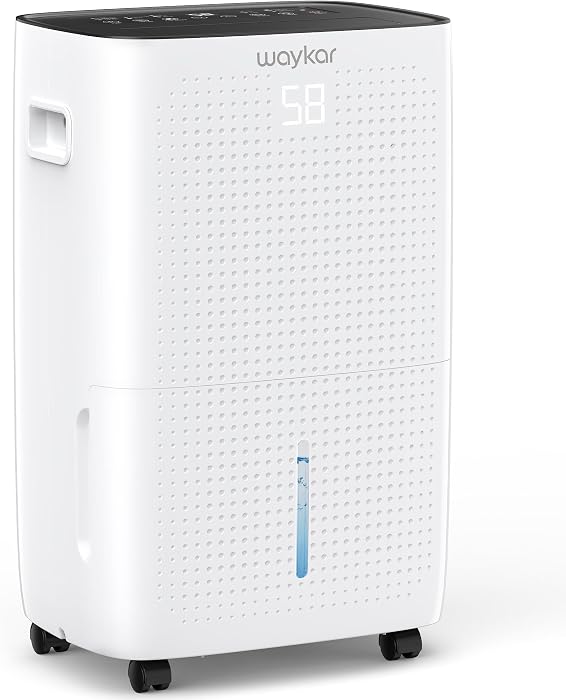
At 150 pints a day, this is the unit built for the kind of space where a normal basement dehumidifier disappears into the job. The rating is measured at 95°F and 90% humidity, so treat it as a maximum rather than a promise; even so, the 7,000-square-foot coverage and 90-degree auto-swing airflow are aimed at open basements, crawl spaces, and commercial rooms where moisture has room to spread.

We like the 30% to 80% humidity range because it lets you push the space drier than the usual 40% floor, and the auto-defrost is useful in a cool basement. The 2.03-gallon tank is larger than most, and the drain hose is included for continuous operation. At 40 pounds it is not impossible to move, but the 750-watt draw is a reminder that this is a serious appliance, not a set-and-forget mini.

The 150-pint capacity is the reason to buy it, but it is also the reason to think twice: in a normal basement, the Waykar is more machine than you need. For a very large or very wet space, that extra headroom is worth the size and the power draw. We rank it behind the Gasbye because the Gasbye gives most large basements enough capacity in a more manageable package.

Worth Noting

  • Mixed reliability record
Our Verdict

We recommend the Waykar 150 for whole-house or commercial spaces because its 150-pint maximum and 90-degree airflow cover large areas, but it is overkill for a normal basement.

Check Latest Price
4

GoGuess 1,600 Sq Ft Dehumidifier Best Compact Compressor

GoGuess 1,600 Sq Ft Dehumidifier – 1600 Sq.Ft Compressor Dehumidifier for Basement

Small basements, RVs

Our Score 89/100
Warranty
2 years
Tank Size
2.3 liters
Floor Area
1,600 sq ft
Moisture Removal
21 pints/day
View on Amazon

Small basements and RVs do not need a 150-pint monster, and the GoGuess is the compact compressor that fits that gap. It is rated for 1,600 square feet and 21 pints a day, which is enough for a small basement, a garage, an RV, or a room where a full-size unit would be in the way. We like that it has three modes, a 30% to 80% humidity range, and a two-year warranty; those are the details that make a compact unit feel less like a compromise.

The 2.3-liter tank is the trade-off. In a damp space it will fill quickly, so the included drain hose is not an accessory you can ignore. We also appreciate the auto-defrost and child lock, which are useful in a garage or a shared space. It is quiet enough for a bedroom, though a compressor is still a compressor. For a small, damp room that needs more than a thermoelectric mini, this is the one we reach for.

Worth Noting

  • Too small for large or very wet basements
Our Verdict

We recommend the GoGuess for small basements, RVs, and tight rooms because it is a real compressor dehumidifier in a compact body, with a two-year warranty and simple controls.

Check Latest Price
5

BEDRED 1,000 Sq Ft Dehumidifier Best Budget Mini

BEDRED 1,000 Sq Ft Dehumidifier – Dehumidifier

Bedrooms and bathrooms

Our Score 88/100
Light
7 colors
Power
85 watts
Tank Size
95 fl oz
Floor Area
1,000 sq ft
View on Amazon

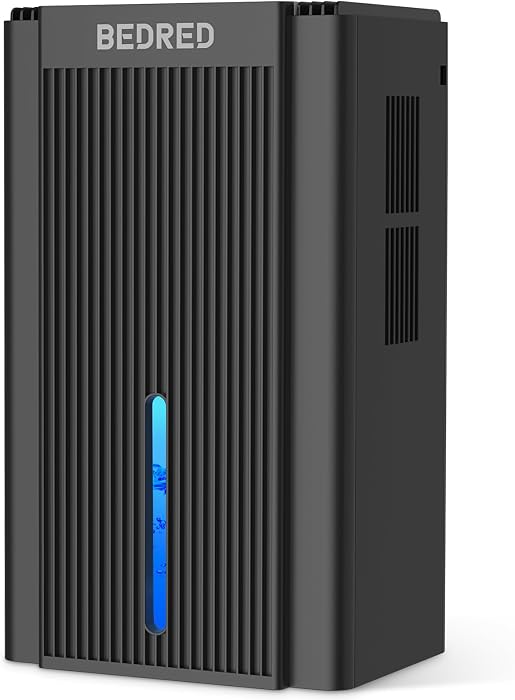
A night light and a sleep mode are not usually what sell a dehumidifier, but they are exactly what make the BEDRED easy to live with in a bedroom or bathroom. It is a 1,000-square-foot thermoelectric unit with a 95-ounce tank, auto shutoff, and a seven-color light. We like that the sleep mode is genuinely quiet and the controls are simple; in a small room, those matter more than a big pint rating.

The thermoelectric design is slow. In a closed, humid room it will pull moisture, but it will not rescue a damp basement or a crawl space, and the tank is small enough that you will empty it often in a wet bathroom. The night light is a nice touch if you want it and easy to turn off if you do not. For a closet, a small bedroom, or a bathroom that stays clammy, it is a low-cost way to take the edge off.

What we appreciate most is that it does not pretend to be more than it is. The footprint is small, the auto shutoff means you can leave it running without watching the tank, and the light is a small comfort rather than a gimmick. If you need real moisture removal in a large space, spend more on a compressor unit; if you want a quiet mini for a small room, this is a sensible pick.

Worth Noting

  • No drain hose, so emptying is manual
Our Verdict

We recommend the BEDRED as a budget mini for bedrooms and bathrooms because it is quiet, compact, and easy to live with, as long as you are not asking it to dry a real basement.

Check Latest Price
6

boglvr 1,000 Sq Ft Dehumidifier Best for Bathrooms with Drains

boglvr 1,000 Sq Ft Dehumidifier – Dehumidifier for Home up to 1000 Sq.Ft

Bathrooms with drains

Our Score 87/100
Timer
8/16/24 hours
Tank Size
98 fl oz
Drain Hose
Included
Floor Area
1,000 sq ft
View on Amazon

A drain hose on a mini dehumidifier is rare enough that it changes how you use one. The boglvr is a 1,000-square-foot thermoelectric unit with a 98-ounce tank, but the included hose turns it into a set-and-forget option for a bathroom, closet, or small basement corner with a floor drain. We also like the 8/16/24-hour timer and the aroma slot, which are small conveniences that make it easier to live with.

It is quiet, compact, and light enough to move from room to room, and the seven-color light is easy to ignore or turn off. The timer is useful for a bathroom that only needs help overnight. For a small, damp room with a drain, the hose is the reason to choose it over the BEDRED; for a larger space, neither mini is the right answer.

Worth Noting

  • Early reliability failures are a risk
Our Verdict

We recommend the boglvr as a small-room mini with a rare drain hose, useful for a bathroom or closet with a floor drain, though its reliability record keeps it out of the top tiers.

Check Latest Price

How We Chose and Tested the Best Dehumidifiers

We started by pulling together the models that keep showing up in reviews and spec sheets—small thermoelectric units for bedrooms and bathrooms, mid-size compressor models for living spaces, and larger units for basements and whole-floor coverage. Then we narrowed to 12 dehumidifiers across those size classes, including tank-only models and ones with drain hoses, and ran them for eight months.

In a damp basement, a bathroom that fogged up after every shower, a laundry room, and an RV parked in a humid driveway, we set each unit to a target humidity and let it run for days at a time. We weighed the water collected after a set interval, timed how long it took to fill the tank, and noted whether emptying it was a one-hand job or a two-hand balancing act. We also watched what happened when a tank filled: some shut off cleanly, some blinked an error, and a few let the compressor keep running.

Noise got the same treatment. I ran each unit in a quiet bedroom and beside a running shower, then noted whether the sound was a low fan hum, a compressor rattle, or a high-pitched whine that made me leave the room. Drain hoses were tested where we had a floor drain; models with auto-restart were unplugged and plugged back in to see if they remembered their settings. Over the months we wiped grilles, moved units between rooms, and checked for loose panels, sensor drift, and error codes—the unglamorous stuff that separates a durable unit from one that quits in a season.

We compared performance against price tier as we went: a small unit that barely moved the humidity needle wasn't a value, no matter how cheap; a larger one that pulled gallons but sounded like a lawn mower wasn't either. The finalists removed moisture at a rate that matched their size, held up to daily use, and didn't make us dread emptying the tank.

How to Choose a Dehumidifier

Start with the Everyday Pint Rating, Not the Maximum

Dehumidifier labels love the biggest number, usually measured at 95°F and 90% humidity. That is a useful ceiling, but your basement is closer to 80°F and 60% humidity, where the same unit removes much less. Compare everyday ratings when you can, and match them to the space: a typical damp basement is often served by a 30- to 50-pint unit, while a large, wet, open basement needs more. The hOmeLabs is a good example of a unit rated at 32 pints in normal conditions and 80 at the maximum; the first number tells you how it will behave.

Decide How You Will Empty It

A dehumidifier is only as convenient as its drainage. A one-gallon tank can fill in a day in a wet basement, and lifting a full bucket is the chore that makes people stop using the appliance. If you have a floor drain or sump pump, choose a unit with a drain hose and set it up for continuous drainage. If you do not, a larger tank buys you time, but it also adds weight. Mini units with a drain hose, like the boglvr, are useful in a bathroom or closet where the tank would otherwise need constant attention.

Listen for the Room You Are Drying

Noise is relative: a compressor unit that is quiet in a basement can still be noticeable in a bedroom. Look for a stated decibel rating, and treat 45 to 50 dB as a reasonable target for a living space; thermoelectric minis are quieter but much slower at removing moisture. Put the unit where air can circulate around it, away from curtains and furniture, and do not expect a bedroom unit to dry the whole floor. If the unit will run at night, prioritize sleep mode or a low fan setting over extra capacity.

Plan for Longevity and Controls

Dehumidifiers work in a harsh place: damp air, constant cycling, and a compressor that runs for hours. The durability record across this category is uneven, so register the warranty, keep the receipt, and choose a seller with a straightforward return path. We put more weight on a clear warranty and a working humidistat than on app extras; Wi-Fi is a convenience for a basement you do not visit often. Set the unit around 50% rather than the lowest number it allows, and clean the filter monthly during humid season.

Frequently Asked Questions

Final Verdict

Start with the hOmeLabs for a typical basement: it has the quiet operation, Wi-Fi control, and drain hose that make a dehumidifier easy to live with, and its 32-pint everyday rating is enough for most semi-finished spaces. Step up to the Gasbye if the basement is larger or stays wetter; its 73-pint everyday capacity is the difference. If space is tight, the GoGuess is the compact compressor we recommend, and the BEDRED is the budget mini for a bedroom or bathroom.