Best Single Boiler Espresso Machines of 2026

A single boiler espresso machine heats one body of water to do two jobs — pull your shot, then switch over to steam your milk. That gap between the two, usually under a minute but long enough to notice, defines the whole category. What you get in exchange is real espresso at home without paying dual boiler money.

I've made espresso at home long enough to know the machine only does half the work. My team and I tested 10 machines over four months, from bare-bones models with a steam wand to ones that grind and dose for you. The number sellers print on the box — 20 bars of pressure, usually — mattered far less than whether a machine held its temperature on the third shot in a row. A built-in grinder is the other fork in the road: it saves counter space and a separate purchase, but it's the grinder you're stuck with.

What separated the keepers was boring stuff: no drips underneath after a month, a steam wand that didn't sputter, a price that made sense for how often you'll actually use it. The picks below are the ones we kept reaching for after the novelty wore off.

Our Top Picks

The 8 Best Single Boiler Espresso Machines of 2026

1

Breville Barista Express Best Overall

Breville BES870XL Barista Express Espresso Machine

All-in-one home setup

Our Score 91/100
Weight
30.4 lb
Grinder
Built-in conical burr
Dimensions
13.8"D x 12.5"W x 15.9"H
Temperature Control
PID
View on Amazon

The grinder sits directly above the portafilter on the Barista Express, so beans go into the hopper at the top and the dose lands in the basket at the bottom already ground. That closed loop — grind, tamp, lock, pull — is why this machine takes the top spot: it removes the second appliance and the guessing about how much coffee is in the basket, which is where most home setups stall before the espresso ever gets good.

The rest of the machine is built for repeatability. Digital temperature regulation holds the brew water at a set point instead of letting it swing with the heating cycle, and low-pressure pre-infusion wets the puck gently before full pressure arrives. Those two details are the difference between a shot that tastes like Tuesday's and one that tastes like Sunday's. The steam wand is manual, and we prefer it that way: you decide how much air goes into the milk and when to stop, and after a dozen pitchers the microfoam stops being a mystery.

It is also a lot of machine. At 13.8 inches deep, 12.5 wide, and 15.9 tall, it wants a real block of counter and clear space above the hopper for pouring beans — measure before you commit. Just over 30 pounds means it stays where you put it, which is fine right up until you need to get behind it.

Longevity is the honest caveat. A grinder and a brew circuit sharing one cabinet is more to go wrong than a machine that only brews, and the warranty runs a single year, which is short for the money. Buy it for the workflow and the shots, brush out the burrs, filter the water, and it rewards the attention — but go in knowing this is a machine to look after rather than one to ignore.

Worth Noting

  • Deep, tall body needs a big counter
  • Beans left in the hopper go stale
Our Verdict

An espresso machine, a conical burr grinder, and a real steam wand in one body: we recommend it to anyone who wants café-style shots at home without buying three separate machines.

Check Latest Price
2

Breville Barista Pro Best for Fast Mornings

Breville BES878BSS Barista Pro Espresso Machine

Fast back-to-back lattes

Our Score 90/100
Weight
19.5 lb
Grinder
Built-in conical burr
Heat-up
ThermoJet, 3 seconds
Water Tank
2 liters
View on Amazon

The Barista Pro is the Barista Express with most of the waiting taken out. Breville's ThermoJet system reaches extraction temperature in about three seconds, and the same hardware makes the move from brewing to steaming nearly immediate — on a single boiler machine that handoff is normally where a morning stalls, and here it barely registers. Everything else follows the same recipe: an integrated conical burr grinder, PID temperature control, low-pressure pre-infusion, and a manual steam wand.

If you make two or three milk drinks in a row, that speed is worth paying for; if you pull one straight shot before work, it buys very little. The two-year warranty is the longest term in this group, though, and on a machine with a grinder, a pump, and a heating system inside one cabinet it counts for something.

In daily use it is the easier Breville to move: 19.5 pounds against the Express's 30, so lifting the two-liter tank out for a refill is a one-hand job, and the bigger reservoir means you do it less often. It is also wider at 14 inches, so check the slot before assuming it fits where the Express did. Grind, pull, steam, and the next shot is ready while the first one is still hot — that sequencing is the whole argument for this machine.

Worth Noting

  • Reliability is the open question at this price
Our Verdict

The fastest way to a second latte: it reaches brew temperature in seconds and turns to steaming almost at once, and the two-year warranty is the longest term here.

Check Latest Price
3

Gaggia Classic E24 Best for Learning Espresso

Gaggia RI9380/46 E24 Espresso Machine

Hands-on learning

Our Score 89/100
Dimensions
8"D x 9.5"W x 14.2"H
Water Tank
2.1 liters
Portafilter
58mm commercial
Extraction Pressure
9 bar
View on Amazon

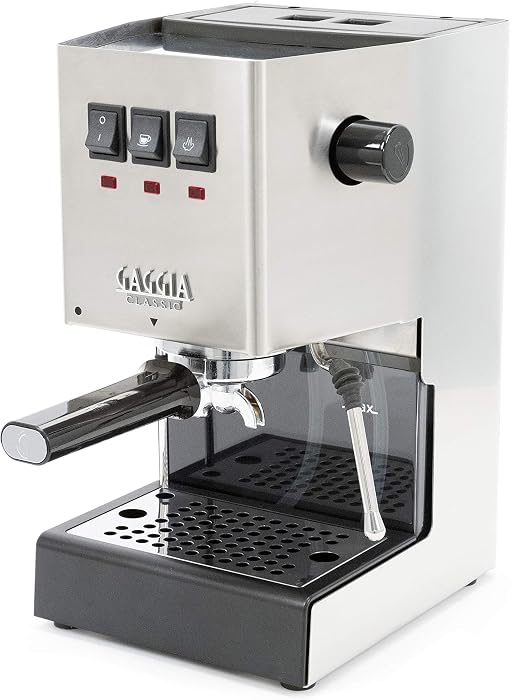
The first week with the Gaggia is humbling. The 58mm basket wants a full dose and an even tamp, the pump pushes a true 9 bar, and the three-way valve leaves a dry puck instead of a soupy basket — none of which happens by itself. This is the opposite of a machine that flatters a careless grind, and that is exactly the point of it.

What you pay for is the parts list: a commercial 58mm portafilter with both commercial and pressurized baskets, a commercial three-way solenoid valve, a steel housing, and a build Gaggia expects you to open and service yourself. It is made in Italy and weighs 20 pounds, the sort of heft that comes from metal rather than from a motor.

Against our top pick it costs less and demands more. There is no screen, no preset, no automatic anything — you supply the scale and the attention, and in exchange you get the same 58mm ecosystem café machines use, where tampers, baskets, and distribution tools are cheap and everywhere. A repair is a gasket and an afternoon rather than a shipping box, which is why we think it is the best value here for someone who wants to understand espresso instead of pressing a button.

Two practical notes before you order. It takes ground coffee or ESE pods, and the pressurized double basket in the box exists for supermarket pre-ground — results with it will be flatter than the machine is capable of, so treat it as a starting point. And at 14.2 inches tall on an 8-inch-deep footprint, it is the friendliest machine here for a shallow counter.

Worth Noting

  • No grinder included; budget for one
  • Steam wand drips between uses
Our Verdict

For anyone who wants to learn on real café hardware, we think it is the best value here: a 58mm commercial portafilter, a three-way valve, and a machine you can service yourself.

Check Latest Price
4

CASABREWS Ultra Best Temperature Control

CASABREWS Ultra Espresso Machine

Switching roasts often

Our Score 88/100
Dimensions
12.2"D x 10.31"W x 12.9"H
Water Tank
73 fluid ounces
Portafilter
58mm
Brew Temperatures
4 settings
View on Amazon

Four brew temperatures on an LCD, a 58mm portafilter with single-wall and dual-wall baskets, a 73-ounce tank, and a 20-bar pump — the Ultra's spec sheet reads like a machine that costs more than this one does. It stands 12.9 inches tall on a 10.3-inch base, so it slides under a standard upper cabinet, and the 58mm group is the part that keeps paying: accessories in that size are the cheapest and most widely sold.

We think the temperature settings are the reason to buy it. Keep a medium roast for espresso and a dark roast for milk drinks, and four steps let you run the dark beans cooler instead of fighting bitterness with your grind. Preheat the mug while you dose — twenty seconds of hot water is the cheapest upgrade you can make to any machine in this group. And the tank is the second largest here, so refills are rare, which matters when the machine lives in a corner.

Worth Noting

  • Drinks can land cooler than the setting suggests
Our Verdict

The most adjustable machine at its price: four brew temperatures, a 58mm portafilter, and a 73-ounce tank make it the pick for anyone who changes beans often.

Check Latest Price
5

CASABREWS CM5418 Best Budget

CASABREWS CM5418 Compact Espresso Machine with Milk Frothing Steam Wand

Tiny kitchens

Our Score 87/100
Dimensions
12.28"D x 5.47"W x 11.97"H
Water Tank
34 oz
Pump Pressure
20 bar
Pressure Gauge
Built-in
View on Amazon

Five and a half inches is the number that sells this machine. The CM5418 is narrow enough to live in the sliver of counter between the toaster and the wall, and at 8.6 pounds it moves out of the way when you need the space back. Narrow is the whole proposition.

What you get is a 20-bar pump, a 1350W heating system, 51mm baskets for one and two shots, a tamper with a spoon on the end, a steam wand, and a built-in pressure gauge. Treat the 20-bar figure as marketing — espresso wants about nine bar at the puck and every pump here gets there — but take the gauge seriously. It tells you when a grind is too fine before you have wasted a shot, which is the most useful thing a beginner's machine can show you.

The shot itself is the surprise. With fresh beans, a decent grind, and a scale, this pulls an espresso with real crema and enough body to hold up under milk, which is not what a machine this small and this cheap usually manages. Register the one-year warranty the day it arrives, and the compact body leaves the rest of your counter free — for a lot of kitchens that is the difference between owning an espresso machine and not.

Worth Noting

  • 34-ounce tank needs frequent refills
Our Verdict

If your counter is the constraint, this is the machine we point to: 5.47 inches wide, with a steam wand and a pressure gauge, for the least money here.

Check Latest Price
6

Gevi Espresso Machine with Grinder

Gevi 20 Bar Espresso Machine with Grinder & Steam Wand for Latte Cappuccino

Budget 58mm setup

Our Score 86/100
Dimensions
12.01"D x 11.5"W x 16.53"H
Water Tank
2.3 liters
Portafilter
58mm
Grind Settings
30
View on Amazon

Sixteen and a half inches is the first thing to know about the Gevi. It is the tallest machine here, and a machine that tall needs clear space above the hopper for pouring beans and above the tank for lifting it out. Measure that gap before anything else; if it fits, this is close to the most machine you can get for the money in this group.

A built-in conical burr grinder with 30 settings, a 58mm portafilter with single-wall and dual-wall baskets, NTC and PID temperature control, pre-infusion, and a 2.3-liter tank: this is the same basic architecture as our top pick for a good deal less money. We think the 58mm group is the reason to consider it, since it opens up the cheapest and most plentiful accessories in espresso, and the baskets you buy for this machine will fit the next one.

The rest is thoughtful in small ways. The tank is the largest in this group, the cup warmer on top is not decorative, and every function sits on one panel instead of hiding behind a dial. Longevity is the open question with a newer name at this price, so the case for it is the parts it puts in your hands.

Worth Noting

  • Grind dosing is by time, not weight
Our Verdict

The Gevi puts a 58mm portafilter and a built-in grinder in your kitchen for a lot less than the Breville, provided your cabinet has the height for it.

Check Latest Price
7

AMZCHEF CM1626 Best for Number-Driven Brewing

AMZCHEF Espresso Machine With Grinder

Number-driven brewing

Our Score 85/100
Dimensions
12.5"D x 10.82"W x 13.38"H
Water Tank
60 oz
Grind Settings
44
Brew Temperature
190–201°F
View on Amazon

A cold-brew button on a single boiler espresso machine reads like a gimmick, and on this AMZCHEF it mostly is. The features that matter sit next to it on the same touch panel: 44 grind settings, a brew temperature you can set anywhere from 190 to 201 degrees, and a screen that shows grind time, brew time, and temperature at once.

The grinder earns its place. Forty-four steps is more granularity than most people will ever use, but the range is the useful part — fine enough for a real espresso grind, coarse enough to matter if you brew other ways. The temperature window is the other half. Light roasts want the top of that range and dark roasts want the bottom, and being able to move within it instead of guessing is what turns one lucky shot into a repeatable one.

Around that, the machine is tidy: a 60-ounce tank, a 13.9-pound body about 12.5 inches deep by 10.8 wide, and an 8mm steam wand that does what a steam wand should. The descaling function is worth mentioning because descaling is the chore people skip until the flow slows.

What it comes down to is repeatability at a midrange price. Grind time, brew time, and temperature are all on the screen, so once you find numbers you like you can write them down and get the same shot tomorrow — more than most machines at this price can promise. It is not the machine for someone who wants 58mm accessories or a long service history behind the badge; it is the one for someone who wants to dial in by the numbers without spending Breville money.

Our Verdict

Adjustable temperature, 44 grind settings, and a screen that shows every number: we like it for anyone who wants to dial in by the numbers rather than by feel.

Check Latest Price
8

De'Longhi Classic Signature Best for Beginner Milk Drinks

De'Longhi Classic Signature Espresso Machine

Beginner milk drinks

Our Score 84/100
Frother
Dairy and plant milk
Heating
Thermoblock
Dimensions
11.22"D x 13.98"W x 15.94"H
Pump Pressure
15 bar
View on Amazon

Fifteen bar is the number on the box, and it is the least useful thing about this machine. Espresso wants roughly nine bar at the puck, and every pump in this group gets there; what separates machines is how they behave around the shot. The Classic Signature's answer is convenience: a Thermoblock that heats fast, one-touch single and double presets, and a dual-mode frother.

That frother switch is the detail we didn't expect to lean on. Plant milks, oat especially, need a gentler stretch than dairy, and a machine that names both settings is telling you it has thought about the difference. You get a decent microfoam for a cappuccino either way, and you stop guessing which pitcher to reach for.

The body is 9.3 pounds and 15.94 inches tall on a footprint nearly 14 inches wide — the widest machine here — so it wants a genuine slot of counter rather than a corner. The presets save a step in the morning, and the box includes a scoop, a tamper, and single and double baskets.

Where it lands: this is the easiest machine in the group to hand to someone who has never pulled a shot. Presets remember your dose, the Thermoblock is ready quickly, and the frother covers the milk. What it doesn't give you is a way to chase a difficult bean — the settings are what they are — and for a household that wants a decent cappuccino before work, that is a fair trade.

Worth Noting

  • Brew temperature runs cool on some units
  • Plastic housing under a metal-look finish
Our Verdict

The easiest machine here to hand to a beginner: presets, a quick Thermoblock, and a frother that handles oat milk as readily as dairy.

Check Latest Price

How We Tested the Best Single Boiler Espresso Machines

We started by reading through specs and a pile of buyer reviews, then narrowed the field by boiler type, footprint, price, and whether the machine grinds its own beans. Ten machines came in. Each one lived on a real kitchen counter for four months, not a lab bench, and got used the way people actually use them: one rushed shot before work, then a slower weekend round of four drinks in a row for whoever was in the house.

We timed every machine from cold start to ready, then timed it again after steaming, since a single boiler has to come back down before the next shot. Each dose was weighed, pulled into a cup sitting on a scale, and timed, and a probe in the cup recorded the temperature at first sip. For consistency, we pulled three identical shots back to back and tasted all three.

Leakage showed up in the boring checks. The tank stayed full overnight, and every morning we ran a finger under the group head and around the base looking for drips. Steam wands got a workout on whole milk, and we noted whether the wand sputtered, scorched the milk, or built foam that actually held. Four months of daily use, descaled per each manual, showed us which drip trays rattled loose and which portafilters still locked in tight.

Value came down to what arrived in the box versus what we had to buy separately, and how much counter it claimed. We wiped each machine down daily, too — brushed stainless picks up fingerprints fast, and a couple of finishes had visibly dulled by month three.

How to Choose a Single Boiler Espresso Machine

The Handoff Between Shot and Steam

A single boiler espresso maker does one job at a time. You pull the shot, turn to steam, and wait for the boiler to climb to steaming temperature; after the milk, you wait again while it cools back down before the next shot. How long those waits last is the biggest single difference between a relaxed morning and a fiddly one.

Fast-heating designs shorten the gap considerably. Breville's ThermoJet reaches brew temperature in about three seconds and moves to steam almost immediately, and a Thermoblock like the De'Longhi's warms quickly too. A heavier traditional boiler, like the Gaggia's, holds temperature well but asks you to plan the order of operations. Two cappuccinos back to back every morning? Pay for recovery speed. Straight shots only? Spend the money elsewhere. And ignore the pump rating on the box: 15, 20, even 9 bar all get reduced to roughly nine bar at the puck, so it tells you nothing about the handoff.

Decide Whether the Grinder Lives Inside

Three machines here grind as part of the workflow, and that changes the morning: dose from the hopper straight into the basket, tamp, pull. You buy one appliance, give it one footprint, and never discover at six in the morning that you are out of ground coffee.

The trade is that a grinder fault takes the whole machine off your counter, and a hopper is a place for beans to go stale. A separate grinder costs more and occupies its own space, but it outlives the machine and can be upgraded later. Either way, a burr grinder is the requirement; a blade grinder produces a mix of powder and chunks that no basket can rescue.

Measure Depth and Height Before Width

Counter depth and overhead clearance decide more installations than width does. These machines run from 8 inches deep to nearly 14, and from about 12 inches tall to 16.5. You need room above the machine to pour beans into a hopper, lift a tank out, or fill a reservoir from a pitcher without aiming.

Compact in a listing usually means narrow, not shallow: our budget pick is 5.5 inches wide but still 12.3 inches deep, and the tallest machine here stands 16.5 inches before you add clearance. Tape out a cardboard box at the machine's exact dimensions and leave it on the counter for a week. That settles the question faster than any spec sheet.

Portafilter Size Sets Your Accessory Path

Baskets here come in 51mm, 54mm, and 58mm. Fifty-eight is the commercial standard, which is why tampers, replacement baskets, distribution tools, and bottomless portafilters in that size are cheap and everywhere. A 51mm machine usually ships with a plastic scoop-tamper that is awkward to use well, and the aftermarket for that size is thin.

If you expect to keep the machine for years and add a better basket, pay for 58mm now and buy accessories once. If the smallest possible footprint is the priority, a smaller basket is part of how a machine gets that small; just order a real tamper along with it.

Temperature Control Is Where the Money Goes

Digital control, whether PID or NTC, holds the brew water at a set point instead of letting it swing with the heating cycle, and the machines that let you choose the temperature are the ones that handle a range of roasts. The CASABREWS Ultra offers four settings; the AMZCHEF runs from 190 to 201 degrees.

Without it you work around the machine: run a blank shot to warm the cup and the group, stick with one bean you like, and accept that a light roast will taste sharper than it should. If you buy a bag at a time and drink milk drinks, temperature adjustment matters less than a good grind. If you switch roasts regularly, it is the first feature to look for.

Frequently Asked Questions

Final Verdict

A single boiler machine doesn't have to be a compromise you notice every morning. We recommend the Breville Barista Express as the default: the grinder, the PID control, and the steam wand work as one workflow, and the shots justify the counter space they take.

If you already own a burr grinder and want to learn on café parts, the Gaggia Classic E24 costs less and teaches more. And if the counter itself is the problem, the CASABREWS CM5418 is 5.47 inches wide and still pulls a real shot. Pick the constraint you actually live with, and the choice makes itself.