Best Quiet Window Air Conditioners of 2026

Window air conditioners have always carried a tradeoff: cheap cooling, expensive noise. One unit can turn the hottest bedroom in the house into the room everyone crowds into, but older ones rattle and cycle like a lawn mower, and you choose between sleeping and being cool. A good quiet unit fixes that — cold air without giving up your sleep, your calls, or the TV volume.

My team and I installed and lived with 10 window units over the past six months, from a 5,000 BTU model for a 150-square-foot office to 10,000 BTU smart units meant to carry an open floor. One thing you learn fast is that bigger isn't better: an oversized unit blasts a room down to temperature, then shuts off before it has pulled the humidity out, so the room stays clammy and the compressor thumps all night.

Sizing to the room, matching the unit to your window, and deciding whether you want an app matter as much as the spec sheet. The picks below cover all three, including saddle-style units the window closes down onto.

Our Top Picks

The 6 Best Quiet Window Air Conditioners of 2026

1

Midea U 10,000 BTU Inverter Best Overall
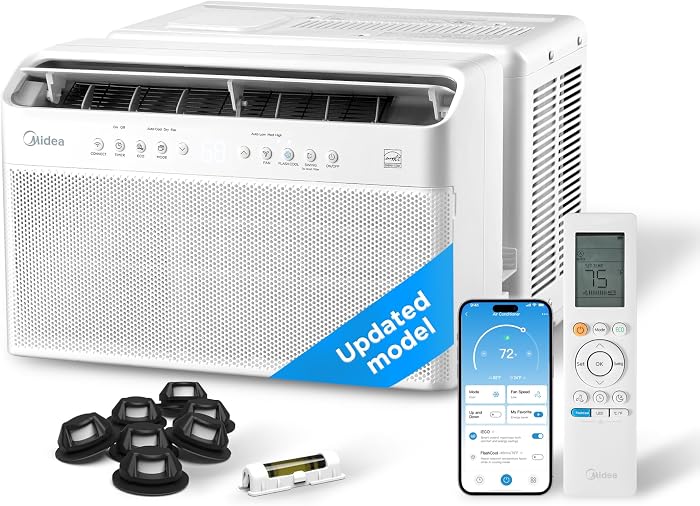
Midea U 10,000 BTU Inverter

Large bedrooms

Our Score 85/100
Efficiency
15 SEER
Rated Noise
32 dB
Room Coverage
450 sq ft
Cooling Capacity
10,000 BTU
View on Amazon

The Midea U doesn't sit in a window so much as straddle it. The chassis is shaped like a U, the sash drops into the gap, and the compressor ends up on the far side of the glass while you keep the bottom half of your view. That single decision is why it's our top pick: the loudest part of an air conditioner is outside the room, behind a closed window, and Midea backs it up with a 32 dB rating, the lowest figure in this group. The inverter compressor does the rest, settling into a low hum instead of starting and stopping all night.

Quiet designs usually ask you to give something up. This one doesn't ask for much. It's rated for 450 square feet, the largest coverage here, on 15 SEER, and it's the only unit in the group we couldn't find a recurring complaint about — cooling, installation, running cost, and noise all hold up. Four of the six picks here use an inverter compressor; this is the one that pairs it with a chassis that puts the machinery outside.

Plan the install. A quick-snap bracket carries the weight, the unit sits on it, and the side arms lock it down, so the window sash isn't holding 56.9 pounds of machinery. The opening needs to be 22 to 36 inches wide and at least 13.75 inches high, and the lift is a two-person job. Once it's in, the window closes all the way, and it opens a few inches above the unit when you want outside air.

What we keep coming back to is the window itself. Being able to see through it, and to shut it properly on a cool night, sounds like a small thing until you've spent a summer with a white box blocking half the light. Only one pick here costs more, and the Wi-Fi and voice control aren't why we recommend it.

Worth Noting

  • Costs more than every pick here but one
  • 56.9 lb install takes a second person
Our Verdict

It's the one we recommend when noise is the whole reason you're shopping: quietest rating here, 450 square feet of cooling, and a window that still closes.

Check Latest Price
2

Midea 8,000 BTU Inverter Best Inverter for Medium Rooms

Midea 8,000 BTU Inverter

Medium bedrooms

Our Score 83/100
Rated Noise
50 dB
Room Coverage
350 sq ft
Cooling Capacity
8,000 BTU
Window Height Needed
19.5 in
View on Amazon

The Midea 8,000 BTU is the same inverter idea as our top pick in an ordinary rectangular box. For a bedroom up to 350 square feet it's the easier unit to own: it costs noticeably less, it weighs 43 pounds instead of 56.9, and it installs the way a conventional window unit does, with a kit and a sash.

We reach for it when the room is a spare bedroom, a home office, or a guest room that only runs in July. At 8,000 BTU and 14 SEER it covers 350 square feet, and 50 dB is a step behind the U-shaped Midea but still near the quiet end of this group. The variable-speed compressor does the same overnight work: it throttles down and keeps running rather than cycling on and off, which is the noise that actually wakes people up.

One measurement to take before you order: this unit wants 19.5 inches of window opening height. Most 8,000 BTU models need 13 or 14, so a shallow sash or a slider is a real problem here. Width is the usual 23 to 36 inches.

The rest is convenience: Wi-Fi with Alexa and Google, a remote, four modes, and a 24-hour timer. The remote does everything the app does and doesn't care whether your network is up, which is why it's the one we reach for.

Worth Noting

  • Needs 19.5 in of window opening height
  • Rated 50 dB, a step behind the U-shaped Midea
Our Verdict

For a 350-square-foot bedroom we point most people here: inverter-quiet, 43 pounds, less money than the U — as long as the window opening is at least 19.5 inches tall.

Check Latest Price
3

LG 10,000 BTU Dual Inverter Best for Large Rooms

LG 10000 BTU Window Air Conditioners [2023 New] Dual Inverter Remote WiFi

Large rooms

Our Score 82/100
Efficiency
15 SEER
Rated Noise
44 dB
Room Coverage
450 sq ft
Cooling Capacity
10,000 BTU
View on Amazon

Forty-four decibels in sleep mode is the number that matters on LG's 10,000 BTU dual inverter. It isn't the lowest figure here — the two U-shaped units beat it — but it's the quietest we found in a conventional chassis, and the dual inverter compressor with LG's BLDC motor ramps up and down instead of switching, so a summer night sounds like a fan on low and not much else.

It's rated for 450 square feet on 15 SEER, which puts it level with the Midea U on capacity and a little behind it on noise. What it adds is reach: the ThinQ app, Alexa control, and a filter reminder let you run it from another room, and 10,000 BTU brings a hot room down fast when you've been out all day.

The trade-offs are physical. At 62.8 pounds it's the heaviest unit we cover, it draws 970 watts at full output — the highest here — and it's the most expensive pick on the page. It fits a double-hung window 22 to 36 inches wide with 13 inches of height, and nearly 27 inches of chassis depth means you should check the clearance outside the sash to be sure it clears. In a ground-floor living room someone else carries it into, none of that is much of an obstacle.

Worth Noting

  • Most expensive pick on this page
  • 62.8 lb and 970 W at full output
Our Verdict

Forty-four decibels in a conventional box is what you're paying for, and in a room you sleep in we think it's worth it: 450 square feet, 15 SEER, and app control that reaches the room before you do.

Check Latest Price
4

LG 8,000 BTU with Wi-Fi Best Value

LG 8000 BTU Window Air Conditioners 2023 New Remote Control WiFi Enabled App

Value-minded cooling

Our Score 81/100
Weight
57.3 lb
Rated Noise
52 dB
Room Coverage
350 sq ft
Cooling Capacity
8,000 BTU
View on Amazon

The LG 8,000 BTU with Wi-Fi is the least expensive way into 8,000 BTUs in this group, which is most of its argument. It's a fixed-chassis unit with the usual EZ Mount kit, a washable filter behind a slide-out tray, three fan speeds, a small remote, and ThinQ app and Alexa control at a price where you usually don't get them.

Physically it's a handful: 57.3 pounds, which is 14 pounds more than the Midea of the same capacity, and 19.4 inches deep, so it hangs further out the back. The opening needs 22 to 36 inches of width and 13 inches of height, the most forgiving fit of the 8,000 BTU units here.

Where it wins is the arithmetic: the same 350 square feet as the Midea above, app and voice control, and less money than anything else at this capacity. What you give up is the inverter. Without one, the compressor runs flat out and then stops, and that on-and-off is the sound people notice at three in the morning — a real difference in a bedroom, a much smaller one in a living room you leave by ten.

Worth Noting

  • Non-inverter compressor cycles on and off
  • 57.3 lb, heavy for its capacity
Our Verdict

Our value pick at 8,000 BTU: 350 square feet, app and voice control, and less money than anything else here at this capacity — with the on-and-off cycling of a standard compressor.

Check Latest Price
5

ZAFRO 10,000 BTU U-Shaped Best for Wide Windows

ZAFRO U Shaped Inverter Window Air Conditioner

Wide windows

Our Score 80/100
Weight
59.5 lb
Efficiency
15.1 SEER
Rated Noise
32 dB
Cooling Capacity
10,000 BTU
View on Amazon

ZAFRO is the one name here you probably haven't seen before, and its spec sheet reads like the Midea U's: 32 dB, an inverter compressor, 15.1 SEER, a U-shaped chassis that lets the window come down, and six modes including a Mute setting. On paper it's the closest thing to our top pick in this group.

The numbers hold up under inspection. It draws 460 watts, less than half of what the LG 10,000 BTU pulls at full output, it takes app, voice, and remote control, and it fits windows up to 48 inches wide — a foot wider than the Midea U, which matters on a big picture window.

What it doesn't have is a history. This is a newer name with far less behind it than Midea or LG, so how it behaves in year three is an open question, and the capacity headline needs reading twice: the same listing calls it 10,000 BTU by the ASHRAE standard and 6,200 BTU by the DOE standard, which makes it an 8,000 BTU-class machine. Size it for about 350 square feet, not 450.

Two practical notes before you buy. At 59.5 pounds it's a two-person lift, and the drain sits toward the room rather than outside, so a sticky week can mean a shallow pan underneath — worth confirming against the manual before you install.

Worth Noting

  • 10,000 BTU headline is 6,200 BTU by the DOE standard
  • 59.5 lb, so plan on a two-person install
Our Verdict

We think the ZAFRO is worth a look when the Midea U won't fit your window: 32 dB, a 48-inch maximum width, and inverter efficiency, sized as an 8,000 BTU unit rather than the 10,000 on the box.

Check Latest Price
6

Windmill 5,000 BTU Lite Best for Small Bedrooms

Windmill 5,000 BTU Lite

Small bedrooms

Our Score 77/100
Rated Noise
51 dB
Window Width
23-34 in
Room Coverage
150 sq ft
Cooling Capacity
5,000 BTU
View on Amazon

The Windmill Lite is the only unit here that looks like someone designed it for a room instead of a loading dock. The front is smooth, the control panel dims itself at night so it doesn't glow across a dark bedroom, and at 17.8 inches wide it doesn't swallow the window.

We like it for small rooms for exactly that reason, and because it's the least expensive pick on this page. At 5,000 BTU it covers 150 square feet — a bedroom or a home office and not much more — on 460 watts, and the app and Alexa control are genuinely useful at this size, since you can cool the room before you go up. Small units rarely come with them.

Noise is where the Lite gives ground. The 51 dB rating is a lowest-fan figure, and the compressor is what you hear when it starts; three feet away on a conference call, you'll notice it. It's the quietest small unit here, which says as much about 5,000 BTU machines as it does about this one. The fit is easy, at least: 23 to 34 inches of window width and 14.5 inches of height, with a kit for single and double-hung windows.

Worth Noting

  • Louder in practice than its 51 dB rating suggests
Our Verdict

The Windmill Lite is the one we point to for a small room that's on show — best-looking unit here, least expensive — as long as you don't need it to be the quietest.

Check Latest Price

How We Tested the Quietest Window Air Conditioners

We started by pulling every window unit we could find with a real quiet claim, then filtered by BTU-to-square-footage match, window compatibility, price, and whether the smart controls were usable without a subscription. Ten units made the cut, and each one ran for six months in a real room — a home office, a bedroom, a small living room, and a basement apartment with a single slider.

Noise came first. We measured each unit with a decibel meter three feet from the front grille on high, low, and sleep settings, and noted the gap between the compressor running and the fan alone, since that cycling is what actually wakes people up. Two of us also slept with each unit for a week and took calls at a desk two feet away.

For cooling, we placed thermometers at three and ten feet from the unit and logged how far the temperature dropped at 30 and 60 minutes with the door shut, watching for corners the air never reached. We checked whether each unit held the temperature we set, ran a watt meter to compare draw at steady state, and paired every smart model to WiFi, built schedules, and restarted the router to see whether it reconnected on its own.

Installation we timed solo with a stopwatch, no second set of hands, in a standard double-hung window, then checked whether the sash could close and lock over a saddle-style unit. Drainage got its own check: we ran each unit for hours on a humid day and noted water pooling in the pan, the tilt it took to drain, and where the condensate actually landed. We washed filters on schedule and watched for rattles and loosening seals as the season wore on.

How to Choose a Quiet Window Air Conditioner

Decibels Are a Floor, Not an Average

Noise ratings are taken at the lowest fan setting with the compressor at its easiest, so treat every figure on this page as a best case. What separates these units is where the noise is made and how it changes. A U-shaped chassis puts the compressor outside the glass with the sash closed over it, and an inverter compressor settles at a low speed instead of restarting every few minutes. Compare decibel figures against each other, then look at the shape of the chassis and the type of compressor before you trust the number.

The trap is assuming a low number travels. A 32 dB rating on a U-shaped unit and a 32 dB rating on a conventional box describe very different rooms, because one of them has a pane of glass between you and the machinery.

Size the Unit to the Room, Not the Room to the Unit

5,000 BTU covers about 150 square feet, 8,000 covers about 350, and 10,000 covers about 450, which is roughly where this group tops out. The common mistake is oversizing: a single-speed unit that's too big blasts cold air, shuts off before it has pulled the humidity out, and starts again, so the room feels clammy and the cycling is what wakes you. If you're between two sizes, choose the smaller one and step up only for a sunny kitchen or an open plan that won't close off.

Inverter or Single-Speed?

An inverter compressor runs at variable speed and holds a temperature; a single-speed one runs flat out and stops. The inverter is quieter overnight, drier in humid weather, and cheaper to run, which is why four of the six units we recommend here have one. It's worth the premium in a bedroom. In a workshop, a laundry room, or a room you cool for an hour at a time, a single-speed unit does the job for less — just expect the on-and-off.

Measure the Window Before You Shop

Width and height both matter, and the height requirement is the one people miss. Most 8,000 BTU units take an opening 13 to 14.5 inches high; the Midea 8,000 BTU needs 19.5, which rules out a shallow sash. U-shaped units need 22 to 26 inches of width plus room for a bracket, and the ZAFRO takes openings up to 48 inches wide. Check the sash type too: these mount in double-hung windows, and a horizontal slider needs different parts entirely.

What Smart Controls Are Actually Worth

Wi-Fi, an app, and voice control are the first features to misbehave and the last ones you'll use. What earns a place in a bedroom is a remote with a readable display, a 24-hour timer, an eco or sleep mode, and a panel that dims or blacks out at night. Pay for those. Pay for the app only if the unit is in a room you want cooled before you walk into it — that's the one job the phone does better than the remote.

Frequently Asked Questions

Final Verdict

The Midea U is the pick we lead with. If your window takes a U-shaped chassis, nothing else here matches 32 dB, 450 square feet of cooling, and a sash that closes over the top, and the window stays usable all summer.

For a smaller bedroom, the Midea 8,000 BTU inverter saves money and 14 pounds, provided the opening is at least 19.5 inches high. If the room is small and the unit will be visible from the street, the Windmill is the better-looking, cheaper answer — with more noise than its rating implies.