Best Produce Storage Bags of 2026

There's a particular kind of defeat in pulling a bunch of cilantro from the crisper four days after you bought it and finding black sludge. I've thrown out plenty of produce because I stored it in whatever bag it came home in, knotted shut, moisture pressed against the leaves. A good produce bag does the opposite of what most of us assume: it manages humidity instead of sealing it in, holding just enough to stop wilting while letting the excess escape before rot can start.

Over the past four months, my team and I have tested 16 produce storage bags — mesh, cotton, muslin, plastic roll bags, and the green ethylene-absorbing kind. The surprise is that no one material wins: mesh keeps onions and potatoes firm, cotton holds humidity for herbs, and plastic is still best for a half-used loaf of bread. Two things I now check before anything else: a printed tare weight, and whether a cashier can scan through the bag — a wet mesh sack unpacked at the register is its own small misery. The bags that survived my kitchen drawer are below.

Our Top Picks

The 8 Best Produce Storage Bags of 2026

1

Debbie Meyer GreenBags Best Overall

Debbie Meyer GreenBags

Fridge freshness

Our Score 97/100
Reuse
8 to 10 times per bag
Closure
Fold top
Material
BPA-free film with mineral ethylene control
Bag Count
40 (16 medium, 16 large, 8 extra-large)
View on Amazon

Ethylene is the gas that turns one ripe banana into a countdown clock for everything around it. GreenBags are the only pick here built around that problem: the green film carries a mineral formulation designed to manage ethylene gas, so what is inside slows down instead of racing past ripe and straight into the compost.

That mechanism is why this pack sits at the top of the list. Mesh and cotton solve the trip home; this one solves the week after, and the difference shows most with the produce that gives up fastest, which means bananas, berries, herbs, and leafy greens. The pack also reads like a system rather than a sampler: 16 medium, 16 large, and 8 extra-large bags, each with a gusseted bottom that opens wide enough to take a head of romaine without crushing it.

We sorted a shop into ours in one pass. Extra-large for greens and a bunch of bananas, large for apples and peppers, medium for berries and cut herbs. Each bag is meant to be rinsed, dried, and reused eight to ten times, which is what makes the count sensible rather than excessive: 40 bags is closer to two seasons of drawer duty than a one-time purchase. BPA-free film and U.S. manufacturing round out a package that is easy to keep stocked.

Two limits are worth knowing before you order. The closure is a fold-over rather than a seal, and the listing rules out the freezer, so plan on the fridge, the counter, and the pantry. The film is thin as well, and bags that spend their lives around damp greens are the ones most likely to split before their tenth round. Dry the produce first and the bags last considerably longer.

Worth Noting

  • Thin film can split before the tenth use
  • Fold top, and not for the freezer
Our Verdict

We recommend the GreenBags to anyone whose produce dies in the crisper: 40 bags in three sizes, a film built to slow ripening, and eight to ten uses apiece.

Check Latest Price
2

purifyou Reusable Produce Bags Best Reusable Mesh Set

purifyou Set of 9 Reusable Produce Bags

Weekly grocery runs

Our Score 96/100
Washing
Machine and dishwasher safe
Bag Count
9 (5 large, 2 extra-large, 2 small)
Bag Sizes
12 x 14, 12 x 17, 12 x 8 in
Tare Weights
Color-coded tag on each bag
View on Amazon

Nine mesh bags is not a hard sell. The tare tag is what separates this set from the pile: each bag carries a color-coded tag with its own weight, so the register can subtract the bag instead of guessing at it, and the color tells you the size when all nine are loose in a tote. That single detail is why we rate it the most complete mesh set here.

The size spread does the rest. Five large at 12 by 14 inches, two extra-large at 12 by 17, two small at 12 by 8, so a bunch of chard, a sack of oranges, and a handful of shallots each get a bag that fits rather than one they rattle around inside. The mesh is open enough to read a sticker through and light enough that a full bag barely moves a scale.

Cleaning decides whether a reusable bag gets used twice or sits in a drawer, and these go through both the washing machine and the dishwasher. The polyester mesh dries fast enough to be back in the tote the next morning, and the whole set folds into a grocery bag pocket when the shop is done.

Worth Noting

  • Breathable mesh will not extend fridge life
Our Verdict

For weekly shoppers who want one mesh set that handles everything, we point to purifyou: nine bags, three sizes, and tare tags that speed up the register.

Check Latest Price
3

Cottify Organic Cotton Mesh Bags Best Plastic-Free Cotton Set

Cottify Organic Cotton Mesh Bags – 12+1 Reusable Produce Bags Grocery Washable

Plastic-free shopping

Our Score 95/100
Sizes
4 small, 4 medium, 4 large
Washing
Machine washable
Material
Organic cotton mesh, no plastic toggle
Bag Count
13 (12 bags plus carry bag)
View on Amazon

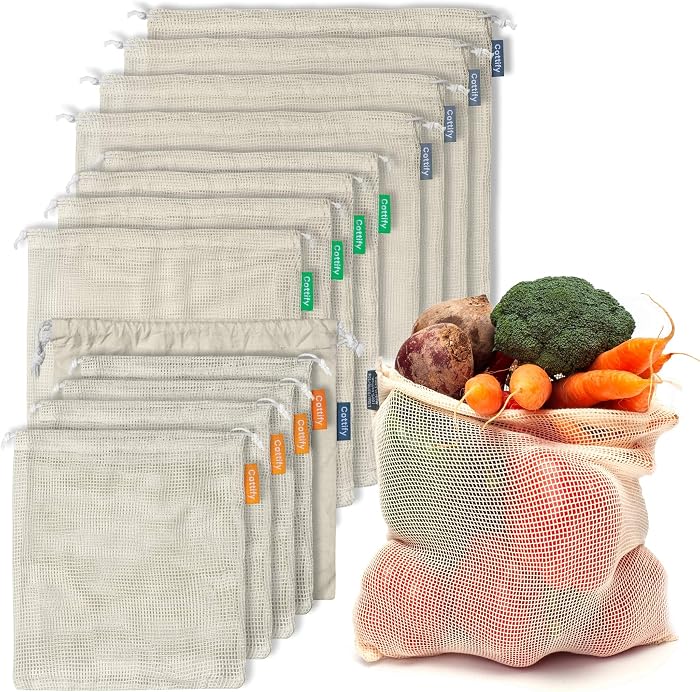
Plenty of cotton produce bags still close with a little plastic bead, which is an odd thing to find on something sold as zero waste. Cottify leaves it out: cotton cord on a cotton mesh body, double-stitched at every seam, with no plastic or metal toggle to crack in the wash or survive the compost heap for a few centuries.

Thirteen pieces make up the set: four small, four medium, four large, plus a carry bag that keeps the lot together between shops. The knit is fine enough that limes, garlic, and a handful of Brussels sprouts stay put, and open enough that onions and potatoes can breathe the way they want to. The large is generous enough for a whole head of cabbage.

What we appreciate most is that the entire bag is compostable at the end, cord included, with no hardware to cut off first. Thirteen pieces also stops the rationing that comes with a six-pack: one for the onions, one for the apples, one for the loose carrots, and still one left in the car for the unplanned stop.

Worth Noting

  • Heavier and slower to dry than polyester mesh
Our Verdict

Buy the Cottify set if plastic-free matters down to the drawstring: 13 compostable cotton bags, machine washable, with nothing synthetic to lose in the laundry.

Check Latest Price
4

FungLam Plastic Produce Bags on a Roll Best Disposable Roll

FungLam Plastic Produce Bags on a Roll – 12" X 16" Plastic Produce Bag on a Roll

Everyday fridge storage

Our Score 94/100
Bag Size
12 x 16 in
Dispensing
Perforated tear-off roll
Reusability
Disposable
Bags Per Roll
350
View on Amazon

Per bag, nothing in this group is cheaper, and nothing is faster to grab when your hands are wet. A roll of 350 sits by the cutting board, a bag comes off at the perforation, and a head of chard goes into the fridge without hunting for a container, a lid, or a matching bag.

Twelve by sixteen inches is the size that does the most work: a loaf of bread, a head of romaine, a bunch of greens, a bag of green beans, a bundle of Swiss chard. The film is rated for food contact and clear enough to identify contents without opening anything, and 350 of them carry a household through months of shopping. The roll earns its drawer space beyond produce too, since wet swimsuits, muddy shoes, and pet waste all make the same grab.

Know what you are buying: these are disposable, and the film is on the thin side of what you get from a name-brand box. Heavy or sharp-edged loads are where a bag gives out, so double up for a melon, and give the perforation a firm tug rather than a hopeful one when the roll is new.

Worth Noting

  • Thin film splits under heavy or sharp loads
  • Bags can be fiddly to separate from the roll
Our Verdict

For wet, muddy, high-volume produce, we keep the FungLam roll on the counter: 350 bags that cost the least per bag of anything here.

Check Latest Price
5

LEAFICO Cotton Storage Bags Best for Bread and Pantry Storage

LEAFICO Cotton Storage Bags – Cotton Storage Bags

Bread and potatoes

Our Score 93/100
Closure
Drawstring
Bag Size
14 x 17 in
Material
100% cotton muslin
Bag Count
6
View on Amazon

These are not fridge bags, and that is the point. Fourteen by seventeen inches of cotton muslin with a drawstring is the shape that suits a pantry: a loaf of sourdough, five pounds of potatoes, a net of onions, a winter squash that needs air around it.

Cotton lets all of that breathe, which is what keeps a sack of onions from going soft the way it does when it sweats inside plastic. The drawstring closes tight enough to hang the bag from a hook, and the seams are sewn to take real weight, because a full sack of potatoes is not a light load. Empty, they fold flat into a drawer; full, they hang out of the way.

Six sacks cover the staples most households buy weekly, and they go through the wash when something turns in one. What we like best is the double duty: the same bag carries bread home, holds a batch of rolls for the freezer, and corrals shoes or knitting when the pantry is full. Ours went straight from the grocery tote into a cabinet basket, which is more than the plastic bags they replaced ever managed.

Worth Noting

  • Runs small against the listed 14 x 17 in
Our Verdict

If your storage problem is a sack of potatoes and a loaf of bread, we like the LEAFICO cotton sacks: six large breathable bags for pantry staples.

Check Latest Price
6

Earthwise Reusable Mesh Produce Bags Best for One-Bag Shopping

Earthwise Reusable Mesh Produce Bags

One-bag shopping

Our Score 92/100
Closure
Drawstring
Bag Size
11 x 13.5 in
Material
Polyester mesh
Bag Count
9
View on Amazon

Nine bags, all of them 11 by 13.5 inches. No sizes to sort, no color code to learn, no digging for the right one. You reach into the tote, take whichever is on top, and get on with the shop. That sounds like a small thing until you have watched someone stand in the produce aisle comparing bag sizes.

Where the set genuinely earns its place is transparency. The mesh is open enough that a barcode reads through it and you can see what is inside without untying anything, so checkout moves faster than it does with an opaque cotton sack. The bags weigh close to nothing, they take asparagus, corn, or eight or nine apples without complaint, and a full load of potatoes does not strain the stitching. It is the set we hand to anyone who wants one bag that does everything.

The scope is worth naming, because these are shopping bags first. They breathe, which is right for onions and potatoes and no help at all for keeping lettuce crisp, and they are sold as a single size, so a few shallots will rattle around in one.

Worth Noting

  • Not water resistant, so wet greens drip
Our Verdict

For a no-decisions mesh bag, we like Earthwise: nine identical see-through bags that weigh next to nothing and read at the register.

Check Latest Price
7

Organic Cotton Mart Mesh Produce Bags

Organic Cotton Mart Mesh Produce Bags – Reusable Cotton Mesh Produce Bags

Small-item produce

Our Score 91/100
Washing
Machine washable
Material
100% organic cotton mesh
Bag Count
6 (2 large, 2 medium, 2 small)
Bag Sizes
12 x 15, 10 x 12, 8 x 10 in
View on Amazon

The knit on these is tight, and that matters more than it sounds. Anyone who has chased shallots, garlic cloves, or Brussels sprouts around the bottom of a coarse mesh bag knows the feeling of reaching in after them. The fine cotton knit here holds a handful of anything small without letting it slip through the weave.

Six bags arrive in pairs: two large at 12 by 15 inches, two medium at 10 by 12, two small at 8 by 10. The big one takes a head of kale or a pile of garden potatoes, the small one a few lemons, and the pair arrangement makes sense once you realize you rarely need three of anything at the same moment.

Organic cotton, double-stitched seams, and packaging that is recycled paper rather than a plastic sleeve, this is a set built to be washed and kept rather than used up. Through the machine and hung to dry, ours came back soft rather than stiff, which is not something every cotton mesh manages.

We like this set best for herbs, loose nuts, and anything small enough to escape ordinary mesh, and for anyone who wants cotton without a plastic toggle at the closure. Be ready for a slower checkout, though: the dense weave is harder for a cashier to read a sticker through.

Worth Noting

  • Dense knit is slow to scan through
  • Cotton holds water and dries slowly
Our Verdict

We recommend Organic Cotton Mart for small produce and herbs, since the tight cotton knit holds what looser mesh lets fall through.

Check Latest Price
8

SPLF Reusable Mesh Produce Bags Best for Big Weekly Shops

SPLF Reusable Mesh Produce Bags – 12 Pcs Heavy Duty Reusable Mesh Produce Bags

Big weekly shops

Our Score 90/100
Sizes
Three sizes, tagged by color
Washing
Machine washable
Material
Polyester mesh
Bag Count
12
View on Amazon

Twelve bags, three sizes, and a colored tag on each one: green, blue, or purple tells you small, medium, or large at a glance. For a household that fills five or six bags on a normal shop, the count is the whole feature, because the failure mode with reusable bags is running short and reaching for plastic again.

Five small at 12 by 8 inches, four medium at 12 by 14, three large. The large is roomy enough that a tall head of romaine goes in without being folded in half, and the small is the bag that finally gives loose green beans somewhere to live instead of rolling around the cart.

They machine wash, they dry fast, and the material is food-contact safe and free of BPA, lead, and mercury. The drawstring pulls clean, the size tags have stayed put, and the bags fold into a tote pocket when the shop is over.

Buy this set for the count and the size sorting. Twelve bags spread a week of produce across more separate bundles than any other set here, which is exactly what a big household needs, and the colors mean nobody has to open three bags to find the apples.

Worth Noting

  • Scanning through the mesh is inconsistent
Our Verdict

Twelve bags in three sizes give SPLF the strongest count for the money here, as long as you do not count on scanning through the mesh.

Check Latest Price

How We Tested Produce Storage Bags in Real Kitchens

We rounded up every style we could find — supermarket roll bags, drawstring mesh, unbleached cotton, muslin sacks, and the green bags sold for extending shelf life — then cut anything whose seams looked ready to split at the corner or whose drawstring was attached in a single pass. The field ran from small herb bags to extra-large sacks built for a head of romaine or a five-pound bag of potatoes; anything too narrow to swallow a whole romaine heart was out early. Sixteen bags made the final cut, and I used them for four months.

Every Saturday I brought a farmers market haul home in the mesh and cotton bags, then kept things in those same bags in the crisper, on the counter, or in the pantry, checking daily: whether cilantro went limp or slimy, whether onions stayed firm, whether bread crust turned leathery or soft, and where condensation beaded on the fabric. On ordinary grocery runs I handed the loaded bags to a cashier and timed checkout, noting whether the barcode read through the mesh or the bag had to be emptied first.

I weighed every bag empty on a kitchen scale and compared it against the tare weight printed on the tag, and I judged thickness by holding each one up to a window and pinching the weave, since a bag thin enough to see through easily is also thin enough to split. Each one went through repeated machine washes, and after every cycle I checked seams, drawstrings, and whether the bag held its shape. The ones that came out ahead are the ones I stopped noticing — no pooling moisture, no snagged drawstring, no unpacking at the register.

How to Choose Produce Storage Bags

Carrying and Keeping Are Two Different Jobs

Mesh and cotton sets replace the flimsy roll at the store: they hold up at the register, breathe in the crisper, and fold into the tote between trips. Ethylene-managing film bags like the GreenBags do almost nothing on the way home and everything in the drawer afterward. Those are the two products hiding under one search term, and mixing them up is how people end up disappointed by a perfectly good bag.

If your lettuce wilts by Thursday, buy the film bags first. If your problem is a drawer full of plastic grocery bags, start with mesh produce bags and add a film pack later. Very few households need only one of the two.

Match the Bag to the Produce

Breathability is the dividing line. Onions, potatoes, garlic, winter squash, and anything you keep on the counter want air, which is the job a cotton or mesh sack does well. Greens, berries, herbs, and cut fruit want moisture held close without turning swampy, and that is what the film bags were designed for.

The most common way to undo a good bag is to wash the produce first. Water on leaves speeds decay, so dry greens and berries before they go in, and leave a little room rather than packing the bag tight.

Sizes, Counts, and How Much You Actually Shop

Count the bags you fill on a normal trip before you buy a thirteen-piece set. Most households land on two large, three medium, and two small bags, plus one extra-large for bunches of greens, which is roughly the nine-bag configuration that shows up again and again here.

Rolls solve a different problem. 350 bags at 12 by 16 inches covers a year of fridge storage, wet produce, and all the other things you reach for a plastic bag to do, at a per-bag cost no reusable set can touch. Buy a set if you want to stop buying bags; buy a roll if you want one in your hand without thinking about it.

Tare Weight, Scanning, and the Checkout

Mesh and cotton both weigh something, and at a bulk bin that weight lands on your bill unless the bag carries a tare tag or you have noted the number yourself. Cotton is the heavier of the two, while polyester mesh is close to invisible on a scale.

Scanning is the other register-time snag. Clear mesh helps, but a sticker wrapped around a single avocado defeats it, so expect the cashier to open a bag now and then. Sets with printed tare weights and an open weave move fastest.

Frequently Asked Questions

Final Verdict

Start with the Debbie Meyer GreenBags if the problem you are solving is produce dying in the crisper. The film is the only thing here that works on the week after the shop, and 40 bags in three sizes cover a full drawer.

If you are shopping for the store instead, the purifyou set's tare tags and three sizes make it the easiest mesh to live with, and the FungLam roll is the one to buy when you want a bag in your hand for pennies and do not care about reusing it.