Best Pie Weights of 2026

A blind-baked crust has one job: stay flat. Mine kept failing. I'd dock the dough, line it, fill it with beans from the pantry, and still pull out a shell with a dome in the middle and walls that had slumped. The problem isn't technique, it's weight: pie weights press the dough against the pan while it sets, so the crust bakes crisp and the sides stay put.

Weight is the spec nobody prints in large type. A 9-inch shell wants close to two pounds of beads to fill the bottom and reach the corners, which is why a two-cup jar of pretty pellets can leave you short on a deep-dish pan. Over three months we baked with 14 sets — glazed ceramic, unglazed stoneware, and one stainless disc — and the keepers share a few traits.

Bead size matters more than bead count, and cleanup matters more than either — unglazed clay grabs butter and holds it. Color varies batch to batch on the natural sets. What follows survived a season of tarts, quiches, and one deep-dish pie.

Our Top Picks

The 8 Best Pie Weights of 2026

1

ROCKSHEAT Ceramic Pie Weights Best Overall

ROCKSHEAT Ceramic Pie Weights – K Ceramic Pie Weights

Everyday 9-inch pies

Our Score 96/100
Weight
2.2 lb (1000 g)
Container
Wheat straw canister
Heat Rating
600 °F
Water Absorption
0.1%
View on Amazon

Two and a quarter pounds is the number that decides this set. A standard 9-inch shell wants close to two pounds of ceramic before the base stays flat and the sides hold their shape through a full blind bake, and this canister arrives with 2.2 pounds in a single order. That one figure puts it ahead of every smaller set here: with 8 ounces or 1.2 pounds, you are buying twice before you bake once. The beads are also genuinely uniform in size, which matters more than it sounds, since gaps between mismatched beads are exactly where a crust finds room to puff.

The material is where the extra money goes. These are fired at 2200 °F and rated to 600 °F, so a 450 °F blind bake is nowhere near the ceiling. The clay is non-porous, with a stated water absorption rate of 0.1 percent, and that is the property that keeps last week's quiche from turning up in this week's lemon tart.

We are also fond of the container, a wheat-straw canister with thick walls and a lid that seats properly instead of perching on top. Pouring hot beads back in straight from the parchment is the routine here, and it never felt like we were testing our luck.

Push this to a 10-inch deep-dish pan and the coverage thins out; that is the job the Jefferson Street bag handles better. For the 9-inch pies most of us actually bake, this is the set we keep reaching for.

Worth Noting

  • One canister covers one pie, not two
  • Hand wash only
Our Verdict

We recommend this one for most bakers: 2.2 pounds fills a deep 9-inch shell, the 600 °F rating outruns a hot oven, and the canister takes beads straight off the parchment.

Check Latest Price
2

Jefferson Street Ceramics Pie Weights Best for Deep-Dish Pies

Jefferson Street Ceramics Pie Weights

Deep-dish and 10-inch pies

Our Score 95/100
Weight
2.4 lb
Storage
Cotton mesh bag
Coverage
One 10-inch pie or two 7-inch shells
Heat Rating
575 °F
View on Amazon

Where the ROCKSHEAT canister stops at a 9-inch shell, this bag keeps pouring. At 2.4 pounds it is the heaviest set here, and the coverage that comes with it, one large 10-inch pie or two 7-inch shells, lines up with what that much weight does in a deep dish. If your idea of a pie is a thick pumpkin in a 10-inch stoneware plate, nothing smaller on this list will hold the sides.

What we like is where the premium goes. The beads are American clay, handcrafted by potters and fired to 2200 °F for a vitrified finish that resists moisture, odors, and staining, and the difference shows up in small ways: they feel dense in the hand, they rinse clean in seconds, and they do not hang on to the smell of a savory tart.

The cotton mesh bag is a better storage choice than it first looks. Beads that are still faintly damp after washing dry out inside it instead of sitting in a closed tub, and it takes less shelf space than a canister. The trade-off is that a bag does not stand up or stack, so a tipped one in a crowded drawer leaves beads in the corner.

Gray is the color, with the natural unevenness of clay, so some bags run lighter and more mottled than others. Nobody at the table will notice, but it is worth knowing if you were drawn to the mottled look in the photos.

Worth Noting

  • Highest price of the ceramic sets
Our Verdict

For a deep-dish pan or a double batch of small shells, this is the set to buy: more clay than anything else here, made in the U.S., and a bag that lets damp beads dry.

Check Latest Price
3

Sukh Ceramic Pie Weights Best Budget

Sukh 1.94LB Pie Weights for Baking

Budget first set

Our Score 94/100
Care
Hand wash
Weight
1.94 lb
Material
Ceramic stoneware
Bead Count
500 beads
View on Amazon

Per pound, this is the best value on the page, and 1.94 pounds sits close enough to the 2.2-pound sets that we never saw a difference in how a crust baked. The beads are evenly sized, they settle into the corners of a pan, and they do the one thing they are asked to do without fuss.

The beads arrive vacuum-sealed with a fine manufacturing powder on them. Tip them into a sieve, rinse under warm water, and let them dry completely before they touch dough. New ceramic carries kiln dust, and a damp bead will cake in the corners of a shell.

Uniformity is the quiet advantage. Beads of mixed sizes leave small gaps where a crust can lift, and these don't, because every bead in the bag matched the others to the eye. It is a plain bag of good beads, and for a lot of bakers that is the whole requirement.

Worth Noting

  • No storage container in the box
Our Verdict

The budget pick: nearly two pounds of uniform ceramic for the least money here, with no container and a dusty first rinse standing between you and the first pie.

Check Latest Price
4

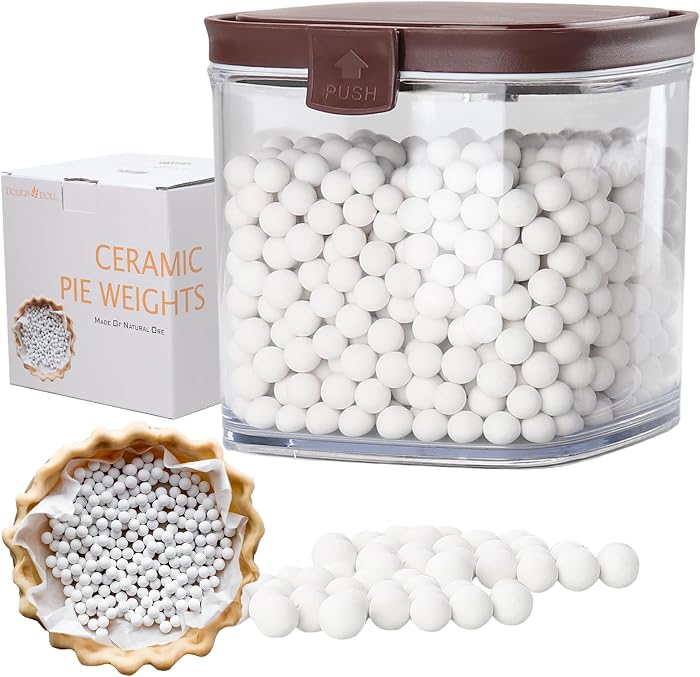
Dough&Doll Ceramic Pie Weights Best Storage Container

Dough&Doll Ceramic Pie Weights – 2 Pounds Ceramic Pie Crust Weights Pre-Washed for Baking Quiche Tart Natural

Sealed pantry storage

Our Score 93/100
Weight
2 lb
Container
1.1 L sealed jar
Heat Rating
200 °C
Bead Diameter
10 mm
View on Amazon

The jar is the whole idea here. It is a 1.1-liter sealed canister, about 38 ounces of volume, with a lid that comes off one-handed. That sounds like a small thing until you are holding a hot pie plate in the other hand and need somewhere to put two pounds of ceramic.

Inside sit 2 pounds of 10 mm beads, pre-washed so you can bake the afternoon they arrive. Two pounds is the right amount for a 9- or 10-inch shell: it fills a deep pan without leaving the top edge of the crust unweighted, and the beads are uniform enough to spread evenly instead of stacking up in the middle of the plate.

The number to respect is 200 °C, roughly 392 °F, which is below the 425 to 450 °F most blind-bake recipes call for. Keep the oven at or under 400 °F while these are in the shell. Work inside that limit and this is the set that makes blind baking feel tidy: fill, bake, pour back, one hand each time.

Worth Noting

  • Storage lid is the weak point
Our Verdict

Buy this one for the jar: a 1.1-liter canister you can open with one hand, filled with 2 pounds of pre-washed beads and a heat ceiling to watch.

Check Latest Price
5

FurRain Ceramic Pie Weights Best for Tarts and Small Pans

FurRain Ceramic Pie Weights – Ceramic Pie Weights Reusable 10mm Baking Beans Pie Crust Weights Natural

Tarts and small pans

Our Score 92/100
Weight
1.2 lb
Container
Wheat straw tub
Heat Rating
480 °F
Bead Diameter
10 mm
View on Amazon

The container is what sells this one: a wheat-straw tub with a lid that closes flush and walls thick enough that a hot pour does not warp anything. It is the kind of packaging you keep using after the beads are in it, which is not true of the pouch-and-nothing sets.

The beads are 10 mm ceramic rated to 480 °F, uniform enough that they settle into the flutes of a tart pan instead of bridging across them. At 1.2 pounds this is a set for small work, and for small work it is genuinely good: a 6-inch pan, a tray of tartlets, a shallow quiche.

New beads carry a chalky film, which the maker says plainly, so rinse and dry them before the first bake. After that there is nothing to manage. They rinse clean in under a minute, they dry fast, and the tub closes on the way back to the shelf.

Worth Noting

  • Costs more per pound than the big sets
Our Verdict

A good small set: the wheat-straw container is sturdier than most, and 1.2 pounds is right for tarts and 6-inch pans, though it will not fill a standard shell.

Check Latest Price
6

MOBYKE Ceramic Pie Weights Best for Baking Two Pies

MOBYKE Ceramic Pie Weights – 2.2 LB Ceramic Pie Weights

Baking two pies

Our Score 91/100
Weight
2.2 lb
Storage
Sturdy box
Material
Natural ceramic
Heat Rating
480 °F
View on Amazon

Holiday math is the reason to look at this one. Two boxes put 4.4 pounds of ceramic in your kitchen for a little less than one bag of the premium stuff, which is enough to line two 9-inch shells and get both in the oven at once instead of baking pies in shifts.

Each box is 2.2 pounds of natural ceramic rated to 480 °F, with beads uniform enough to spread evenly across a crust. The box is a plain tub rather than a thick canister, but it closes, it stacks, and 2.2 pounds is one full 9-inch pie with no arithmetic required.

We put this a half step behind the ROCKSHEAT set for two reasons that will not reach most bakers: a lower heat ceiling and humbler packaging. At a 425 °F blind bake neither one matters, and two boxes still come in under two canisters of the top pick.

Worth Noting

  • Plain tub instead of a thick canister
Our Verdict

Two of these boxes give you 4.4 pounds for two shells at roughly the price of one premium bag, which is the sensible way to cover a holiday bake.

Check Latest Price
7

Mrs. Anderson's Ceramic Pie Weights Best for Tartlet and Mini Pans

Mrs. Anderson's Baking Ceramic Pie Crust Weights

Tartlet and mini pans

Our Score 90/100
Weight
8 oz (135 beads)
Material
Ceramic stoneware
Container
Reusable tub
Heat Rating
480 °F
View on Amazon

A hundred and thirty-five beads in a tub looks like plenty until you pour them into a 9-inch plate. At 8 ounces the box covers the base of a standard shell and leaves the sides well short of weighted, so the honest way to buy this set for pies is two boxes at once.

As beads, they are fine. Ceramic stoneware, food safe, rated to 480 °F, small enough to work into the corners of a fluted tart pan, and quick to rinse. The tub stores them tidily on a shelf, which is more than the bagged sets offer.

The lid does not lock down once it has been opened, so plan on a jar or a heavy zip-top bag for storage. And these are the beads on this list most likely to chip or flake after a few trips through the oven, so run a hand through them before each bake and retire any bead that has lost its surface.

Our take: this is the box to buy for tartlets, mini pies, and a 6-inch pan, where 8 ounces is exactly right and two boxes would be waste. For the Thanksgiving pie, put the money into a full-size set instead.

Worth Noting

  • Beads can chip and flake over repeated bakes
Our Verdict

Buy it for tartlet pans and mini shells, or as a cheap way to try blind baking — one box is about half of what a 9-inch pie needs.

Check Latest Price
8

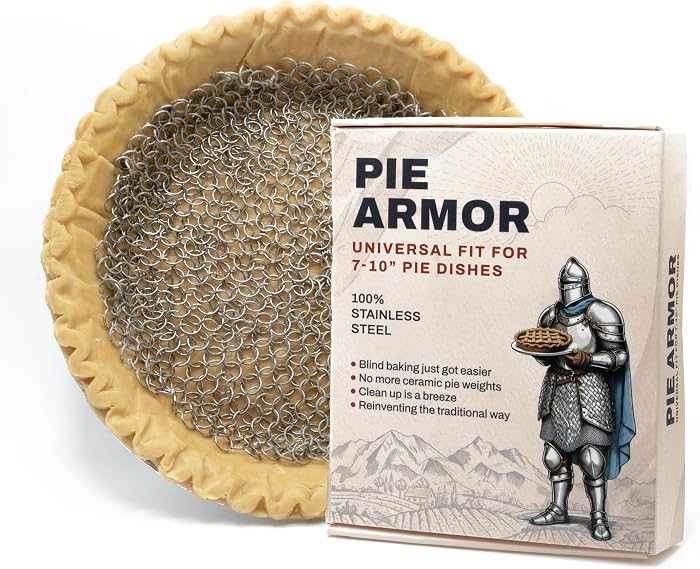
Pie Armor Stainless Steel Pie Weight Best for No Loose Beads

Pie Armor Stainless Steel Pie Weight

No loose beads

Our Score 89/100
Fits
7 to 10 inch pies
Weight
4.96 oz
Material
304 stainless steel
Heat Rating
800 °F
View on Amazon

There is nothing to pour with this one. Pie Armor is a single round of 304 stainless mesh that drops into the shell, presses the dough flat, and lifts out in one piece. No parchment sling, no beads chasing each other across the counter, no stray bead under the stove for a month.

The practical case is strong. It is dishwasher safe, rated to 800 °F, stores in a box about the size of a saucer, and comes away from a crust without tearing it. It is also the one weight here that never needs rinsing before a bake, which is why it gets used on a Tuesday.

The catch is weight: just under 5 ounces of steel, which presses the base but does little for the sides of a deep or fluted shell. The sides are the part that slumps, and a flat disc does not reach up them. In a shallow plate or a quiche, where the base is the whole battle, that is a fair trade.

So we recommend it for shallow pies, quiche, and anyone who has quietly stopped blind baking because of the mess. Keep a bag of ceramic in the cupboard for the deep-dish apple pie and use this one for everything else.

Worth Noting

  • Will not hold a deep, fluted shell
Our Verdict

The one-piece option to choose when loose beads drive you up the wall — just don't expect it to hold the sides of a deep tart.

Check Latest Price

How We Tested Pie Weights

We started with about 30 sets sold at every price from impulse buy to small splurge, then cut the list by three practical questions: how much usable weight you actually get, whether the beads are small enough to pack into the corners of a tart shell, and whether the set comes with something you can pour them back into. That left 14 sets, which we baked with for three months — long enough to run each one through repeated quiches, tarts, and single-crust pies, plus a deep-dish apple pie that used every bead in the house.

First I weighed each set on a kitchen scale, since that label number is a claim until you check it, and then measured bead diameter with calipers and noted how well the small ones settled into the flutes. Every set went into the oven twice: once under parchment, once straight onto the dough. Afterward I looked for dimples in the crust, beads stuck to the surface, and any puffing along the bottom or up the sides. The stainless disc got its own round of testing, because a solid round covers the base fast but can't press into a corner the way loose beads can.

Cleanup sorted the group more than I expected. Beads that had baked against bare dough came out tacky, so each set went into a colander under warm water, and I noted which ones rinsed clean and which needed a soak. I dropped a handful onto a tile floor to see which chipped, checked that jars and bags sealed and held the full set with room to scoop, and compared price by usable pound rather than sticker.

How to Choose Pie Weights

Count in pounds, not beads

A recipe assumes you will fill the shell to the rim, and that takes close to two pounds of ceramic for a standard 9-inch plate, more for a deep dish. A 135-count box sounds generous until you weigh it: that is 8 ounces, roughly half a shell. Before you check out, find the weight in pounds and ask whether one container covers the pan you bake in most often.

Two smaller boxes can beat one large one on price, and a second set is genuinely useful when you want two pies in the oven on the same morning. Buying by the pound rather than the bead count is the single decision that separates a smooth bake from a crust that slumps at the rim.

Beads or a one-piece weight

Ceramic beads, often sold as baking beans, conform to whatever shape you press them into, which is why they are the only style here that supports the fluted sides of a tart pan and the crimped rim of a pie. The cost is fiddliness: parchment first, then a careful pour, then lifting hot beads out afterwards.

A one-piece mesh or silicone disc skips all of that and lifts out clean, but it presses mostly on the base. If your crusts slump at the sides rather than puff at the bottom, beads are doing the work you actually need.

Match the heat rating to your recipe

Most blind bakes run at 425 to 450 °F, so a 480 °F rating is the practical floor and anything above it is headroom. Read the number before you buy. A listing capped at 200 °C, about 392 °F, means keeping the oven cooler than the recipe asks, which changes your browning.

Ceramic is dense enough to stay in contact with the dough as it sets, which is why a weighted crust browns more evenly than an empty one. Ratings above 550 °F mostly buy peace of mind for very hot ovens.

Storage and cleaning decide how often you use them

Beads come out of the oven hot, so the container matters: a thick-walled canister or a sealed jar takes a warm pour, a thin tub or a bag does not. Plan on hand washing and thorough drying, since damp beads cake together and pick up whatever is on the shelf beside them.

New ceramic carries kiln dust, so rinse and dry before the first bake. And keep them out of the sink — a handful of 10 mm beads and a garbage disposal are a bad combination.

Frequently Asked Questions

Final Verdict

For most bakers, the ROCKSHEAT set is the one to buy: 2.2 pounds fills a deep 9-inch shell, the 600 °F ceiling outlasts any recipe you will throw at it, and the canister holds hot beads without drama.

If you bake in a 10-inch deep-dish plate, step up to the Jefferson Street bag for the extra weight. If you are spending as little as possible, the Sukh set gets you nearly two pounds and asks you to supply your own jar.