Best Pasta Extruders of 2026

A pasta extruder doesn't roll dough flat and cut it — it pushes a stiff dough through a metal die, which is why bucatini comes out with a hole in the middle and rigatoni comes out ridged enough to hold sauce. That one mechanism explains most of what separates a machine you'll love from one that ends up in a cabinet: how hard the auger has to work, how warm the dough gets on the way through, and whether the die clogs halfway through a batch.

Over eight months, we ran 12 extruders — stand-mixer attachments and standalone countertop machines both — through Sunday batches, weeknight dinners for two, and one dinner party for six. The pattern was clear: the extra discs a machine brags about matter far less than whether swapping them takes a quick twist or a genuine fight. Extruded dough also wants to be drier than rolled dough, so expect to adjust flour by feel the first few times, no matter which model you buy.

The picks below earned permanent counter space, judged on pasta quality, cleanup, and the honest test of whether we wanted to make another batch just for fun.

Our Top Picks

The 5 Best Pasta Extruders of 2026

1

KitchenAid Gourmet Pasta Press Best Overall

KitchenAid KSMPEXTA Gourmet Pasta Press Attachment for Kitchenaid Mixers

Hollow shapes, weekly

Our Score 93/100
Shapes
Spaghetti, bucatini, rigatoni, fusilli, and two macaroni sizes
Mixer Fit
All household KitchenAid stand mixers
Pasta Discs
6 quick-change
Dishwasher-safe Parts
Auger, pasta ring, cleaning tool
View on Amazon

Hollow shapes are the reason to own an extruder at all. A roller gives you sheets, and sheets become tagliatelle or lasagna; it can't push dough around a central pin to make bucatini, or form rigatoni with a tunnel that fills with sauce. The KitchenAid Gourmet Pasta Press handles six shapes — spaghetti, bucatini, rigatoni, fusilli, and large and small macaroni — on quick-change discs, driven by a mixer that's already bolted to your counter. For a KitchenAid owner, we think that combination makes it the default recommendation here.

The design details are the kind you notice on the second batch. A built-in wire cutter swings across the die face, so you cut pasta to length as it emerges instead of hunting for a knife with dough on both hands. The discs, dough pusher, and stainless steel cleaning tool all live in a fitted case, which keeps the small parts out of the utensil drawer. The auger, pasta ring, and cleaning tool are dishwasher safe, and at 2.7 pounds and 10.3 inches tall the whole thing stows in a cabinet.

Two things temper the enthusiasm. The mixer turns slowly for extrusion, so a batch takes patience and the machine whines while it works — this is not a fast route to dinner. And dough sets hard inside the die holes, so rinse the discs and the auger the moment you finish and use the cleaning tool while everything is soft; left until morning, it becomes a soak. Clean as you go and the attachment earns its cabinet space.

Worth Noting

  • Slow, noisy extrusion; a batch takes patience
  • Priced well above the budget attachments here
Our Verdict

If a KitchenAid stand mixer already lives on your counter, we think this is the extruder to buy: six useful dies, a built-in cutter, and a case that keeps every part together.

Check Latest Price
2

Philips 7000 Series Pasta Maker Best for Big Batches

Philips 7000 Series Pasta Maker

Feeding a crowd

Our Score 87/100
Weight
20 lb
Capacity
Up to 8 portions
Cycle Time
Under 10 minutes
Pasta Discs
8
View on Amazon

No stand mixer on the counter? This is where extrusion starts. The Philips 7000 mixes and kneads the dough in its own chamber, then pushes it through one of eight discs, so there's no separate dough batch, no hub to match, and no second appliance involved. Philips puts a cycle at under 10 minutes and a batch at up to eight portions, which is a different scale from the attachments here.

What we appreciate most is how much judgment it removes. Pasta dough fails on hydration, and this machine kneads to its own resistance instead of asking you to feel whether the dough is stiff enough. Set it going and a smooth, evenly formed batch is waiting when the sauce is ready. Comparing the two approaches, we found the fully automatic version easier to live with on a weeknight — nothing to feed by hand, nothing to catch as it comes.

The trade-offs are physical and financial. It weighs 20 pounds and stands nearly 13 inches tall, so it claims permanent counter space rather than a cabinet shelf, and cleanup means disassembling several pieces — though the non-stick, dishwasher-safe parts do most of the work for you. It's also the most expensive machine in this group. A unit that arrives dead or quits early is the failure worth planning around, so buy where returns are easy and register the warranty.

Worth Noting

  • Twenty pounds of permanent counter space
  • Most expensive machine in this group
Our Verdict

The machine for a household with no stand mixer and a full table: it kneads and extrudes on its own, in batches big enough for a dinner party.

Check Latest Price
3

HOZODO Pasta Press Attachment Best Budget

HOZODO Pasta Press Attachment – Gourmet Pasta Press Attachment for KitchenAid Stand Mixers

Low-cost first extruder

Our Score 86/100
Weight
2.9 lb
Material
Metal and plastic
Mixer Fit
Most KitchenAid stand mixers
Pasta Discs
7
View on Amazon

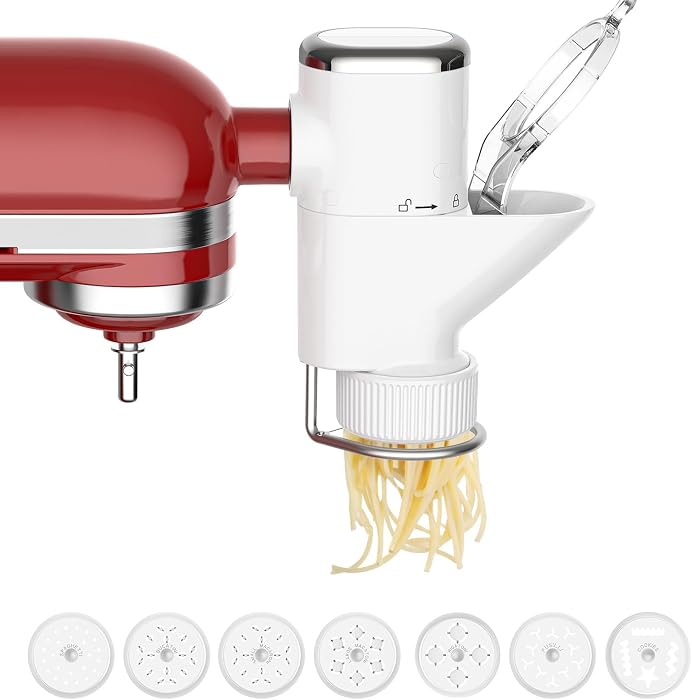
The budget versions of KitchenAid's extruder photograph identically, so what separates them is what happens after the first month. HOZODO's runs seven plates to KitchenAid's six, adds a cutter and a pusher bar, and packs the plates into a case of its own, all for a fraction of the branded press. We think it's the sensible buy for anyone who wants the shapes without the outlay, provided you go in knowing the plastic press parts are the weak point.

In use it's plain and direct. The plate turns onto the body, the mixer drives the auger, and pasta emerges with the cutter riding along the die face. The case earns its place — seven loose plates are exactly what disappears into a drawer. Cleaning surprised us: the removable parts brush out, and dried pasta lifts off these plates without much effort, which is more than we expected at this price. The body only takes a damp wipe, so the rest is hand washing.

Stiffness is where it gets fussy. Dough that's soft or wet backs up inside the body instead of passing through the plate, and the shapes come out smeared; keep it drier than feels right. The plastic press pieces also crack for some buyers, which is the risk the low price buys you. Keep the dough stiff and rinse the plates before the dough sets, and the cost stops being the main thing you notice about it.

Worth Noting

  • Plastic press parts can crack with use
  • Soft dough backs up inside the press
Our Verdict

We think this is the budget attachment to buy if you want seven plates and a storage case without paying for the KitchenAid name — just know the plastic press parts are the gamble.

Check Latest Price
4

Philips Viva Compact Pasta Maker Best for Small Households

Philips Kitchen Appliances Compact Pasta and Noodle Maker

Couples and small kitchens

Our Score 85/100
Weight
13 lb
Batch Size
2 to 3 servings
Cycle Time
18 minutes
Pasta Discs
3
View on Amazon

Eighteen minutes is the claim, and the machine's shape is why it's plausible: the Viva kneads the dough in the same chamber that extrudes it, so there's no transfer to a bench, no flour everywhere, no rolling. Flour and liquid go in the top, you choose a disc, and a nest of pasta comes out the front. At 13 inches long and 5 inches wide it holds a narrow strip of counter, and the three discs store inside the body.

Spaghetti, penne, and fettuccine are the discs, and the penne is the one that justifies the machine, because a roller can't make it. The double-extrusion design gives the pasta a smooth skin, and the taste is the strongest thing about it — tender, and plainly different from anything dried. Flour, egg, and purées such as spinach or carrot all run through the same chamber, so flavored pasta is a matter of what you put in the top.

Three discs is also the ceiling, and we rank that as the real cost: no rigatoni, no bucatini, no fusilli. The dough is less forgiving than the machine's simplicity suggests, too — weigh the flour and follow the included recipe rather than improvising, or a wet batch stalls the mixing arm. Machines that quit within a few months are the failure worth hedging against, so register the warranty and keep the receipt.

Worth Noting

  • Only three shapes; no rigatoni or bucatini
  • About 13 pounds despite the compact body
Our Verdict

A narrow, self-kneading machine that turns out two or three servings of genuinely good pasta, though its three discs stop short of the shapes that make extrusion worth owning.

Check Latest Price
5

InnoMoon Pasta Press Attachment Best for Tight Storage

InnoMoon Gourmet Pasta Press Attachment for KitchenAid Stand Mixers

Tight storage

Our Score 83/100
Weight
3 lb
Material
Plastic with stainless steel blades
Mixer Fit
KitchenAid stand mixers
Pasta Discs
7
View on Amazon

The risk with any budget attachment is that the plastic gives out before the novelty does, and that's the question to ask of InnoMoon's version. The body is the most compact of the mixer-driven presses here, 6 inches long where the HOZODO runs more than 9. Seven plates, a cutter, a pusher bar, and a plate box come in the package, and the plates turn onto a KitchenAid hub the same way the others do.

We rank it behind the HOZODO at the same money. Both run seven plates and both store them properly, but durability is the weaker story here — the plastic press parts are where these attachments fail, and this one has the shakiest record of the three. What it offers instead is size, and in a kitchen where the gadget drawer is already full, a body three inches shorter is a real argument.

Everything else is the standard budget-press experience: the knob turns to load, the plates are the same family of design as the others, and the pasta comes out looking like pasta from any of them. Keep the dough stiff and the cutter close to the die face. What's genuinely smaller is the box it comes in, and for some kitchens that's the whole argument.

Worth Noting

  • Shakiest durability record among these attachments
  • Hand-wash only; body cannot be submerged
Our Verdict

Worth a look only if cabinet space decides it for you: this is the shortest press body here, but it also carries the shakiest durability record of the attachments.

Check Latest Price

How We Tested 12 Pasta Extruders, Batch After Batch

We started with a long list of everything on the market and split it into two camps: attachments that run off a stand mixer you already own, and standalone machines that mix and extrude on their own. From there we cut anything with fewer than three dies, a thin auger, or a price out of step with what it delivered, which left 12 units. Eight months later, most of them were still earning counter space.

Testing happened where pasta actually happens — a small kitchen on Sunday afternoons, a weeknight dinner for two, and one dinner party where we fed six people from a single batch. For each machine, we weighed flour and water exactly as the manual specified, then noted whether the dough came out crumbly, gummy, or just right, and how much correction it took. We timed every run from switch-on to the first strand, and swapped each disc at least twice, counting the steps involved.

Then we cooked and ate. Every shape went into salted boiling water so we could see whether it held its shape, turned mushy, or clumped together, and we tasted batches side by side to compare texture and flavor. Cleanup got equal attention: we checked how much dough hid inside the die and around the auger, how long dried bits took to pick out, and which parts could go in the dishwasher.

Durability showed up over repeat runs — back-to-back batches on the same afternoon, listening for strain, watching for wobble, and tracking whether the twelfth batch came out as clean as the first. Fun counted too; we noted whether anyone volunteered for a second batch or asked to help. Value came down to simple math: how many discs we actually used, and how often we reached for the machine when nothing was being tested.

How to Choose a Pasta Extruder

Attachment or Standalone Machine?

It comes down to your counter. A stand-mixer pasta press weighs under 3 pounds, lives in a drawer or a fitted case, and borrows the mixer's motor; you feed the dough and cut it as it emerges. That's the KitchenAid press and the budget copies, and the trade is pace — the mixer turns slowly for extrusion, so a batch takes patience.

A standalone machine such as the Philips 7000 or Viva kneads the dough itself and extrudes faster, but it weighs 13 to 20 pounds and expects to stay out on the counter. If you own a KitchenAid and make pasta a couple of times a month, buy the attachment and spend the difference on flour.

Which Shapes You Actually Get

Extrusion earns its place with shapes a roller can't make: bucatini with a hole down the middle, rigatoni and macaroni that hold sauce inside the tube, fusilli with its twists. Count the discs, then check that yours are among them. The KitchenAid press covers six of the most useful, the budget attachments run to seven, and the Viva stops at spaghetti, penne, and fettuccine — fine if those are what you cook.

A big plate count doesn't mean speed, since small dies like spaghetti extrude slowly. If baked mac and cheese from scratch is the goal, confirm there's a macaroni die before you order.

Dough Consistency Beats Any Feature

Extruders want a stiff, dry dough — noticeably drier than what you roll by hand. Wet dough smears instead of forming, clogs the die, and stalls the cycle, and most trouble with slow output or pasta that won't hold its shape comes back to hydration. Start from the maker's recipe, weigh the flour instead of scooping it, and add liquid a spoonful at a time until a pinch holds together without sticking to your palm.

An automatic machine is more forgiving because it kneads to its own resistance, but no machine rescues a dough that is already too wet.

Cleaning Is the Real Cost

Dough sets inside the die holes within minutes, and once it has, a brush barely touches it. Rinse the discs and the auger the moment you finish, while everything is soft, and keep the cleaning tool by the sink rather than in the case. That ten minutes decides whether an extruder gets used weekly or ends up at the back of a cabinet.

Check what can go in the dishwasher before you commit. KitchenAid rates its auger, pasta ring, and cleaning tool as dishwasher safe, while several of the budget presses allow only a damp wipe on the body and hand washing for the rest.

Match Capacity to Your Table

The Viva tops out around 2 to 3 servings, which suits two people with lunch leftovers. The 7000 promises up to eight portions in a single cycle, and that's the machine for a family or a dinner party. Attachments sit in between: you make a couple of batches rather than one big one, but you're never waiting on a machine to knead. Portion claims assume a serving size, so halve them when you're feeding teenagers.

Frequently Asked Questions

Final Verdict

For anyone with a KitchenAid stand mixer already parked on the counter, the KitchenAid Gourmet Pasta Press is the extruder to buy. Six discs cover the hollow and twisted shapes a roller can't produce, the wire cutter and fitted case keep the workflow tidy, and the fit is guaranteed across household KitchenAid mixers. Rinse the dies while the dough is soft and cleanup stops being a deterrent.

Without a mixer, the Philips 7000 is the better machine: it kneads and extrudes on its own and handles a dinner party in a single cycle. The Viva does the same job sized for two, and the HOZODO is the budget route to seven plates — provided you keep the dough stiff and accept plastic parts that may not last.