Best Pasta Drying Racks of 2026

Fresh pasta night starts joyful and ends with fettuccine draped over chair backs, the oven door handle, and one very patient broom. A drying rack fixes that: every strand gets its own place to hang, so the pasta dries evenly instead of clumping into a sticky nest, and your kitchen becomes a kitchen again.

The racks look nearly identical online and behave very differently on the counter. Over four months, my team and I assembled, loaded, folded, and stored 14 of them, from bare-bones plastic trees to beechwood ones with rotating arms, and the gap between a rack that holds steady under a full batch and one that tips at the fourth strand is enormous. A cheap rack that wobbles is no bargain, and neither is a sturdy one that needs a manual and ten minutes to set up.

Arm count turned out to be the least useful number on the box. Arms crammed close together dry slower than fewer, better-spaced ones, and a rack that doesn't fold flat ends up living on the counter forever. Below are the ones that earned their space.

Our Top Picks

The 8 Best Pasta Drying Racks of 2026

1

KITCHENDAO Stainless Collapsible Rack Best Overall

KITCHENDAO Collapsible Pasta Drying Rack

Everyday batches

Our Score 96/100
Arms
8 rotating rods
Storage
Fits in a drawer
Capacity
6 lb
Material
Stainless steel
View on Amazon

The arms rotate, and once you've loaded a rack that does this you notice the ones that don't. You drape a strand, turn the ring a quarter, and the next one goes onto a clean rod instead of swinging into the pasta you just hung. Eight stainless rods and a listed six-pound capacity put a full batch of fettuccine on in a couple of minutes, and the frame doesn't shift while you work.

Getting it out of the way is the other half of the pitch. The legs fold up, the arms come off, and the whole thing turns into a bundle you can put in a drawer — nothing to lose, no box to keep track of. Setup takes seconds and needs no tools, and the arms detach for washing, which matters more than it sounds: dried dough is far easier to remove from a rack that comes apart than from one that doesn't. The included wand earns its place too, lifting cut strands off the machine and onto the rods without a floured tray in between.

What you give up is wood. Stainless doesn't warm up a kitchen the way beech or bamboo does, and this isn't a rack you leave out as decoration. It's also eight rods against twelve on the 8SOM, so an unusually big batch goes on in two rounds. For most households one batch is dinner, and we think the drawer-friendly shape wins that argument.

Worth Noting

  • Costs more than the plastic folding racks here
Our Verdict

We recommend it as the default rack: six pounds of capacity, arms that spin to load, and a folded bundle that fits in a drawer.

Check Latest Price
2

Eppicotispai EP 102 Beechwood Rack Best Wood

Eppicotispai EP 102 Natural Beechwood Collapsable Pasta Drying Rack

Wood lovers

Our Score 95/100
Material
Beechwood
Folded Size
12 x 14.25 x 1 in.
Drying Space
More than 10 square feet
View on Amazon

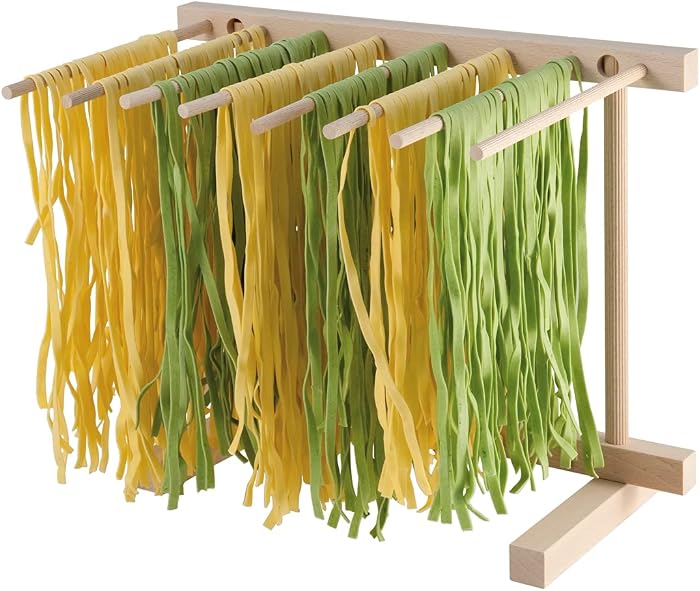
Folded, the EP 102 is about an inch thick. That's a different kind of storage from racks that come apart into a post and a handful of dowels: we stand it on edge behind the stand mixer, and it takes up less room there than the flour canister does. It opens into a beechwood frame with more than ten square feet of hanging space, and it's the least expensive wood rack here.

The wood is the reason to pick it. Beech takes on a patina instead of looking worn, the frame reads as a kitchen tool rather than a gadget, and there's no plastic to yellow. It's light enough to move with one hand and wipes clean after a session, and the ten square feet of pegs swallow a batch for six without crowding.

The catch is that a light frame full of wet pasta has to be loaded with a little sense. Fill one side and it has less resistance than the heavier wooden racks; alternate sides as you go, keep it away from the counter edge, and it sits still while you work. Do that and this is the best-looking rack in the group and the flattest to put away.

Worth Noting

  • Tight gaps between pegs for wide ribbons
Our Verdict

Buy it for real wood, ten square feet of drying space, and an inch of storage — just load both sides evenly.

Check Latest Price
3

Norpro Wood Pasta Drying Rack Best for Long Strands

Norpro Pasta Drying Rack Wood

Long strands

Our Score 94/100
Arms
8, from four 18-in. dowels
Base
7/8-in. thick
Height
16.5 in.
Material
Rubberwood
View on Amazon

Sixteen and a half inches tall, with four 18-inch dowels pushed through the center post to make eight arms, the Norpro gives long pasta somewhere to go. Fettuccine and linguine hang clear of the counter instead of coiling into a nest at the bottom, and the 7/8-inch base has enough mass to stay upright while you load it. Height plus a base with some weight behind it is the combination we look for first, and it's why this is our rack for long strands.

Assembly is four dowels into a post, by hand, and breakdown is the same in reverse — under a minute either way, and the pieces go back in the box it arrived in. The design hasn't changed in decades because there isn't much to improve.

Eight arms carry pasta for four or five servings comfortably, which is a family dinner and not much more. If you make pasta once a month, that's more rack than you need; if it's a Sunday habit, the extra height is worth more than another arm or two on a shorter frame.

Worth Noting

  • Dowels can pull out under a heavy load
  • Unfinished wood needs wiping, not washing
Our Verdict

Our pick for long pasta: 18-inch dowels, a heavy base, and a rack that breaks down into its own box.

Check Latest Price
4

Marcato Tacapasta Drying Rack Best Splurge

MARCATO Tacapasta Pasta Drying Rack

Counter appeal

Our Score 93/100
Capacity
4.4 lb
Material
Aluminum
Dimensions
12 x 4 x 22 in.
Removable Rod
Included
View on Amazon

The Tacapasta costs more than any wooden rack here, and the money goes into the folding: the arms open and close like a fan in one motion, with nothing to take apart and nothing to lose. It's aluminum, it's red, and of everything in this group it's the rack most likely to be left out on the counter on purpose.

The removable center rod is what justifies the price. Slide it out, catch strands on it as they come off the machine, carry them to the rack, lay them down — no lifting a tangled handful of fettuccine across the kitchen. We found moving a batch with the rod noticeably calmer than doing it by hand, and the pasta arrived on the arms separated rather than stuck together.

Its listed capacity is 4.4 pounds, under the six the stainless KITCHENDAO handles, and the arms fold down flat rather than coming apart, so storage is a flat stack instead of a drawer full of loose rods. Neither is a reason to talk you out of it.

Worth Noting

  • Costs more than any wood rack here
Our Verdict

Worth the splurge if you make pasta often: the removable rod alone changes how a batch gets from machine to rack.

Check Latest Price
5

8SOM Bamboo Pasta Drying Rack Best for Big Batches

8SOM Bamboo Pasta Drying Rack – Bamboo Pasta Drying Rack with Transfer Wand and 12 Bars

Double batches

Our Score 92/100
Arms
12 bars
Material
Moso bamboo
Assembled Size
16 x 12 x 12 in.
Collapsed Size
12.5 x 4.5 x 2 in.
View on Amazon

Thirteen pounds is the listed capacity, and no other rack here makes a claim that size. Twelve bamboo bars, each set at an angle so strands don't creep forward, plus a transfer wand — on paper this is the rack for someone who makes pasta by the afternoon rather than by the plate.

The realistic load is two batches of noodles side by side, which is still more than most of this group manages. The wand works the way the Marcato's rod does: catch the strands as they leave the machine, carry them over, lay them down, and nothing tangles on the way. Bamboo keeps the whole thing at a pound, light enough that we shift it one-handed while it's loaded.

Two things to know before you order. The pegs need a firm push to seat and a firm pull to come out, and their ends are where the finish wears first. And although it collapses to 12.5 by 4.5 by 2 inches, it's happiest stored with the bars in — pull them every time and putting it away becomes a chore. Give it a shelf and it's the highest-capacity bamboo rack here.

Worth Noting

  • Pegs take a firm push to seat and remove
  • Wants shelf storage rather than a drawer
Our Verdict

Choose it for volume: twelve bars and a wand handle a double batch, as long as you have a shelf to store it on.

Check Latest Price
6

KITCHENDAO Plastic Collapsible Rack Best Budget

KITCHENDAO Collapsible Pasta Drying Rack

Tight budgets

Our Score 91/100
Capacity
5 lb
Cleaning
Dishwasher safe
Material
Food-grade plastic
Dimensions
17.28 x 11.97 x 11.77 in.
View on Amazon

This is our top pick's idea in plastic, and the differences are the ones the material suggests: a lighter frame, five pounds of listed capacity instead of six, and a build we're happy to hand to a kid or lend to a friend without a speech about the finish.

What it adds is the dishwasher. None of the wooden racks here can go in the machine, and the stainless one is a hand-wash job; this one comes apart, rinses, and goes in the rack, which is the difference between a drying rack you use every week and one that stays in the drawer because cleaning it is a chore. It folds flat enough for a utensil drawer, sets up in about fifteen seconds, and the arms rotate so a batch goes on quickly.

Five pounds is the honest limit — a double batch goes on in two rounds — and it takes roughly 17 by 12 inches of counter when it's open, about the same as the stainless version. Neither number is a problem in a normal kitchen; both matter if you're working beside a stand mixer on a narrow counter.

Worth Noting

  • Holds five pounds, one less than the stainless version
Our Verdict

Our budget pick: dishwasher-safe, drawer-sized, and quick enough to set up that you'll actually use it.

Check Latest Price
7

KitchenAid KPDR Pasta Drying Rack Best for Small Kitchens

KitchenAid KPDR Pasta Drying Rack Attachment

Small kitchens

Our Score 90/100
Storage
Folds flat
Capacity
4 lb
Material
Plastic
Warranty
1 year
View on Amazon

If counter space is the reason you haven't bought a rack, the KPDR is aimed at you. The legs retract and the arms fold in, and what's left slides into a cabinet or stands in the gap beside the refrigerator — closed, it's barely there at all.

Open, it takes four pounds on arms set at a slight angle so strands don't creep forward. At 1.2 pounds it's roughly twice the weight of the cheapest plastic racks here, and that extra material sits in the base, which is the part that decides whether a rack stays where you put it.

Four pounds is the ceiling, and it's the number to think about: a batch for four fits, a double batch doesn't. Cleaning is a wipe or a rinse in place, and the pale silver finish shows flour, so it's worth doing before the dough sets.

What you're paying for is the folding mechanism, and it's done properly — retracting legs, nested arms, no loose parts to lose between batches.

Worth Noting

  • Most expensive here, and it holds only four pounds
Our Verdict

The one to buy when storage is the constraint: four pounds of capacity in a package that folds into a cabinet.

Check Latest Price
8

Ourokhome Collapsible Pasta Drying Rack

Ourokhome Collapsible Pasta Drying Rack

First pasta machine

Our Score 89/100
Arms
10
Capacity
4 lb
Material
BPA-free plastic
Folded Size
7.8 x 3.5 in.
View on Amazon

Ten arms, four rubber feet, four pounds of pasta — and plastic arms with some give in them. Load the Ourokhome unevenly and the arms flex, which is the trade for a rack that weighs less than a pound and folds to the size of a paperback.

Setup is the fastest in this group. The arms and feet swing out by hand, there's nothing to assemble, and it's ready before the first strands come off the machine. Folded, it's 7.8 inches tall and 3.5 inches wide, small enough to live in a drawer with the rolling pin.

The rubber feet are the detail that earns it a place. On a smooth counter they keep the base from skating while you drape, which is more than some of the wooden racks here manage, and at this end of the market a rack that stays put is most of the battle.

For a first pasta machine or a household of two it's plenty: the arms have taken a four-pound batch every time we've loaded one, and the folded package is small enough to forget about. What it isn't is the rack for a family-sized batch every week; the arms are the part that gives, and a heavy load is where that shows.

Worth Noting

  • Arms flex and can crack under a heavy load
Our Verdict

We recommend it as a starter rack: ten arms, four pounds, rubber feet, and a folded size that fits in a drawer.

Check Latest Price

How We Tested These Pasta Drying Racks

We started by gathering every rack a home cook might realistically buy, folding and fixed, wood, bamboo, plastic, and stainless steel, running from ten arms up to sixteen. Anything that couldn't handle a standard two-pound batch, or that reviewers repeatedly called wobbly, was cut. That left 14 racks, which went through the same routine for four months.

Testing happened on real pasta nights, not a lab bench. We assembled each rack out of the box with a stopwatch running, then broke it down and did it again, since the rack you'll actually use is the one you can set up with flour on your hands. We hung a full batch of fresh cut pasta on each, loaded one side only to see whether it tipped, and pressed on the frame while it was full to check for flex. Racks claiming more capacity got a heavier batch, weighed before hanging, and we spun the rotating arms mid-dry to see whether they held position or drifted.

After every session we cleaned each rack the way a cook would, wiping wooden arms, pulling off the detachable ones, and rinsing plastic under the tap. Then we folded it, stowed it in a cabinet and a low drawer, and noted the footprint and whether anything snagged or sprang open. Over the months we watched for joints that loosened, wood that swelled or splintered after wiping, and arms that sagged under repeated weight; a rack stayed in the running only if it was still steady and still easy to put away at the end.

How to Choose a Pasta Drying Rack

Stability Comes Before Capacity

Wet pasta is heavier than it looks, and the moment the first strands go on, the weight sits off-center. A wide base, rubber feet, or a thick wooden slab all help, and a light frame with a small footprint needs you to load alternate sides rather than filling one arm at a time. Our habit is to hang a few strands, turn the rack or step around it, and keep the load balanced. If your counter is uneven or you'll be reaching past the rack while it's loaded, buy for weight down low.

That is the one number a folded-away rack can't tell you. Four pounds of dough hanging from one side of a 1-pound frame behaves nothing like four pounds spread evenly, so treat any folded weight or footprint as a storage fact and nothing more.

Height and Arm Length Set the Real Limit

Pounds are a rough guide. What actually decides how much pasta a rack takes is clearance: strands need to hang clear of the counter, and the racks here run from about 11 inches to 22 inches tall, with arms from roughly 8 to 18 inches. A tall rack with long dowels keeps fettuccine straight and separate; a compact drawer rack forces you to cut strands shorter or let them double over.

If you make long noodles, choose height and arm length first and count arms second. If your pasta is usually short shapes, a small rack is a better use of the drawer.

Where It Lives Between Batches

Storage style matters as much as capacity, because a rack you dread putting away stops getting used. There are three kinds here: fan-fold racks that flatten to an inch or two and slide behind an appliance, knock-down racks that come apart into a post and dowels and go back in their box, and self-contained racks that fold into their own body and drop in a drawer.

Decide which of those spaces you actually have before you fall for a design. A drawer-sized rack in a kitchen with no spare drawer is a rack that lives on the counter, and a 16-inch-tall wooden frame will not fit in the slot behind the coffee maker.

Material, Cleaning, and Upkeep

Unfinished wood is the friendliest surface for pasta to hang on and the fussiest to clean: wipe it with a damp cloth, dry it, and don't soak it, because water is what takes a wooden rack out of service. Plastic and stainless can be rinsed, and some plastic racks are dishwasher safe, which is the easiest upkeep in this group.

Whatever you buy, clean it while the dough is still soft. Dried flour paste is the hardest thing you'll ever ask a rack to give up, and peg holes are where it hides.

Frequently Asked Questions

Final Verdict

Buy the KITCHENDAO stainless rack if you want one rack that does everything: six pounds of capacity, arms that spin so a batch goes on quickly, and a folded bundle that drops into a drawer. Choose the Eppicotispai if the rack has to look like wood and store an inch deep, and the Norpro if long fettuccine is the whole point.

Spend more only for the Marcato, where the removable rod genuinely changes how pasta gets from the machine to the arms.