Best Olive Pitters of 2026

There's a reason so many cherry and olive pitters end up rattling around the back of a drawer. My first one jammed on a pit within a dozen cherries and shot juice across my shirt, and I went back to a paring knife for years. A pitter is supposed to pop the pit out in one squeeze, leave the fruit intact enough to bake or stuff, and keep the mess off your hands. That's a smaller ask than most of them actually deliver.

The mechanics are simple: a plunger pushes the pit through the fruit and out the other side. What separates the tools shows up on the second pound of cherries, when a dull plunger crushes, a stiff spring sticks, and the pit cup fills with flesh. I check three things before I'll keep one on the counter: whether the handles lock shut for storage, whether it handles olives as well as cherries, and whether it can go in the dishwasher. Three months and 14 pitters later, these are the ones I still reach for.

Our Top Picks

The 8 Best Olive Pitters of 2026

1

OXO Good Grips Cherry and Olive Pitter Best Overall

OXO Good Grips Cherry and Olive Pitter

All-purpose pitting

Our Score 95/100
Weight
4.8 oz
Body Material
Zinc
Pits Per Press
1
Splatter Shield
Removable
View on Amazon

The cup is what settles it for us. It is wide enough to swallow a fat Bing cherry and shallow enough at the center that a small olive sits down in it instead of skidding sideways when the rod comes down. That combination is rarer than it sounds, because most pitters here are good at one size and merely tolerant of the other. The splatter shield is a separate piece, which we count as a feature rather than a fuss: press it on for cherries, lift it off for olives, rinse it under the tap.

The shield is also the part that gives us trouble. It can work its way loose mid-bowl no matter how firmly you seat it, and then juice finds the gap. Our fix is to press it back down every dozen olives, or leave it off entirely when olives are the job, since they give up far less liquid than cherries. Nothing else about the tool needs managing. The body is zinc, the press runs smoothly through a full bowl, and the handles lock shut so it does not spring open in a drawer.

If your drawer is tight, the Westmark below is a third of the weight and half the footprint, and if splatter is what keeps you from pitting, the Cuisipro's guard wraps the fruit better. Otherwise this is the one we hand people, because the everyday case here is a handful of olives and a few cherries, and it handles both without a second thought.

Worth Noting

  • Small olives can jam a pit in the hole
Our Verdict

This is the pitter we point most buyers to: the cup takes olives and fat cherries, and the shield cuts the spray when you press.

Check Latest Price
2

Westmark Kernex Cherry Pitter Best Compact Metal Build

Westmark Cherry Pitter Tool “Kernex”

Compact precision work

Our Score 92/100
Length
6.5 in
Weight
1.6 oz
Material
Cast aluminum
Dishwasher Safe
Yes
View on Amazon

Half the footprint of our top pick and a third of the weight, the Kernex is 6.5 inches long and 1.6 ounces, which is the size of a pair of pliers rather than a kitchen gadget. It is one piece of cast aluminum with a powder-coated finish, made in Germany, and there is nothing on it to lose: no shield, no tray, no plastic collar to crack.

That small head is the trade-off, and it is why we rate it second rather than first for olives. A generous cup forgives a sloppy aim; this one does not, so you line each olive up over the hole and press. What you get in exchange is a press precise enough to save the fruit, with the rod going through the pit rather than the flesh, and hands that are not aching after a dozen. It is also the tool we came back to for small sour cherries, which rattle around in a wide cup.

It is dishwasher safe, backed for five years, and less expensive than our top pick, a fair trade for the smaller cup and the plainer finish. What you are buying is a single casting that will not change shape on you, which is the whole argument for metal in a job where the pit is harder than the tool.

Worth Noting

  • No splash guard for juicy cherries
Our Verdict

Buy this one if you pit a dozen olives at a time and want a metal tool that takes up almost no drawer space.

Check Latest Price
3

Cuisipro Cherry/Olive Pitter Best Splatter Control

Cuisipro Cherry/Olive Pitter

Juicy, messy fruit

Our Score 91/100
Cup
Silicone with flexible fins
Length
5.75 in
Warranty
25-year
Splash Guard
Extra long
View on Amazon

The front of this pitter is a scoop, and the cup behind it is lined with soft silicone fins. Together they do something none of the others here manage: you pick an olive straight out of the jar, set it in the fins, and press, without your fingers ever touching the fruit. The fins hold a small olive upright, which is exactly what you need when the pit is tiny and the rod has to find it. We think it is the smartest piece of design in this group.

The other half of that design is the splash guard, the longest of the pitters here and the one that does the most work. It wraps the fruit instead of sitting behind it, so juice that would otherwise cross the counter hits plastic and runs down. For a jar of olives before guests arrive, that is the difference between a quick rinse and wiping down the wall behind the cutting board.

It is the priciest pick in this guide and it has the most parts to rinse, since the cup and guard both come away. The counterweight is a 25-year warranty, which is the longest commitment anyone makes here. If you pit in a good shirt and hate the cleanup more than the price, this is the one.

Worth Noting

  • Joint can loosen when olives fight back
Our Verdict

Worth the extra money if splatter is what keeps you from pitting: the long shield and finned cup keep juice and olives where you put them.

Check Latest Price
4

Chef'n QuickPit Cherry and Olive Pitter Best Trigger Grip

Chef'n QuickPit Cherry and Olive Pitter

Small hands, light grip

Our Score 90/100
Length
4.7 in
Weight
1.44 oz
Operation
Trigger pull
Sharp Parts
None
View on Amazon

You squeeze this one like a staple gun instead of leaning on a plunger. The trigger does the work with your fingers rather than your palm, and at 4.7 inches and 1.44 ounces it disappears into a hand, including a small one. There is no sharp part anywhere on the tool, which is why we let a kid who wants to help work through a bowl of olives for a snack.

For olives it is quick and tidy: the pit drops out the bottom and the trigger springs back on its own, so you can work one-handed over a bowl without repositioning. The body is plastic throughout, though, and it is the least substantial thing in this group. We treat it as a light-duty tool that lives in a drawer and comes out for drinks and snacks rather than for a cherry marathon.

It is top-rack dishwasher safe, small enough to go in a picnic bag, and priced in the middle of this set. What we keep coming back to is the shape of the grip: nothing about it requires a strong hand, and that makes it the one we hand over without a warning.

Worth Noting

  • Large pits can jam the exit port
Our Verdict

The friendliest option for small hands and nervous parents: you squeeze rather than press, and there is no blade anywhere on it.

Check Latest Price
5

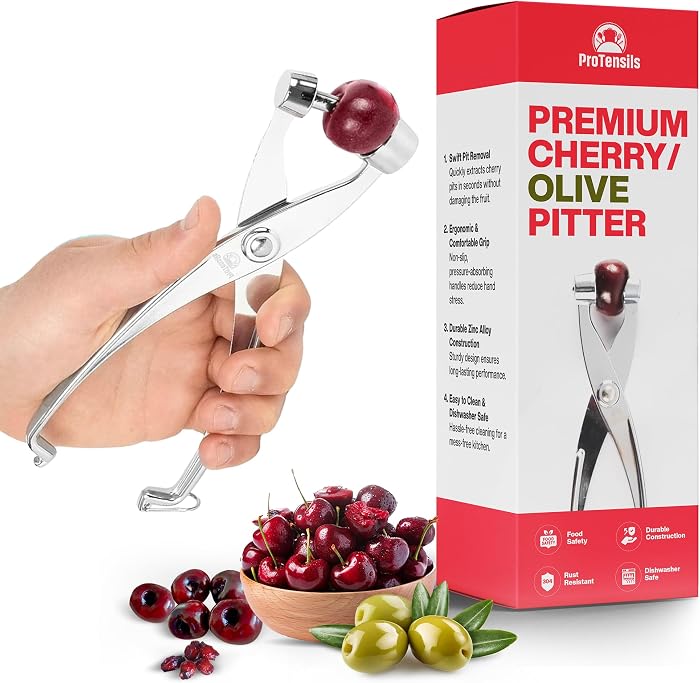
ProTensils Cherry Pitter Best for Long Sessions

ProTensils Cherry Pitter – Cherry Pitter Tool Pit Remover with Locking Mechanism

Long pitting sessions

Our Score 89/100
Length
5 in
Weight
6.3 oz
Handles
Non-slip, pressure-absorbing
Material
Zinc alloy
View on Amazon

This is the pitter for the person who says yes when a friend offers a bag from their tree. It is zinc alloy, 5 inches long, and about six ounces in the hand, heavy enough to feel like a tool and light enough that a couple of pounds of olives do not wear you out before the bowl is empty.

The handles are the detail worth paying for. They are wide, non-slip, and shaped to spread pressure across the palm instead of concentrating it in the web of your thumb, and the spring sits hidden inside the hinge where pulp cannot pack into it. The hinge itself has no play in it, which is the thing that usually tells you a pitter is on its way out.

Nothing about it needs managing: no shield to reseat, no tray to empty, no cup to pull off before it goes in the sink. We rate it the best of these for a marathon session on that basis alone. The 120-day return policy is unusually generous for a kitchen tool, and the polished finish wipes clean with a rinse rather than a scrub.

Worth Noting

  • Only one fruit per press
  • Very large pits need a second squeeze
Our Verdict

For a long afternoon with a bowl of olives, this all-metal pitter is the one we keep in reach: comfortable handles and no plastic to crack.

Check Latest Price
6

Leyespot Cherry Pitter Best Budget

Leyespot Cherry Pitter – Cherry Pitter

Tight budgets

Our Score 88/100
Length
7.87 in
Weight
4.6 oz
Material
Stainless steel, silicone, ABS
Locking Handle
Yes
View on Amazon

Cheap pitters are where plastic goes to die, so when we looked at the low end we looked for metal in the two places that matter: the rod and the seat. This one has a stainless push rod, a silicone cradle, and it is one of the least expensive tools in this guide. That combination is the reason it made the list at all.

It is also the longest of the handhelds at almost eight inches, which keeps your knuckles clear of the bowl and gives your whole hand something to wrap around. The press is light, with none of the grunting you get from a stiff spring, and the handle locks shut so it stores flat in a drawer that is already crowded.

What you give up is refinement, and at this price we can live with it. The body is a plain black-and-steel affair, the finish does not pretend to be anything else, and the whole thing goes in the dishwasher. For a first pitter, a spare for the camper, or a kitchen where the utensil drawer is already a negotiation, it is the buy that does not ask you to think twice.

Worth Noting

  • Tip can snap out of the handle under force
  • Some pits need a shake to clear
Our Verdict

A sensible first pitter: a metal rod and silicone cradle at the low end of the range, as long as you pit by the bowl rather than the bushel.

Check Latest Price
7

Yun River Cherry & Olive Pitter Best for Martini-Night Olives

Yun River Cherry & Olive Pitter – Cherry & Olive Pitter Tool

Martini-night olives

Our Score 87/100
Head
Larger cross-pitting head
Length
7.87 in
Weight
4.6 oz
Safety Lock
Yes
View on Amazon

The head is the detail shoppers skip past, and here it is the whole point. It is wider than most of the pitters in this group and cut with a cross-shaped opening, so a firm olive is held at several points while the rod comes down through the middle instead of dragging the fruit off-center. On brine-cured olives that means fewer torn shoulders and fewer pits left sitting on the rod.

The rest is budget-tool sensible. There is a locking latch so it does not spring open in the drawer, the body is slim enough to sit in a crowded utensil cup, and the whole thing is dishwasher safe. At 4.6 ounces and just under eight inches, it feels more solid in the hand than its price suggests, and the press runs light rather than stiff.

We also like that it does not try to be clever. No scoop, no fins, no tray: one olive goes in, the pit comes out, and you move to the next. That simplicity is why it survived our olive testing when more complicated cheap tools did not.

It earns a spot in the also-consider tier because the head holds a firm olive more securely than anything else at this end of the range, and because nothing about it is fussy: rinse, lock, drawer. For a household that pits a jar of Castelvetrano every few weeks, that is the entire job.

Worth Noting

  • Juice sprays sideways out of the cup
Our Verdict

A cheap, sturdy pitter whose wide head suits firm olives, which is exactly the job most people buying this tool actually have.

Check Latest Price
8

SCHVUBENR 7-at-Once Pitter Best for Big Cherry Batches

SCHVUBENR Cherry & Olive Pitter Tool

Big cherry batches

Our Score 86/100
Weight
8.8 oz
Material
Food-grade plastic, ABS prongs
Dimensions
5.1"L x 3.6"W
Pits Per Press
Up to 7
View on Amazon

Seven cherries at once is a party trick until you are standing over a flat from the farmers market with an hour of pitting ahead of you. Then the arithmetic changes: load the tray, press once, and seven pits drop into the cup below. That is the case this tool was built for, and on uniform, firm fruit it is genuinely faster than any single-fruit press here.

The force is the catch. With a full tray you are leaning your weight into the press, not just squeezing, and very ripe fruit can slide sideways under the prongs so the pit tears out the side instead of pushing through. Loading four or five instead of seven is the trade most people settle into, and it keeps the fruit intact.

Cleaning is straightforward: the lid, the tray, and the base separate into three pieces that rinse or go in the dishwasher, and the non-slip base keeps the whole thing planted while you press. It is a bigger object than a handheld pitter, so it wants a shelf rather than a drawer.

For olives it is the wrong shape. Olives are smaller and softer than cherries, they do not sit evenly in a seven-slot tray, and the volume is not there: you are pitting a jar, not a bushel. Keep it for cherry season and keep a one-at-a-time pitter for the martinis.

Worth Noting

  • Plastic prongs can snap under pressure
  • Pit cup lifts off and can spill
Our Verdict

Seven at a time is a real advantage in cherry season and a poor fit for a bowl of olives, which is the honest way to buy it.

Check Latest Price

How We Tested 14 Olive Pitters

We started with more than 40 pitters and cut the field down on the details that actually matter: whether the tool is built for both cherries and olives, whether a locking mechanism holds the handles shut, whether it is dishwasher safe or easy to rinse by hand, and whether the body is cast aluminum or stainless steel rather than thin plastic. That left 14, which we used for three months.

Testing ran through cherry season, when the fruit is cheap and everywhere. I pitted about three pounds every weekend for pies, jam, and a clafoutis, and kept a bowl of olives going for salads, tapenade, and martini garnishes. A neighbor's eight-year-old pitted alongside me one afternoon so I could see how a squeeze handle behaves in smaller hands, and every tool lived in the same countertop drawer between sessions so I could find out which ones sprang open and which stayed locked.

With each tool I counted how many pits came out whole versus shattered, and whether a stuck pit had to be dug out with a chopstick, the most common failure I ran into. I wore a white apron and set a white napkin behind the work to catch splatter, then noted how far the juice traveled. After 100 cherries I paid attention to my hand: a stiff spring and a narrow grip turn a five-minute job into a cramp.

Olives got their own pass, since a softer fruit punishes a plunger that is too wide or too blunt. Cleaning meant rinsing under a hot tap and looking for flesh packed into the pit cup and around the plunger, then running the dishwasher-safe models through a full cycle. A tool that saved a couple of dollars but needed a chopstick every ten cherries was not a bargain.

How to Choose an Olive Pitter

Start with the cup, not the handle

Olives are small, firm, and usually slick with brine, so the seat matters more than the press. A wide cherry cup swallows a fat Bing without complaint and lets a small olive slide off-center, which is how pits get torn out of the flesh instead of pushed through it. Look for a recessed center or a silicone-lined cup with flexible fins; the Cuisipro's fins are the clearest version of that idea on this list.

If you pit both fruits, favor the cup that holds the smaller one. A large cherry can be nudged back into position mid-press, but a small olive cannot, and a torn olive in a martini is worse than no olive at all.

Follow the pit all the way out

The rod only starts the job; the pit still has to clear the exit. A pit that rides up with the rod, or one that bridges the hole and stops the press dead, turns a two-second job into a wrestle with a chopstick. A straight rod, an exit opening wider than the largest pit you meet, and a cup that keeps the fruit from rolling all address the same problem.

Then look at where the juice goes. A shield is worth paying for if you pit cherries, and it still earns its keep with olives, which release enough oil and brine to leave a slick patch on the counter and a mark on a sleeve.

Match the mechanism to your hand and your volume

Three shapes cover this category. Plier-style pitters, the classic cherry pitter shape, work by squeezing two handles together and are the most precise over a long session because the whole hand shares the load. Trigger models like the Chef'n QuickPit are the easiest for small hands and short bursts. Batch trays press several fruits at once and demand real force to do it.

For a jar of olives before guests arrive, a one-at-a-time tool is faster than you expect, because you never stop to reload a tray. For a flat of cherries, capacity wins and precision loses.

Buy metal where the pit meets the tool

An olive pit is hard, and plastic prongs take the abuse. The pitters here that hold their shape are cast aluminum or zinc alloy; the Westmark's single casting and the ProTensils body are the two that feel like they will not deform. Plastic is not disqualifying at the budget end, especially for occasional use, but the working end is the first thing to go.

A warranty tells you what the maker expects from its own tool. Twenty-five years on the Cuisipro and five on the Westmark are the two longest commitments in this group, and both are backed by metal where it counts.

Frequently Asked Questions

Final Verdict

The OXO Good Grips is the pitter we recommend to most people, and the reason is the cup: it holds a small olive and a big cherry without either one rolling, and the shield comes off when you do not want it. That combination covers the olive bowl and the cherry season with one tool.

If your drawer is tight and your fruit is firm, the Westmark Kernex does the same job at a third of the weight. And if splatter is the thing that stops you from pitting at all, pay for the Cuisipro and its long guard.