Best Microwaves with Sensor Cooking of 2026

Sensor cooking sounds like a marketing line until the first time it works: you put in a plate of last night's rice and chicken, press one button, and the oven decides when it's done. The catch is that plenty of sensors give up halfway and hand the food back lukewarm, or run so long the edges turn to leather. What you actually want is a microwave that reads the steam coming off your dinner and adjusts to it — a smaller club than the shelf at the store suggests.

I've reheated the same mug of coffee at 3 p.m. for years, so I notice when an oven nails it on the first press. Over the past six months, my team and I ran 10 sensor microwaves through the same routines, watching how evenly they heated, how quickly the touchpads responded, and how loud they got doing it. Wattage on the box tells you less than you'd think; a steady inverter melts butter without splattering it, while an on-off model scorches the middle and leaves the edges cold.

The picks below are the ones that earned permanent counter space, whether you're defrosting chicken at 6 p.m. or just making popcorn.

Our Top Picks

The 3 Best Microwaves with Sensor Cooking of 2026

1

Panasonic NN-SN686S Best Overall

Panasonic Microwave Oven NN-SN686S Stainless Steel Countertop/Built-In

Everyday reheating

Our Score 88/100
Sensor
Genius Sensor
Capacity
1.2 cu. ft.
Footprint
15.8"D x 20.7"W x 12.2"H
Cooking Power
1200 watts
View on Amazon

The inverter is the part we care about most, and it's why this Panasonic is our default. A conventional microwave fires full power in bursts; this one delivers a steady, lower stream of it, so a reheat set to 50 percent behaves like 50 percent instead of a string of small blasts. Pair that with the Genius Sensor, which reads the steam coming off the food and ends the cycle when it's ready, and you get what people buy a sensor oven for: a plate of leftovers that's hot through the middle without a time entry or a stir-and-restart.

Sensor Cook, Sensor Reheat, and 14 presets cover the usual breakfast and dinner work, and the keypad is laid out plainly enough that nobody needs to keep the manual in the drawer. At 1.2 cubic feet this is the smallest cavity in our group, with a 13.4-inch turntable that takes a dinner plate but not a big casserole. The 12.2-inch height clears most upper cabinets, and 25.5 pounds is light enough for one person to lift onto the counter.

Two things we noted after a couple of weeks. The window is heavily tinted behind the stainless and the interior light is weak, so you'll open the door to check whether anything has boiled over. And long-term reliability is the question mark on this one: a magnetron that gives out after a few years is the failure to watch for, so register the one-year warranty the day the box arrives.

Worth Noting

  • Dim interior light behind tinted glass
  • Some units stop heating after a few years
Our Verdict

For most kitchens this is the sensor microwave we recommend: inverter power for even reheating, a Genius Sensor that earns its keep, and controls you can read without the manual.

Check Latest Price
2

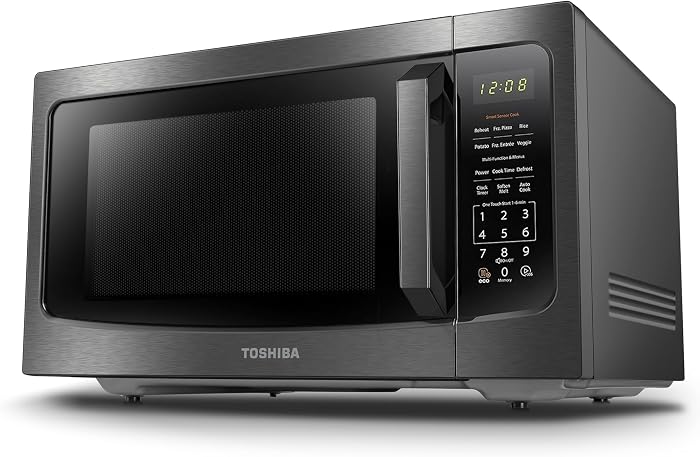
Toshiba ML-EM45P(BS) Best Value

TOSHIBA Microwave Oven with Smart Sensor

Budget family kitchens

Our Score 87/100
Sensor
Humidity sensor
Capacity
1.6 cu. ft.
Footprint
17.8"D x 21.8"W x 12.9"H
Cooking Power
1200 watts
View on Amazon

Drop down a step in price from our top pick and the cavity gets bigger, not smaller. The Toshiba holds 1.6 cubic feet on a 13.6-inch turntable, enough for a 13-inch pizza or two boxed frozen dinners side by side, which the 1.2-cubic-foot Panasonic can't manage. If interior space per dollar is the question, this is the answer in this group.

The humidity sensor and its ten sensor menus do the same job as Panasonic's Genius Sensor: pick the category and the oven decides when the food is done. What surprised us is the position-memory turntable. It puts the glass back where it started, so the handle of the mug you just reheated is where you left it rather than somewhere behind the door frame. The beeper can be muted by holding the 8 for a few seconds, which is a small feature until the first early-morning reheat.

The keypad is where the savings show up. The membrane buttons are stiff, and a press that lands off-center often does nothing, so you learn to hit them flat and firm. That's an irritation rather than a malfunction, and it's the price of the extra space. At 36.6 pounds the oven also wants a second set of hands for the lift.

Worth Noting

  • Keypad needs a firm, centered press
  • Deeper body than the other picks here
Our Verdict

If the budget is the deciding factor, this is the one: 1.6 cubic feet, sensor menus that handle the usual reheats, and a keypad that asks you to press like you mean it.

Check Latest Price
3

Panasonic NN-SD975S Best for Big Families

Panasonic Microwave Oven with Cyclonic Wave Inverter Technology

Large households

Our Score 84/100
Sensor
Genius Sensor
Capacity
2.2 cu. ft.
Footprint
19.44"D x 23.88"W x 14"H
Cooking Power
1250 watts
View on Amazon

The turntable gives this one away. At 17 inches across it's about three inches wider than the plates in the other two picks, and the 2.2-cubic-foot cavity around it is the only one here with room to spare for a big casserole dish. If you cook ahead, reheat for four, or regularly wish there were somewhere to put a party platter, this is the model we point to: it ends the transfer-the-food-to-a-smaller-dish routine.

Cyclonic Wave is Panasonic's name for spreading microwave energy in three dimensions instead of from one side, and it's aimed at the classic inverter weak spot, the cooked gray ring around the edge of a block of frozen ground beef. We found the dial-and-preset control takes a few days to feel normal, then it's faster than punching digits, and 20 presets plus a keep-warm cycle cover more than most people will ever press. This is also the only pick that accepts a trim kit, sold separately, for a built-in look.

Two costs come with the size. At 23.88 inches wide and 19.44 inches deep it needs a genuinely deep counter and clearance above, and 36.8 pounds is a two-person lift. The other cost is longevity: a turntable motor or inverter board that quits inside the first year is the weak spot to know about on this model. Buy it for capacity you'll actually use, and keep the receipt.

Worth Noting

  • Nearly 24 inches wide and 19 inches deep
  • Some units fail inside the first year
Our Verdict

Buy this one when the cavity has to hold the whole family's dinner: 2.2 cubic feet, a 17-inch turntable, and Cyclonic Wave heating that keeps a big dish even.

Check Latest Price

How We Tested 10 Sensor Microwaves

The shortlist started with a spec filter, not a brand list. I looked for ovens that carry an actual humidity or temperature sensor rather than a panel of preset buttons with the word sensor printed on them, with at least 1.0 cubic foot of capacity, 1,000 watts or more, and a body narrow enough to sit under a standard upper cabinet. Anything whose sensor only worked for popcorn and a baked potato got cut. That left 10 microwaves, which we ran side by side for six months.

They lived where a microwave actually lives: on the counter by the coffee maker. Mornings were oatmeal and a mug of milk, afternoons were leftover rice, pizza, and a full dinner plate, and evenings meant defrosting a pound of frozen ground beef or chicken thighs, plus weekend popcorn and baked potatoes. With each one, I pressed the sensor setting first and let it run, timing the cycle and taking temperatures at the center and edges instead of trusting the beep.

Then the less glamorous checks. I counted how many presses it took to start a reheat, and whether the touchpad caught a light tap or needed a firm push. I measured noise with a decibel app at arm's length, noting whether we could hear it over a running range hood. I taped each footprint on the counter to see how much work surface was left, confirmed a standard dinner plate cleared the turntable and walls, and wiped the door after every session to see how badly the stainless held fingerprints.

Six months in, we watched for drift: sensors that returned lukewarm food after a few weeks, doors that needed a slam to latch, turntables that started grinding. We also compared notes on whether the pricier models actually behaved better at the buttons than the cheaper ones, because that premium only makes sense if the sensor earns it.

How to Choose a Microwave with Sensor Cooking

What the Sensor Is Actually Measuring

Nearly every countertop sensor works the same way: it watches the moisture rising off the food, and when the steam builds to a set point it starts the countdown. That's why the presets are tied to specific foods and weights, and why a plate piled with dense meat next to a few green beans confuses the oven no matter which button you press. Spread food into a thin, even layer, cover it loosely so the steam can build, and save Sensor Reheat for one portion rather than a whole casserole.

Panasonic's Genius Sensor runs on the same steam logic, and the newer version on the flatbed models adds temperature sensing. None of it rescues an uncovered, heaped plate.

Inverter Power Versus a Burst-Firing Magnetron

In a conventional microwave the magnetron runs full blast and switches on and off to average out a lower setting, which is the hum you hear dropping in and out. An inverter, which both Panasonic picks here use, holds a steady reduced output instead. At full power the difference is small. At 30 or 50 percent, where defrosting and gentle reheating happen, it's the difference between meat that thaws evenly and meat with cooked edges and a frozen middle.

If you defrost regularly, an inverter is worth paying for. If you only ever press two minutes on high, put the money into capacity instead.

Match the Cavity to the Counter

Cubic feet describe the inside; the numbers that decide whether the oven fits are the outside ones. The largest pick here is 23.88 inches wide, 19.44 deep, and 14 tall, which needs genuine counter depth and clearance under the cabinet, while the 1.2-cubic-foot Panasonic is 20.7 inches wide and 15.8 deep. Measure the counter, the overhang above it, and the room the door needs to swing before you order.

Weight belongs in the same calculation: anything in the mid-thirty-pound range is a two-person lift onto the counter. And when a listing calls a model compact, it's describing the cavity, not the footprint.

Controls, Light, and Noise

You touch the keypad several times a day, so it deserves as hard a look as the wattage. A dial plus a handful of one-touch keys is fast for reheating; a flat membrane pad is easier to wipe down but can demand a firm, centered press. Two details never make the feature list and always matter in a quiet kitchen: whether the interior light comes on when the door opens, as it does not on plenty of countertop models, and how loud the finished beep is.

If you reheat early in an open-plan kitchen, look for a mute or volume setting before you look at preset count.

The Longevity Question

Failures cluster around the magnetron, the inverter board, and the turntable motor, and every model here carries a one-year warranty, which is short for an appliance that lives on the counter for a decade. That shapes the purchase: buy where returns are simple, keep the receipt and the packaging through the first month, and register the warranty the day it arrives. It's also an argument for spending on the cavity size and controls you'll use instead of on preset count, since the electronics are the part most likely to let you down.

Frequently Asked Questions

Final Verdict

Our recommendation for most kitchens is the Panasonic NN-SN686S: the Genius Sensor and inverter cover the reheating you do every day, and the 1.2-cubic-foot body fits a normal counter without a two-person lift. Go to the NN-SD975S when the food itself is oversized, whether that's big platters, a 17-inch turntable's worth of dishes, or a household that cooks ahead.

The Toshiba ML-EM45P(BS) is the budget answer, as long as the extra interior space is worth a keypad that makes you press like you mean it.