Best Maple Cutting Boards of 2026

Maple cutting boards are heavy, and that's the point. The heft is what keeps a board from skating across the counter while you work through a pile of onions, and it's why a flimsy one feels hollow and rattles under the knife. What you're actually buying is a stable, quiet surface that spares your knife edge and takes years of weeknight dinners without splitting.

I've cut on wood for years, and the hard-won lesson is that thickness, grain, and footprint matter more than a pretty face — the best-looking board I ever owned was an inch too long for my sink. We spent nine months cooking on 12 of them, from striped edge-grain boards to heavy butcher blocks sitting on little wooden feet, and the ones worth owning were the ones that stayed flat and didn't gouge.

One thing first-time buyers get wrong: edge grain, the striped construction most of these boards use, is more stable and far less expensive than end grain, and it's what a home kitchen actually needs. Size is the other trap — measure your sink and your longest counter run before you fall for a big board. The picks below are the ones I'd buy again, and they split fairly cleanly between boards built for carving and boards built for everyday prep.

Our Top Picks

The 4 Best Maple Cutting Boards of 2026

1

Sonder Los Angeles Winsome Maple Board Best Overall

Sonder Los Angeles Winsome Maple Wood Cutting Board Made in USA

Prep and serving

Our Score 92/100
Weight
8 lb
Thickness
1.5 inches
Dimensions
17 x 13 inches
Working Faces
Juice groove and cracker well
View on Amazon

One face of the Winsome has a juice groove, and the other has a channel carved to hold crackers. That sounds like a party trick until you live with it: we broke down a chicken on the grooved side, wiped the board down, flipped it, and set out cheese on the same surface an hour later. Two faces with two different jobs is the reason this one keeps its place on our counter instead of going back in the cupboard.

Size settles it for most kitchens. At 17 by 13 inches and 8 pounds, it handles a pile of onions and still lifts to the sink with one hand on the built-in grip — a balance the 24-inch blocks in this guide can't match. The edge-grain American maple is tightly joined and smooth out of the box, without the sandy feel some new boards have, and the 1.5-inch slab sits still while you work.

Length is the trade. Seventeen inches is not where you break down a whole brisket or lay out corn for a crowd; the John Boos RA03 is the board for that. For ordinary cooking — an onion, a bunch of herbs, two chicken breasts — we never wanted more room, and the serving face means the board stays out between jobs instead of being tucked away.

Worth Noting

  • 17-inch surface is short for big batches
Our Verdict

This is the maple board we recommend first: two working faces, a size that fits a normal sink, and a finish that has held up to daily cooking.

Check Latest Price
2

John Boos Block RA03 Cutting Board Best Heavy-Duty Block

John Boos Block RA03 Maple Wood Edge Grain Reversible Cutting Board

Permanent counter spot

Our Score 91/100
Weight
24.8 lb
Thickness
2.25 inches
Dimensions
24 x 18 inches
Reversible
Yes, with finger grips
View on Amazon

Just under 25 pounds is the first thing you notice about the RA03, and it's the whole reason to buy it. The board doesn't creep across the counter mid-chop, doesn't need a damp towel underneath, and stays where you put it on a polished surface where lighter boards skate.

We like it for volume work: a 24 by 18 inch surface, 2.25 inches thick, with recessed finger grips at each end so you can reposition it without pinching. Two flat faces let you carve on one and prep vegetables on the other. The thickness is what separates it from the 1.5-inch boards here — it reads as a block of wood rather than a plank, and knife work on it is quiet and solid.

What that mass buys is permanence: this is a board that lives in one spot, gets scraped and wiped, and doesn't travel. Thick edge-grain maple can still open along a glue seam if it dries out, so the oiling routine matters here, and the one-year guarantee covers defects rather than wear. We kept ours oiled and wiped after use, and it has stayed flat.

Worth Noting

  • Too heavy to lift into most sinks
Our Verdict

Our pick for a board that never leaves the counter: just under 25 pounds of edge-grain maple that sits still through heavy chopping.

Check Latest Price
3

Farberware Reversible Maple Board Best Budget

Farberware Reversible Hardwood Cutting Board with Juice Groove and Finger Grips

First kitchens

Our Score 90/100
Weight
5 lb
Handling
Finger grips on the ends
Dimensions
12 x 18 inches
Working Faces
Juice groove and flat side
View on Amazon

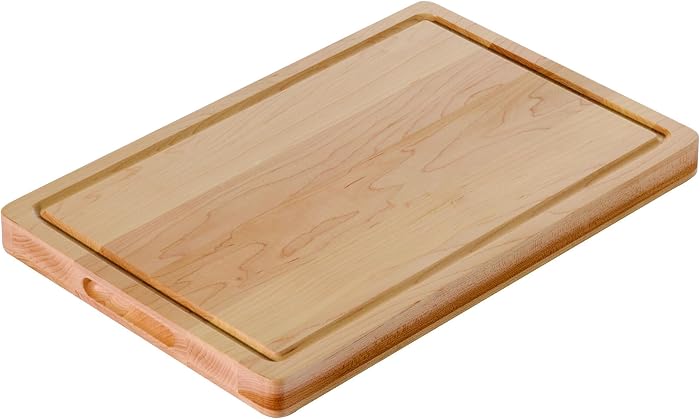
The least expensive board here covers the same two jobs as boards that cost far more: one grooved face for juicy things, one flat face for everything else, plus finger grips at each end. The groove is deep enough to catch what runs off a whole chicken, and the reverse gives you a clean surface for bread or vegetables. We came to the Farberware expecting a starter board and got one we kept reaching for.

Five pounds is what makes it work. It's heavy enough to stay put while you dice and light enough to pick up one-handed and rinse, which is the balance the 25-pound John Boos gives up. At 18 inches long by 12 deep it fits a strip of counter beside the stove and slides into a dish rack to dry; if you cook in volume, the extra depth of a 24-inch block is worth having, but for a household of two and a nightly pile of vegetables this is plenty.

Worth Noting

  • Pale maple shows stains from beets and turmeric
Our Verdict

We think it's the best value here: a grooved, reversible maple board with enough mass to stay put, for far less than the rest of the group.

Check Latest Price
4

John Boos B12S Square Maple Board Best for Small Counters

John Boos B Series Square Wooden Maple Cutting Board 12”x12”

Small kitchens

Our Score 89/100
Base
Non-reversible with 1-inch bun feet
Weight
6 lb
Thickness
1.5 inches
Dimensions
12 x 12 inches
View on Amazon

An inch of bun feet lifts the B12S off the counter, and that changes what it is. On a small counter it reads as a miniature butcher block; on a table it's a cheese board with a cutting surface underneath. Either way it stays out, which is more than we can say for the flat boards we tuck into a cupboard.

Twelve inches square and 1.5 inches thick, it's sized for an onion, a bunch of herbs, a lemon, or a round of brie — not a holiday dinner. The maple is edge grain and easy on knives; our chef's knife came away clean after a week of daily dicing. Set it on a level counter and the feet hold it steady, though on a slightly uneven surface it can rock.

Six pounds makes it easy to move from counter to table, and the 12-inch footprint leaves room for a skillet beside it, which is the point in a kitchen this size. What it isn't is a batch board: a pile of kale or a whole chicken wants the Sonder's bigger surface, and a board that never gets washed because it's too big is no bargain.

Worth Noting

  • Non-reversible, so only one cutting face
Our Verdict

For a counter with no room to spare, we like this 12-inch maple square: it chops, holds cheese, and looks better than the space it takes.

Check Latest Price

How We Tested Maple Cutting Boards

We started by gathering every maple board we could find from big retailers and small U.S. woodshops, then narrowed the field by wood species, thickness, footprint, and price until 12 remained. Anything that turned out to be a maple veneer over a cheaper core got cut in the first round.

Those 12 boards spent nine months in my kitchen and two colleagues' kitchens. They handled Sunday meal prep, weeknight onion and carrot dicing, breaking down a whole chicken, carving a roast, and one long stretch of holiday cooking. A few stayed out on the counter the entire time so we could watch them age.

On day one we weighed each board, measured its thickness with calipers, and checked flatness against a straightedge, then repeated those checks over the nine months to catch any that started to bow or cup. To judge stability, we chopped on a damp counter and noted which boards slid and which stayed put. After a month of daily use, we ran a fingernail across the scratches to feel whether the cuts had closed back up or were raised and splintery, and we flipped each reversible board to see whether both faces were finished to the same standard.

Every juice groove got a quarter cup of water tipped into it to see whether it actually contained anything. We washed and dried each board by hand the way the maker instructed, oiled them when they looked dry, and noted how much oil each one drank as a rough read on density. Craftsmanship came down to what we could see and feel: tight glue joints, even sanding, eased corners, feet fastened squarely. Value was the last calculation — price weighed against thickness, footprint, and how the board looked after a fresh coat of oil.

How to Choose a Maple Cutting Board

Measure the sink before the stove

A 24-inch board is a beautiful thing until it's time to wash it. Sinks vary more than counters do, and a slab that won't lie flat in yours becomes a board you can only wipe, never scrub. Measure the interior length and width of your basin and buy a board that drops in with an inch or two to spare; 17 to 18 inches is the practical ceiling for most kitchens.

Thickness follows the same logic. Anything from 1.25 to 1.5 inches is plenty for daily prep and keeps the weight manageable, while 2.25 inches is a board you leave in one place and treat like a fixture.

Weigh mass against lift

Mass is what stops a board from skating across the counter while you chop, and it's also what stops you from carrying it to the sink. Boards in the 5-to-10-pound range are the sweet spot: heavy enough to stay put, light enough to lift one-handed when you're done.

Past 20 pounds you're buying a butcher block that never moves — steady as a rock and permanently stationed. Neither choice is wrong, but know which one you're shopping for before you fall for a big slab in a photograph.

One face or two

A reversible board gives you two cutting surfaces, which doubles its working life and lets you keep one side for raw meat and one for vegetables. Boards raised on bun feet give you a single face and a serving piece that sits above the counter — lovely for cheese, less useful for a pile of greens.

Our preference is a reversible board as the primary tool and feet on a small second board that lives on the table. A thick board with no second face is a serving piece first and a work surface second, and it should be priced accordingly.

Grooves, wells, and serving extras

A juice groove earns its place if you carve meat or cut tomatoes and citrus; it catches what would otherwise run onto the floor. The trade is a few square inches of flat surface at the edge, which matters more on a 12-inch board than on a 24-inch one.

A cracker well or a carved handle belongs to the serving half of the job. Decide whether you're buying a tool or a platter first — most people need the tool, and a serving feature that crowds the cutting area is a feature you'll resent.

Oil, water, and the reason boards warp

Wood moves as it takes on and gives up moisture, and it moves unevenly. A board left to soak, or washed on one face and left wet on the other, dries unevenly and bows; a thick edge-grain block that dries out completely can open along a glue seam. The routine that prevents both is short: wash by hand, towel it dry, and stand it on edge so both faces see the same air.

An oiled surface sheds water instead of drinking it, which is why the oil matters more than which oil you buy. A dry board is a board that's about to move.

Frequently Asked Questions

Final Verdict

For most kitchens the Sonder Los Angeles Winsome Maple Board is the one to buy: two working faces, a 17-inch length that fits a normal sink, and enough mass to stay put without becoming furniture. If your board never leaves the counter and you want the surface to feel like a workbench, the John Boos RA03 is worth the upgrade.

And if you're outfitting a first kitchen, the Farberware covers the same ground for a fraction of the money — that's the decision, and it doesn't need a third option.