Best Knives for Cutting Raw Meat of 2026

A raw chicken breast is one of the most honest tests a knife can face: wet, slick, and happy to roll away the moment your grip slips. A blade that skates instead of biting in makes dinner take twice as long.

I've fought that fight on a cramped apartment counter. Over the past six months, my team and I worked through a dozen knives — stiff chef's knives and slicers, plus curved boning knives from semistiff to flexible — on whole chickens, pork shoulders, and salmon sides. The keepers grabbed wet protein instead of sliding over it, stayed put in greasy hands, and carried the cut without tiring my wrist.

Flexibility is a job description rather than a buzzword: a stiff blade muscles through clean cuts, while a flexible one curves around bone and silver skin, and mixing them up is why people blame the knife. Full tang construction and a grippy handle matter more than most shoppers expect. The picks below cover both ends of that range, along with the slicers and cleavers for holiday roasts.

Our Top Picks

The 8 Best Knives for Cutting Raw Meat of 2026

1

Victorinox Fibrox Pro 8-Inch Chef's Knife Best Overall

Victorinox Fibrox Pro 8 Inch Chef’s Knife

Everyday raw-meat prep

Our Score 99/100
Handle
Textured TPE, non-slip
Blade Length
8 inches
Construction
Stamped
Blade Material
Stainless steel
View on Amazon

Raw meat is the slipperiest thing most of us cut, and the handle is usually where a knife gives up first. The Fibrox Pro's molded TPE handle has a light texture and a palm swell, and it stays secure with chicken juice on your hands — the detail we noticed before anything else. The blade is 8 inches of stamped stainless steel, made in Switzerland and covered by a lifetime warranty against defects.

That grip is a big part of why this is the knife we recommend to nearly everyone. Stamped blades are ground thin, so the Fibrox slides through a breast or a loin instead of wedging and tearing at the surface, and the light weight means a long trimming session does not leave your wrist aching. Splitting, slicing, chopping, mincing: it is the closest thing here to a whole raw-meat kit in one blade.

What you give up is mass. Thin and light is an advantage in muscle and a disadvantage against a joint, so cut around bone instead of through it; the blade will flex if you lever. The edge also wants a few light passes on a steel every couple of sessions, which is ordinary upkeep rather than a flaw. Victorinox rates it dishwasher safe, though we wash and dry anything that has touched raw meat before it goes back in the block.

Add a boning knife when you start buying whole birds or shoulders, or step up to a set if primals become a habit. Until then, this plus a board is the whole setup.

Worth Noting

  • Light blade flexes if you lever against bone
Our Verdict

We recommend the Fibrox Pro to anyone who cooks raw meat more than once a week: it grips when wet, slices without wedging, and takes a honing rod in stride.

Check Latest Price

2

Cutluxe 3-Piece Butcher Knife Set Best Butcher Set

Cutluxe 3-Piece Butcher Knife Set

Breaking down primals

Our Score 98/100
Handle
Pakkawood
Construction
Full tang
Set Contents
12-inch brisket, 10-inch cimeter, 6-inch boning
Blade Material
High carbon German steel
View on Amazon

A chef's knife can take a pork shoulder apart, but it does it in choppy passes: too short to draw through a big cut, too tall to work close to a shoulder blade. That gap is what this set fills. Three knives arrive together — a 12-inch brisket slicer, a 10-inch curved breaking cimeter, and a 6-inch boning knife — in high-carbon German steel with full-tang pakkawood handles.

The cimeter is the one we reach for first on a primal. Its curved belly lets you rock through a shoulder or a rib section without lifting the tip off the board, and the pakkawood stays usable when your hands are tacky with fat. The 12-inch slicer does what a long blade is for: one clean pull through a packer brisket or a whole round of beef, bark intact. The edge holds through a long session before it wants a steel.

As a package it is the most direct way in this group to own all three meat-cutting shapes at once, and none of the three feels like filler — each is balanced enough to use for an hour without your forearm complaining. If you already buy steaks and chicken breasts, this is more knife than you need; the shapes only pay off when you are the one breaking the animal down.

Two practical notes. The long slicer is genuinely long, so it will sit out most nights when dinner is a two-pound roast. And nothing here comes with a sheath or a roll, which means three bare, very sharp blades competing for drawer space — plan a slot or a magnetic strip before the box arrives.

Worth Noting

  • No sheath or roll for three long blades
  • 12-inch slicer is unwieldy on small roasts
Our Verdict

We recommend the Cutluxe set to anyone who brings home primals or whole packers: three sharp, well-balanced shapes, each doing a job a chef's knife only fakes.

Check Latest Price
3

Victorinox Fibrox Pro Curved Boning Knife Best for Boning and Trimming

Victorinox Victorinox swiss army cutlery fibrox pro curved boning knife

Boning and trimming

Our Score 97/100
Handle
Fibrox, non-slip
Weight
4.2 oz
Blade Type
Curved, semi-stiff
Blade Length
5.5 inches
View on Amazon

Slide a chef's knife along the inside of a rib cage and you will either gouge the meat or fight the bone. A boning knife is built for exactly that pass, and this curved Victorinox is the second knife we tell people to buy: the point pierces, the curve follows the bone, and the 5.5-inch blade stays maneuverable in tight spots. It also meets NSF standards, which matters if the knife moves between a home kitchen and a commercial one.

The semi-stiff blade is the part worth understanding. It has a slight bend for a delicate touch but does not wander the way a fully flexible fillet knife does, which makes it the right tool for pork shoulders, beef primals, and whole birds. It arrives sharp, hones back in seconds, and the Fibrox handle keeps its grip when your hands are slick with fat.

What it is not is a breakdown knife for big primals. At 5.5 inches it is close-quarters work, and a breaking knife or a long slicer does the sectioning. The curved tip also rewards a slow finish to each cut — rush the last inch and the point comes off the board — so keep the off hand curled and the blade flat.

Worth Noting

  • Short blade cannot section large primals
Our Verdict

Add this curved boning knife the first time you buy a whole chicken or a pork shoulder — it separates meat from bone faster than any chef's knife.

Check Latest Price
4

Mercer Culinary Millennia 14-Inch Slicer Best for Big Roasts

Mercer Culinary M13914 Millennia Black Handle

Brisket and roasts

Our Score 96/100
Handle
Santoprene, textured
Weight
7.2 oz
Blade Length
14 inches
Blade Material
High carbon Japanese steel
View on Amazon

Fourteen inches is more blade than most kitchens own, and that is the whole point. Drawn once across a packer brisket or a turkey breast, a blade this long makes one clean slice — no saw marks, no torn bark, no second pass to even things up. The same stroke works on a holiday ham and a pork loin.

Of everything here, this is the knife we came back to for big roasts. The high-carbon Japanese steel takes a keen edge and comes back with a few passes of a honing rod rather than a session on stones, and the Santoprene handle has molded finger points that hold up to a wet hand. It is a one-job knife, and it does that job better than the shorter carvers in this group.

The cost of the length is logistics. It needs a board long enough to take the full stroke and a slot or a magnetic strip to live in — it will not fit a standard block, and no sheath comes in the box. Mercer also asks for hand washing, which is a small chore next to what the blade does on a brisket.

Worth Noting

  • Too long for standard knife blocks
  • Hand wash only
Our Verdict

If brisket or a whole turkey is the centerpiece, this 14-inch slicer makes the single clean pass a shorter knife cannot.

Check Latest Price
5

Mairico 11-Inch Granton Carving Knife Best Budget Carving Knife

Mairico 11-Inch Granton Carving Knife – 11-Inch Ultra Sharp Brisket Slicing and Carving Knife for Meat

Budget brisket slicing

Our Score 95/100
Edge
Granton (hollow)
Handle
Triple-riveted
Weight
14.4 oz
Blade Length
11 inches
View on Amazon

This is the least expensive way here to own a dedicated brisket slicer, and it does not feel like a compromise in the hand: an 11-inch blade with 15-degree Granton hollows, a full tang under triple rivets, and a storage box that makes it an easy gift for whoever cooks the holiday bird. We recommend it to anyone carving a roast a few times a year who does not want to buy a specialist's knife to do it.

The hollows are our favorite detail. They break the suction that makes a thin slice cling to a plain blade and tear as you lift it, so brisket slices come away whole with the bark attached. At 11 inches it is long enough for a home-sized packer and still short enough to steer, and the weight — a bit over 14 ounces — gives it a planted feel without arm fatigue.

Run it over a honing rod before the first roast; the factory edge can arrive wanting a few light passes, and you do not want to find that out halfway through carving. Keep its role straight, too: this is a carver for cooked meat and long raw cuts, not a tool for taking apart a shoulder. It is dishwasher safe, though hand washing keeps the finish.

Worth Noting

  • Factory edge can arrive needing a hone
  • Not built for breaking down raw primals
Our Verdict

If you carve a roast a few times a year, the Mairico gives you clean, hollow-edge slices without paying for a specialist's knife.

Check Latest Price
6

Mercer Culinary Ultimate White 6-Inch Boning Knife Best Budget Boning Knife

Mercer Culinary Ultimate White 6-Inch Boning Knife

Budget boning work

Our Score 94/100
Handle
Textured polypropylene
Weight
4.6 oz
Blade Type
Curved
Blade Length
6 inches
View on Amazon

Blade stiffness is the thing to know about this one. It runs stiffer than a classic flexible boner, and how stiff varies from knife to knife — for trimming fat and silverskin off a shoulder that is steady and predictable, and for working tight around small bones you will want a lighter touch.

Everything else is straightforward. The 6-inch curved blade is high-carbon Japanese steel that takes a sharp edge, the textured polypropylene handle has finger points that keep your hand where it belongs, and the whole knife weighs under five ounces. It comes sharp enough to separate a chicken into parts without a second pass, and it hones back in seconds.

Here is the case for it: this is the least expensive knife in this group, and it does the two jobs that matter in a raw-meat kitchen — getting meat off bone and getting fat off meat. If you break down a bird a week, it earns its keep. Mercer asks you to hand wash it, and nothing in the box protects the edge, so plan a slot or a guard.

Worth Noting

  • Blade stiffness varies between knives
  • Hand wash only
Our Verdict

The Ultimate White is the boning knife we point to when the budget is tight: sharp, curved, and comfortable through a whole chicken.

Check Latest Price
7

Paudin 8-Inch Chef Knife

Paudin 8-Inch Chef Knife

Stylish everyday prep

Our Score 93/100
Handle
Pakkawood
Weight
6.88 oz
Blade Length
8 inches
Blade Material
High carbon stainless steel
View on Amazon

The first thing anyone notices is the blade: a waved, wood-grain pattern etched across the steel, matched to a pakkawood handle. Paudin says plainly that it is not Damascus, and it is not — it is a finish, and a good-looking one that makes an inexpensive knife read as considerably more expensive than it is.

Underneath is a competent 8-inch chef's knife in 5Cr15Mov high-carbon stainless, stamped, at just under seven ounces. It arrives sharp, the balance sits where you want it for push cuts and rocking, and the handle suits a wide range of hand sizes — the kind of knife that becomes the one always left out because it feels good to pick up.

On raw meat it does what an 8-inch chef's knife should: clean passes through chicken breast and steak, enough belly curve to rock through a pile of trim. The limits are care and cosmetics. Pakkawood does not want the dishwasher, so this is a wash-and-dry-by-hand knife, and the pattern on the blade is decoration — it does not change how the steel holds an edge.

Our read: this is the chef's knife for someone who wants a good-looking blade and will treat it accordingly — dry it, hone it, keep it out of the sink. If what you want is the most forgiving knife for heavy raw-meat work, the Victorinox is the safer buy.

Worth Noting

  • Wood handle needs hand washing and drying
  • Blade pattern is decorative, not Damascus
Our Verdict

The Paudin is the chef's knife we hand to someone who wants a good-looking blade that still cuts raw meat cleanly.

Check Latest Price
8

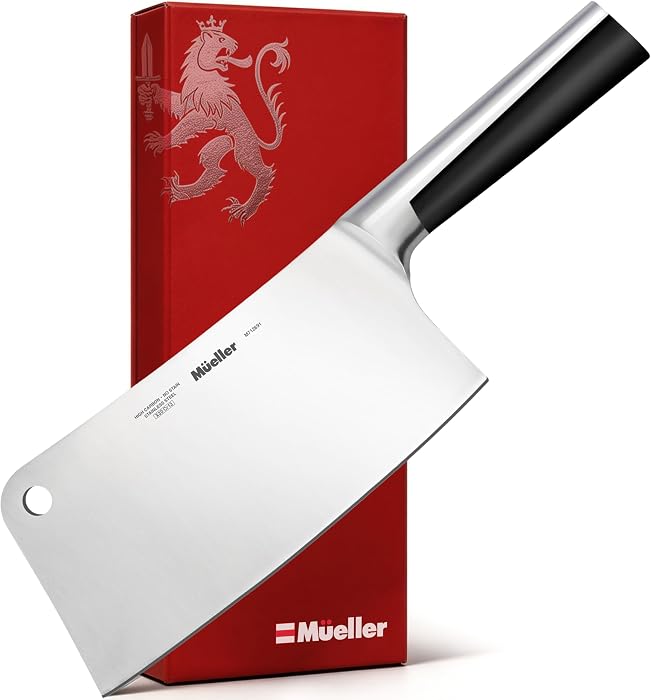
Mueller 7-Inch Meat Cleaver Best for Chopping Poultry Joints

Mueller 7-inch Meat Cleaver Knife

Chopping poultry joints

Our Score 92/100
Handle
Stainless steel
Weight
1.1 lb
Blade Length
7 inches
Blade Material
Stainless steel
View on Amazon

There is a job neither the chef's knife nor the boning knife does well: coming straight down through a chicken joint or a rack of ribs, then scooping the pieces into the pot. That is cleaver work, and this Mueller is a 7-inch stainless blade on an all-steel handle, 13 inches overall.

At 1.1 pounds it is light for a cleaver, and that number explains most of what it does. Light means you let the blade fall rather than force it, which is fine for poultry joints, portioning ribs, and cutting stew meat into cubes — and it means heavy bone is not this tool's job. The broad face is the underrated part: it scoops a pile of diced meat off the board in one move.

The handle is the weak spot in a raw-meat kitchen. It is smooth polished steel with no texture, so once your hand is slick with fat there is less to hold onto than the Fibrox or Santoprene handles on the other picks. Dry your hands and the board between birds and it behaves.

Our take: buy it for joints, ribs, and scooping, not for bone. It is the least versatile knife here and the one that makes a specific job easy, which is a trade worth making if you spatchcock and portion poultry regularly.

Worth Noting

  • At 1.1 pounds, light for heavy bone
  • Smooth steel handle offers little grip when wet
Our Verdict

Buy the Mueller if you portion poultry and ribs and want a broad blade for scooping — not if you plan to go through heavy bone.

Check Latest Price

How We Tested a Dozen Knives on Raw Meat

We built the shortlist by pulling in the knives that kept surfacing in butcher-shop and home-cook reviews for meat work — chef's knives, butcher and breaking knives, boning knives, slicers, and a cleaver — then filtered by blade steel, full tang construction, handle material, and price, dropping anything that only made sense in a professional kitchen. That left 12 knives, which we bought at retail and used for six months.

Testing happened where these knives actually live: weeknight counters breaking down whole chickens, a Sunday trimming session with pork tenderloins and a leg of lamb, a salmon side, and a long weekend carving a smoked brisket for a crowd. Every knife did the same jobs — splitting a bird into parts, running along a rib cage, peeling silver skin off a tenderloin, cutting even slices off a roast — so the comparisons were direct.

We watched whether an edge bit into wet chicken skin on the first stroke or slid across it, and whether the blade dragged or released cleanly from each slice. Handles got a fair shake too: we coated our hands in chicken fat and kept cutting, noting slipping, hot spots, and pressure points on longer sessions. Each knife went on a kitchen scale, then got judged on how that weight felt through a full breakdown, since a cleaver and a thin boning knife earn their mass in different ways. For flexibility, we flexed the boning knives around the curve of a thigh and along bone to see which ones followed the contour and which fought it.

We tracked edge retention by honing only when a knife started to struggle and logging how many sessions it took to get there, then weighed that upkeep against what each knife costs. A modest blade that holds through a month of chicken breakdowns is a better value than a fussy one that needs steeling every other meal.

How to Choose a Knife for Raw Meat

Match the Blade to the Cut

An 8-inch chef's knife covers splitting, slicing, chopping, and trimming at the board. Two shapes handle what it cannot: a 5.5- to 6-inch curved boning knife for close work around bone and silverskin, and a long slicer or carver for roasts and brisket. A cleaver is a fourth, narrower case — it exists to come straight down through joints and it is poor at anything delicate.

If you buy primals rather than steaks, a set of butcher knives that includes a breaking knife, a slicer, and a boner saves you from making three separate choices and three separate purchases.

Length, Board Space, and Where It Lives

A long blade is only useful if you have room to draw it. A 14-inch slicer needs a board longer than the blade and a slot or magnetic strip that will hold it; it will not fit a standard block, and neither will a 12-inch brisket knife. The trap is buying the longest blade you can afford and finding it only leaves the drawer at holidays.

Match the blade to the biggest thing you actually cook. Eleven or 12 inches covers most home briskets and turkeys, 8 inches is plenty for a pork loin, and a 6-inch boning knife is easier to steer than either.

Grip Matters More With Raw Meat

Fat and meat juices make a handle slippery in a way vegetables never do, so grip deserves more weight than it usually gets in a knife decision. Molded textured handles stay secure with a wet hand; smooth wood and polished steel look better and offer less to hold onto.

If you love a wood or steel handle, keep a towel beside the board and dry your hands between cuts. If you break down a bird or a shoulder every week, buy the textured synthetic handle and worry about the finish later.

Stamped or Forged, and How Much Knife You Need

Stamped blades are cut from sheet steel and ground thin, which is why they slide through muscle with less wedging and stay comfortable over a long trimming session. Forged blades carry more steel and more mass, which helps when you want the knife's own weight to fall through a cut and works against you when you are on your feet for an hour.

Neither is better in the abstract. Buy stamped for slicing and trimming, and consider forged only where you want mass — a cleaver, or a heavy chef's knife for big jobs.

Cleaning, Storage, and Raw-Meat Hygiene

Anything that touches raw meat needs hot soapy water and a full dry before it goes back in the block, and that is the real argument for hand washing even on knives rated for the dishwasher: you control the drying. Wood and pakkawood handles do not like soaking, and riveted joints trap water.

Storage is the other half of the decision. Two or three long blades with no sheaths will find each other in a drawer, so budget for a strip, a roll, or a couple of edge guards at the same time you buy the knife.

Frequently Asked Questions

Final Verdict

For most kitchens the answer is one knife: the Victorinox Fibrox Pro 8-inch chef's knife. It grips when your hands are wet, cuts raw meat without wedging, and covers splitting, slicing, and trimming in a single blade. Add the Victorinox 6-inch boning knife the first time you buy a whole chicken or a pork shoulder — that pair handles nearly everything a home kitchen asks of it.

If primals are a habit, the Cutluxe set puts three butcher knives in your hands at once and saves you from buying them one at a time. If brisket is the reason you are reading this, the Mercer 14-inch slicer is the blade that does it in one pass — provided you have a board and a slot long enough to hold it.