Best Infrared Meat Thermometers of 2026

An infrared thermometer reads surface temperature in a fraction of a second—exactly what you want for a screaming-hot cast-iron skillet or a pizza stone, and exactly what you don't want if you're judging the center of a roast. I've used infrared guns for years, and the most common mistake is expecting one to do a probe's job. The best models make that surface reading fast, clear, and repeatable, so you can adjust the heat before dinner goes sideways.

Over the past three months, we tested 15 infrared thermometers, from bare-bones laser guns to dual-mode models with fold-out meat probes. We compared accuracy, ease of use, temperature range, and build quality, and we focused on features that change how you cook: adjustable emissivity, distance-to-spot ratio, and a min/max display. The laser is genuinely fun—I zapped more than one ceiling fan—but a reading that's off or a body that feels flimsy isn't worth the money. These are the ones that earned a spot in the kitchen, the grill bag, and the toolbox.

Our Top Picks

The 7 Best Infrared Meat Thermometers of 2026

1

Etekcity Lasergrip 774 Infrared Thermometer Best Overall

Etekcity Infrared Thermometer Laser Temperature Gun 774

All-around cooking

Our Score 94/100
Warranty
2 years
Emissivity
Adjustable
Spot Ratio
12:1
Temperature Range
-58° to 842°F
View on Amazon

Two settings decide whether an infrared gun is a real kitchen tool or a novelty: the distance-to-spot ratio, which fixes how far back you can stand and still read a tight target, and whether you can tell the sensor what kind of surface it is looking at. The Lasergrip 774 gets both right, with a 12:1 ratio and an emissivity setting you can dial down for a shiny pan, and it does that for less than most of this group.

In use it is the least fussy thing in the drawer. Squeeze the trigger and the backlit screen refreshes in about half a second, holds the reading when you let go, and shuts itself off so a pair of AAAs does not drain in the cupboard. We used it to watch a pan come up to heat, to check frying oil before the first batch went in, and to find the cool corner of a flat-top, and the point-and-squeeze rhythm never got in the way of the cooking.

What keeps it at the top is the combination rather than any single number. Emissivity control is the feature cheap guns skip and the one that decides whether a reading off dark cast iron or a foil-lined tray is close or nonsense. When a number looks low on shiny metal, drop the emissivity and take another pass; that habit is the difference between a gun that works and one that gets called inaccurate.

The 842°F ceiling is the honest limit. It covers oil, griddles, and most home pizza ovens with room to spare, but it stops short of a wood-fired floor, which is the one job we hand to the KNINE. Two years of coverage is the longest here, and it is why this is the gun we point a first-time buyer toward.

Worth Noting

  • 842°F ceiling stops short of wood-fired oven floors
  • No loop or strap point for hanging at the grill
Our Verdict

Our default for a home kitchen: adjustable emissivity and a 12:1 spot ratio make the readings trustworthy, and it costs less than the specialist picks here.

Check Latest Price
2

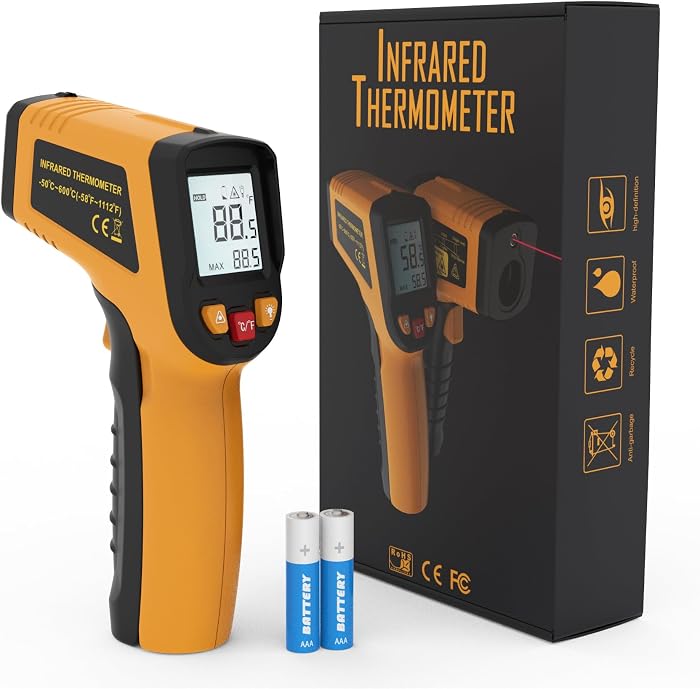
KNINE OUTDOORS Infrared Thermometer Gun Best for High Heat

KNINE OUTDOORS Infrared Thermometer Gun

Pizza and searing

Our Score 93/100
Emissivity
Adjustable, 0.1 to 1.0
Spot Ratio
12:1
Temperature Range
-58° to 1112°F
View on Amazon

Pizza is where most infrared guns run out of scale. A home oven tops out near 550°F, but a stone in a dedicated pizza oven or a grill running wide open climbs past 700°F, and a gun whose scale ends around 900 is guessing up there. The KNINE reads to 1112°F, as high as any single-purpose gun here and a long way past the Etekcity, and that headroom is what matters once you are cooking at 700°F and above.

It is not only a bigger number. Emissivity adjusts from 0.1 to 1.0, so you can set it for a matte stone, a black steel pan, or a shiny kettle lid instead of accepting a fixed default. The 12:1 ratio lets you stand back from an open flame, the single laser dot shows where you are aimed, and the screen is large enough to read at arm's length. Batteries come in the box, which is one less errand.

One thing to do before you trust it: readings can come in around 10 degrees low, so test yours once against a pot of boiling water and note the offset. It takes a minute. After that the gun is set-and-forget, with emissivity that holds where you put it, a °F/°C switch that takes a three-second press, and an auto-off that protects the AAAs.

Worth Noting

  • Body feels plasticky in the hand
Our Verdict

Our pick for pizza ovens and hard searing: 1112°F of headroom, emissivity you can dial in, and a price in the same band as the top pick.

Check Latest Price
3

TempPro TempScan CORE TP30 Best for Griddle Hot Spots

TempPro TempScan Infrared Thermometer Gun for Pizza Oven Griddle HVAC

Griddle hot spots

Our Score 92/100
Emissivity
Adjustable
Spot Ratio
12:1
Reading Modes
Max, min, average
Temperature Range
-58° to 1022°F
View on Amazon

A flat-top is never one temperature. The middle runs hot, the corners lag, and that difference is why one pancake browns while the next sulks. The TempScan CORE is built for that sweep: drag the beam across the plate and the screen keeps the hottest and coldest readings it caught along with the average for the pass, so the cold corner shows up before the food does.

That makes it the most useful surface-only gun here for griddle and grill work, and the rest of the package holds up: a 1022°F ceiling, a 12:1 ratio, adjustable emissivity, and a half-second refresh on a clear screen. This is the one we grab when the question is where the heat is rather than how hot it is.

Consistency is the caveat. Readings can scatter between passes over the same spot, so take two or three sweeps and let average mode do the smoothing instead of trusting a single pull of the trigger. That is a technique fix rather than a reason to walk away, but it is the habit that separates a good reading from a lucky one.

Worth Noting

  • Laser has quit early on some units
Our Verdict

The gun we reach for to map a griddle: max, min, and average readings on one screen show exactly where a flat-top runs cold.

Check Latest Price
4

ERICKHILL ROOK800P 2-in-1 Best 2-In-1

ERICKHILL ROOK800P 2-in-1 – Infrared Thermometer Gun

Surface plus internal

Our Score 89/100
IR Range
-58° to 1472°F
Included
Storage case
Spot Ratio
12:1
Probe Range
-58° to 572°F
View on Amazon

Hauling a gun and a separate probe out to the grill is the inefficiency this design fixes, and the ERICKHILL ROOK800P does it more completely than the other 2-in-1 here: a 1472°F infrared sensor on the front, a stainless probe rated to 572°F, and a storage case that holds the whole thing so the probe is not loose in a drawer.

The split is clean in practice. Point and squeeze for the pan, the stone, or the grate; switch to the probe for the middle of a chicken thigh, with ±2°C of claimed precision and a reading in about half a second. Max, min, and average modes carry across both, the screen is backlit, and two AAAs run it.

It earns its keep in a kitchen with one drawer for tools: surface heat and internal doneness from one handle, no pairing session with a phone, no second case to lose. It lives in the bag with the grill gloves now, and it is the first thing out when the flat-top goes on.

Worth Noting

  • Mode switching takes a trip to the manual
  • Probe tops out at 572°F
Our Verdict

One tool instead of two: a 1472°F infrared sensor for the surface and a stainless probe for the middle of the steak, with a case to keep both together.

Check Latest Price
5

SOVARCATE HS560D Infrared Thermometer Best Budget

SOVARCATE HS560D Infrared Thermometer – Infrared Thermometer Digital Temperature Gun Laser Meat Thermometer for Cooking

Tight budgets

Our Score 88/100
Spot Ratio
12:1
Response Time
0.5 seconds
Stated Accuracy
±1%
Temperature Range
-58° to 1112°F
View on Amazon

Range is what budget guns usually cut, and this one does not: 1112°F on the infrared side, as high as the KNINE and well past the top pick. It reads in about half a second, holds the number when you release the trigger, and runs on two AAAs that come in the box.

For a first gun, a spare to leave by the grill, or a gift for someone who just bought a flat-top, that is the sensible buy. There is nothing to configure beyond °C and °F, and the face is one trigger and one button, which is exactly how much interface this job needs.

The thing to watch is repeatability. Back-to-back readings on the same spot can come back different, so take two and split the difference rather than treating any single number as gospel. Our first move with any cheap gun is a boiling-water check, and this one is no exception.

Worth Noting

  • Back-to-back readings on one spot can differ
Our Verdict

Our budget pick: 1112°F of range and half-second readings from a gun that asks nothing of you but a trigger squeeze.

Check Latest Price
6

AHOSOUTLY UW510 Infrared Thermometer

AHOSOUTLY UW510 Infrared Thermometer – Infrared Thermometer Laser Temperature Gun

Budget emissivity control

Our Score 87/100
Emissivity
Adjustable
Calibration
One-button CAL
Response Time
0.5 seconds
Temperature Range
-58° to 1112°F
View on Amazon

A calibration button is unusual at any price, and this is the least expensive place here to get one. The CAL function runs a one-button routine meant to hold measurement consistency over time, which gives you a way to bring a gun that has wandered back toward a known reference instead of living with the offset.

The rest of the sheet reads like a tool that costs more: -58° to 1112°F, adjustable emissivity, half-second response, a backlit screen, auto-off, and a low-battery indicator. Two AAAs come in the box.

It made the list because emissivity control and a wide range are the two things we tell people not to give up, and it has both at the bottom of the price range. Accuracy is the open question, which is exactly why that CAL button matters: check it against boiling water before you trust it on a sear, and buy it as a second gun or a first one on a strict budget.

Our Verdict

Worth it for the two controls cheap guns usually skip: adjustable emissivity and a calibration button, on a gun that still reaches 1112°F.

Check Latest Price
7

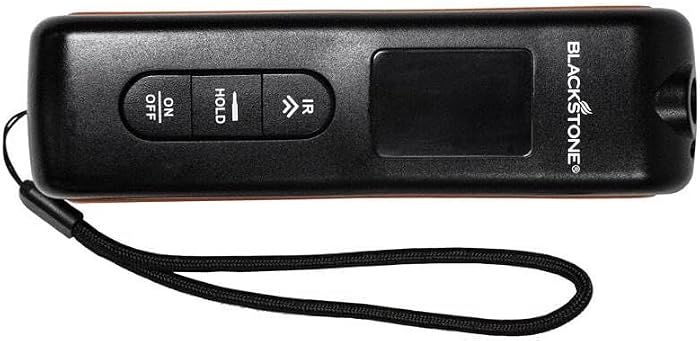
Blackstone Infrared Thermometer with Probe Best for Blackstone Griddles

Blackstone Infrared Thermometer with Probe

Blackstone griddles

Our Score 86/100
IR Range
0° to 932°F
Warranty
1 year limited
Probe Range
122° to 572°F
Probe Storage
Folds into body
View on Amazon

Blackstone built this for the people who own its griddles, and the specs follow the cooking: the infrared side reads 0° to 932°F, enough to watch a plate come up to seasoning heat and to find the cool end of it before the eggs go on.

The probe covers 122° to 572°F, the working range for chicken thighs, burgers, and steak, and the LCD is big enough to read at arm's length with a glove on. There is a low-battery indicator on the screen and a one-year limited warranty behind the body.

The detail we appreciate most is the probe itself. It folds down into the housing instead of living in a separate sleeve, so there is no cap to lose and nothing poking you when the gun goes back on the shelf. For a tool that lives outdoors and gets grabbed with wet hands, that counts for more than another decimal place of accuracy.

As a hot-side companion to a flat-top, it is the tidiest 2-in-1 here: one handle, two readings, and a body that does not mind being set down next to a hot plate. Buy it to cook with, not to audit the refrigerator.

Worth Noting

  • Infrared scale starts at 0°F, so no freezer checks
  • Probe will not read below 122°F
Our Verdict

For griddle owners who want surface and internal readings from one handle, and who cook hot enough to use the whole 932°F scale.

Check Latest Price

How We Tested the Best Infrared Meat Thermometers

We started by researching the category—reading listings, manuals, and owner reviews—and narrowed the field to models with clear specs: adjustable emissivity, a stated distance-to-spot ratio, and a temperature range that covered high-heat cooking and cold storage. We ruled out anything with vague accuracy claims or a battery door that looked like it would snap off. That left 15 units, which we tested over three months.

In the kitchen, I pointed each thermometer at a cast-iron skillet as it heated, a pizza stone in a 500°F oven, and a griddle before pancakes, comparing every reading to a calibrated instant-read probe. On the grill, we checked grate and surface temps before searing steaks, then used the probe models to monitor internal meat temps. We also ran low-range checks in the fridge and freezer, and knocked each unit off a counter onto a wood floor to see whether the readings drifted.

We timed how long it took to get a stable reading one-handed, noted whether the laser was visible in bright sun, and cycled through emissivity settings on a black pan and a shiny stainless kettle to see how much the number shifted. To check the distance-to-spot claims, we took readings from 6 and 12 inches away on the same pan and watched how much the target area changed. We checked display readability in a dim kitchen and whether the buttons made sense without the manual. At the end, we rechecked accuracy and noted which features we actually used—the min/max button earned its keep, while some menu options just added clutter.

How to Choose an Infrared Thermometer for the Kitchen

Surface Heat and Internal Doneness Are Two Different Jobs

A temperature gun tells you the pan, the griddle, the stone, or the oil has reached 425°F. It cannot tell you a pork chop is at 145°F in the center, because infrared light stops at the crust. That is exactly why the 2-in-1 designs exist: an infrared sensor for the cooking surface and a folding probe for the middle.

If you only want to know when the pan is ready, a surface gun is the whole answer and you can ignore the probes. If you also want to stop guessing at doneness, pay for the second function rather than buying two separate tools.

Match the Temperature Ceiling to What You Cook

Every gun on this page will read a frying pan; the differences show up at the top of the scale. Pan work, griddle work, and frying oil all live under 450°F, so a gun that stops near 840°F has room to spare.

Pizza is the exception. A stone in a dedicated oven or a grill running wide open sits between 700°F and 900°F, and Neapolitan setups go higher. If pizza or hard searing is on your list, choose 1000°F or more; in this group that headroom costs almost nothing.

Emissivity Is the Setting That Decides Accuracy on Real Cookware

Infrared sensors infer temperature from the energy a surface gives off, and different surfaces give off different amounts. Cast iron, pizza stone, and hot oil sit close to the 0.95 default most guns ship with. Bare stainless, aluminum foil, and a shiny kettle lid do not, and they read low until you tell the gun otherwise.

Adjustable emissivity is the feature worth paying for, and it is the first thing to check when a reading looks wrong on metal. Fixed-emissivity guns are fine for a griddle and a guess everywhere else.

A 12:1 Spot Ratio Tells You How Close to Stand

The distance-to-spot ratio is the size of the area being measured: at 12:1, a temperature gun averages a one-inch circle from a foot away, and a two-inch circle from two feet. For a steak crust or the corner of a griddle you want a small spot, so get close and let the target fill the cone.

Twelve-to-one is the working standard here. Lower ratios turn a small target into a blur of the grate, the air, and the background behind it, which is how people end up convinced their thermometer is broken.

Build, Display, and the Parts That Wear Out First

Two AAA batteries, a readable screen, and an auto-off are the baseline. What separates these tools is how they hold up: a display that washes out in sunlight is a real annoyance on a patio, plastic probe joints are the part that cracks, and the laser module is the piece most likely to quit early.

A stated warranty tells you how long the maker expects the thing to last, so compare them. Keep the lens wiped clean, too; a greasy film over the sensor reads cool and sends you chasing a problem the gun does not have.

Frequently Asked Questions

Final Verdict

Buy the Etekcity Lasergrip 774 and you are done: adjustable emissivity, a 12:1 spot ratio, and a two-year warranty cover everything from frying oil to a pizza stone, and nothing else here is as easy to recommend to a first-time buyer.

Cook Neapolitan pizza or sear over a wide-open fire and the KNINE's 1112°F ceiling is the better answer for the same money. Need surface and internal readings from one handle? That is the ERICKHILL ROOK800P.