Best Hamburger Patty Presses of 2026

A homemade burger should be the easiest dinner of the week, yet hand-formed patties dome in the middle and thin at the edges, so the center lags behind the rim and the cheese slides off into the grates. A press fixes that in about five seconds, and the patty comes out the same thickness edge to edge.

The category splits in two. Mold-style presses — a plunger, a spring ejector, or a sleeve of patty papers — turn out thick, uniform burgers for grilling. Flat, heavy presses are for smashing a ball of beef onto a hot griddle for the diner-style crust, and weight is everything there; a light one skates across the meat instead of pressing it. In both camps, stuck meat and a mold that's miserable to wash are what push a press to the back of the cabinet.

We've spent three months putting 14 of them through real dinners, from weeknights at the stove to a cookout for 20. The picks below all released the patty cleanly, felt balanced in the hand, and rinsed clean without a soak.

Our Top Picks

The 7 Best Hamburger Patty Presses of 2026

1

Meykers Burger Press Best Overall

Meykers Burger Press – Hamburger Press Patty Maker 150 Paper

Everyday quarter-pound burgers

Our Score 94/100
Material
Cast aluminum, nonstick
Patty Weight
1/4 to 1/3 lb
Patty Diameter
4.5 inches
Dishwasher Safe
Yes
View on Amazon

The moment of truth with any patty press comes when you flip it over. Cold, lean beef grabs the sides of the mold, and the patty tears in half on the way out. The Meykers solves that with the least clever trick here: a stack of pre-cut papers in the box, one under the meat and one on top, so the patty drops onto the tray in one piece. It is the first reason this is our pick for most kitchens.

What you get is a 4.5-inch metal mold that turns out quarter- to third-pound patties — roughly three to a pound, and the size that lands on a standard bun without a fringe of beef hanging over the edge. The nonstick coating is decent rather than magic; with lean beef it still clings in places, which is why the papers matter and why we do not mind them. The handle unscrews so the whole thing lies flat in a drawer, and it is dishwasher safe, a small mercy when you are rinsing raw-beef residue off at nine at night.

The handle is the weak link — a plastic grip threaded into metal, and the part to watch if you lean your whole weight into a press. If you are making patties for a crowd, the Brigii's stainless body takes that better. And the papers run out: 4.5-inch rounds are sold in bulk almost everywhere, so restocking is easy, just not free.

Worth Noting

  • Coating alone will not release lean beef
  • Plastic handle threaded into the body
Our Verdict

This is the press we tell most people to buy: a bun-friendly 4.5-inch patty, papers in the box for a clean release, and dishwasher cleanup when you are done.

Check Latest Price
2

Brigii Stainless Steel Burger Press Best Upgrade

Brigii Stainless Steel Burger Press

Adjustable, all-metal molding

Our Score 93/100
Material
304 stainless steel
Thickness
Adjustable depth
Patty Diameter
4.5 inches
Dishwasher Safe
Yes
View on Amazon

Stainless steel is the whole argument for the Brigii. There is no nonstick layer to flake into your ground beef, nothing to re-season, and no reason to handle it delicately: it goes in the dishwasher and comes out the same. 304 is the grade used for cookware and sinks, so rust is not the worry it is with cast iron. After a run of coated aluminum molds, that absence of maintenance is what you notice.

The part we did not expect to like as much is the spring-back ram. Rather than leaning on a plunger until the meat compacts, you press down and the spring returns the ram, leaving the patty sitting slightly proud of the rim where your fingers can get under it. The depth is adjustable too, so one mold makes sliders and half-pounders — more range than any fixed-depth press here. Bare stainless still grabs cold beef, so keep papers on hand; the spring gives you a cleaner lift, not a frictionless one.

Size is the trade-off. At 4.5 inches across and five and a half inches tall, it stands in a drawer rather than lying flat, which is a real difference in a kitchen with one useful drawer. Set it on a shelf and the height stops mattering. What you are paying for is a press with no coating to wear through and no plastic taking the load — every working part is steel.

Worth Noting

  • Tall body needs shelf space, not a drawer
  • Costs more than double the budget molds
Our Verdict

Our upgrade pick for a reason: no coating to wear out, adjustable depth, and stainless steel that goes straight into the dishwasher.

Check Latest Price
3

Weston Single Burger Press Best Spring-Eject Press

Weston Single Burger Press For 4 1/2" Diameter Patties

Paperless patty release

Our Score 92/100
Release
Spring plunger
Material
Nonstick cast aluminum
Patty Weight
1/4 to 3/4 lb
Patty Diameter
4.5 inches
View on Amazon

No papers, no flipping, no prying. Weston's press packs the meat, and a push on the spring-loaded plunger pops the finished patty up on its own platen. Of the hand presses here, it asks the least of you — and it is the only one that tells you what your patty weighs before it hits the heat.

Those markings are the detail we kept coming back to: quarter-, third-, half-, and three-quarter-pound lines on the handle. Divide a family pack of beef and you know where each patty lands without hauling out a scale. Diameter is 4.5 inches, the same bun-friendly size as our top pick, so buns and cheese slices line up the same way.

The body is cast aluminum with a nonstick face that Weston describes as easy to wipe clean, so a quick hand wash covers most of it. It is a single-patty tool like every hand press here: a dozen burgers means a dozen cycles at the counter, fine on a weeknight and slow before a party. The list of things it can shape runs longer than burgers, though — sausage patties and crab cakes come out just as even.

Worth Noting

  • One patty per cycle, so crowds are slow
Our Verdict

We send anyone who hates fussing with paper liners to the Weston: the spring plunger pops the patty out on its own, and the handle markings keep weights honest.

Check Latest Price
4

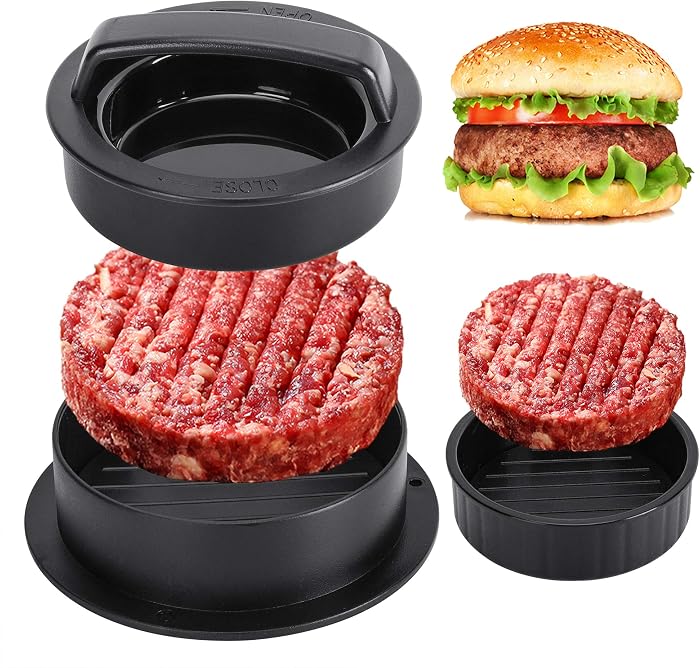
GPYG 3-in-1 Burger Press Best for Stuffed Burgers

GPYG 3-in-1 Burger Press – Burger Press Hamburger Patty Maker

Stuffed burgers, sliders

Our Score 91/100
Base
Removable
Material
BPA-free ABS plastic
Patty Styles
Regular, stuffed, sliders
Included Papers
50 sheets
View on Amazon

Stuffed burgers are a two-step job by hand: flatten, fill, seal, and hope the seam holds on the grill. GPYG's press does it in one pass. The middle ring leaves a well for cheese, bacon, or a spoon of caramelized onion, and the top plate presses the lid down over it. It is the only patty maker here built for that job, and it happens to be the cheapest.

The same three parts cover sliders and full-size patties, and the bottom plate lifts out so the finished patty comes free instead of needing a dig with a knife. Capacity is 12 ounces, which is honest about what this is: a quarter- to third-pound tool, not a half-pound pub-burger maker. Parchment sheets come in the box, and you will want them on both faces — the nonstick surface lets go of lean beef only some of the time.

Plastic is the compromise. It is BPA-free ABS, light in the hand, and it never goes near the heat; this is a counter tool for forming raw meat, full stop. Ours has seated firmly and released cleanly, and the parts feel stiffer than the price suggests. Hand wash it and skip the dishwasher rack — heat is what kills plastic parts like these. For the range of shapes, nothing else here comes close.

Worth Noting

  • Caps out at 12 ounces of meat
  • Plastic body will not take heat or rough handling
Our Verdict

We recommend this one when stuffed burgers and sliders are the point — nothing else here fills and seals a patty in one motion, and it costs the least.

Check Latest Price
5

Cuisinart Cast Iron Smash Press

Cuisinart Cast Iron Smashed Burger Press

Smash burgers only

Our Score 90/100
Care
Hand wash, oil after drying
Material
Cast iron
Pressing Surface
6.5 inches
View on Amazon

Start with what this is not: a mold. There is no rim, no plunger, and no way to turn out a thick, uniform patty for stacking in the freezer. The Cuisinart is a flat 6.5-inch cast iron face that flattens a loose ball of beef against a hot griddle. If the burger you want is thin, brown, and lacy at the edges, nothing else here comes close.

The weight does the work. You set the iron on the ball and the patty spreads across the full face without you leaning into it, which is how you get an even crust instead of a steamed middle. We also found it doubles as the handiest thing in the kitchen for holding bacon flat and weighting a sandwich on the griddle, which is not why you buy it but is why it stays out.

Two practical notes. Beef sticks to a cold iron face, so put a square of parchment between the press and the meat, or wipe the face with oil first, and the smash lifts away clean. And the 6.5-inch face is wider than it looks: in an 8-inch skillet it leaves little room to maneuver, so give it a 10-inch pan or a griddle.

Cast iron comes with a routine. Hand wash it, dry it completely, and wipe on a thin coat of oil; leave it wet and it spots with rust, which is the one maintenance failure this design invites. Do that and the iron will keep doing exactly what it does now.

Worth Noting

  • 6.5-inch face is tight in an 8-inch skillet
  • No rim or plunger, so no thick patties
Our Verdict

For smash burgers this is the press we reach for — heavy iron flattens a ball edge to edge and builds a real crust; it just cannot mold a thick patty for the freezer.

Check Latest Price
6

QELEG Hamburger Patty Maker Best for Wide, Diner-Style Patties

QELEG Hamburger Patty Maker – Hamburger Patty Maker Press

Wide, diner-style patties

Our Score 87/100
Weight
8.4 oz
Release
Lift-out plate
Patty Diameter
4-3/4 inches
Patty Thickness
3/4 inch
View on Amazon

Most molds here ask you to flip the whole press over and tap. The QELEG puts a separate plate inside the ring instead: lift the ring away and the patty is sitting on its own little tray, ready to slide onto a sheet pan or into the skillet. It sounds like a small thing until you have re-formed a torn patty with your hands.

At 4-3/4 inches across and three-quarters of an inch deep, it turns out a wider, slightly flatter burger than the 4.5-inch molds — closer to a diner patty than a pub patty, and a good match for a soft bun. It weighs 8.4 ounces, so it lives in a drawer without a fight, a detail we appreciated in a small kitchen. Two pieces, one of them already holding your dinner.

One thickness, one shape, no settings — and for a household that makes the same burger every week, that is the appeal rather than a compromise. There is nothing to dial, nothing to jam, and nothing to lose at the back of a drawer, and both pieces rinse clean under hot water before the skillet is even warm.

Worth Noting

  • Fixed 3/4-inch depth, so one thickness only
Our Verdict

We like this one for anyone who makes the same burger every week: the ring lifts off and leaves a wide patty on its own plate, with nothing to adjust.

Check Latest Price
7

VEVOR Commercial Patty Maker Best for High-Volume Patty Batches

VEVOR Commercial Burger Patty Maker

High-volume patty batches

Our Score 86/100
Body
Anodized cast aluminum
Weight
20.2 lb
Mold Sizes
4, 5, and 6 inches
Included Papers
1,500 sheets
View on Amazon

Twenty pounds of machine that lives on the counter is not what most people need. But when the guest list runs long — a graduation party, a fundraiser, a food truck's prep day — a hand press becomes the bottleneck. VEVOR's lever machine drops a formed patty onto the tray with one pull, and the maker rates it above 100 patties an hour.

Three molds — 4, 5, and 6 inches — swap out on a thread, so the same machine turns out sliders and half-pounders. A built-in paper holder keeps liners within reach instead of in a drawer across the kitchen, which sounds trivial until you have peeled a hundred sheets apart. The body is anodized cast aluminum with a stainless steel food tray, and it is built like equipment rather than a gadget.

Technique matters more than you would think. Spread the meat to the edges of the tray before you pull the lever; an off-center pile presses out thin on one side and thick on the other, and you will chase that inconsistency all night. And measure the spot before you order — 11.4 inches square and 20 pounds wants a shelf or a prep table, not a cabinet.

For eight burgers on a Saturday this is overkill, and the Meykers or the Weston will do the same job with less ceremony. For a hundred patties before noon, nothing else here keeps up. That is the trade: footprint and money for speed a hand press cannot give you.

Worth Noting

  • 20.2 pounds takes over counter space
  • Premium price for a home kitchen
Our Verdict

We only recommend this if patties come by the hundred: three mold sizes, a lever that does not tire, and a paper holder make short work of a big batch.

Check Latest Price

How We Tested the Best Burger Presses

We started with roughly 40 presses pulled from retailer listings and customer reviews, then narrowed by patty diameter — 4 to 4.5 inches covers a standard bun — material, and how the patty comes out: a spring ejector, a flip-and-peel mold, or a sheet of patty paper. Fourteen came home with us, and we've cooked with them for the past three months.

Testing happened where burgers actually get made: Thursday-night skillets, a backyard cookout for 20, a breakfast run of sausage patties, and crab cakes on a Sunday. We weighed every press on a kitchen scale before the first use, because a heavy smasher that won't budge and a mold that tires your wrist after a dozen patties are two different problems. Each mold got 80/20 chuck and lean turkey; we measured thickness with a ruler, watched whether the edges cracked or the center domed on the grill, and counted how many patties we could turn out before meat started clinging without a paper. Molds that adjusted for thickness or swapped plates for a wider patty earned points for range; anything fiddly lost them on a busy night.

Then the sink. Anything labeled dishwasher safe went through a full cycle after every use; everything else got a hot rinse and 30 seconds with a brush, and we noted which ones needed a soak. After a month we went back over each press for scuffing and flaking on the nonstick, play in the spring or hinge, and rust spots on cast and stainless parts left wet in the sink. A few favorites from week one had dulled by week six; the picks below hadn't.

How to Choose a Hamburger Patty Press

Match the Patty Diameter to Your Buns

Four and a half inches is the number to start with. Ground beef pulls in as it cooks, so a 4.5-inch formed patty lands close to the footprint of a standard bun, while a 6-inch mold is sized for half-pound pub burgers and oversized buns — on a normal bun it hangs over the edge and the first bite is all meat. The wider, flatter diner-style patty is a different look; the QELEG's 4-3/4-inch ring is the one here that produces it.

Read the description before you fall for the photo. A mold advertised as compact is usually a slider press, and a press sold as making quarter-pounders is telling you the diameter as well as the weight.

Decide How the Patty Comes Out

Almost every press here uses one of three release methods: a paper liner, a spring ejector, or a lift-out plate. Papers are the most reliable and the most tedious. The coating on an aluminum mold handles warm, fatty beef fine and cold, lean beef badly, so the liner is doing the work rather than the nonstick layer.

If a press relies on liners, price a pack of rounds into the decision and check the size against the mold — 4.5-inch papers in a 4-3/4-inch ring leave a lip of bare metal. A spring ejector such as the Weston's takes papers out of the routine entirely; a lift-out plate splits the difference.

Choose a Material You Can Live With

Coated cast aluminum is the budget standard: light, dishwasher safe on most models, and fine as long as you use liners. 304 stainless, as on the Brigii, costs more and has no coating to wear through, which is exactly what the extra money buys.

Plastic 3-in-1 presses are for forming raw meat on the counter and nothing else — light, cheap, and vulnerable to heat. Cast iron is a different tool altogether: it smashes a ball rather than molding a patty, and it has to be hand washed and oiled or it spots with rust.

Weigh Adjustability Against Simplicity

A fixed-depth mold makes one patty and makes it well, which suits most households. Adjustability earns its keep when you cook sliders for kids and half-pounders for adults from the same pack — the Brigii's depth setting and the Weston's handle markings both get you there, and both add parts.

More parts means more seams for beef to work into and more to scrub. If you make one size of burger, buy the simple press and spend the difference on better ground beef.

Plan for Storage and Batch Size

A press with a detachable handle lies flat in a drawer; a spring press stands upright and wants shelf space. Decide where it will live before it arrives, particularly in a kitchen with one useful drawer.

Batch size is the other half of that decision. Forming more than a couple of dozen patties at a time tilts the arithmetic toward a lever machine — the VEVOR's 20 pounds buy speed a hand press cannot match, in exchange for permanent counter or shelf space.

Frequently Asked Questions

Final Verdict

If you want one answer, it is the Meykers: bun-size patties, papers in the box so the first flip does not tear dinner, and a body that goes in the dishwasher.

Pay more for the Brigii if you want steel instead of a coating and a depth setting that covers sliders and half-pounders, or choose the Weston if buying liners forever sounds tiresome. And if the burgers you actually cook are thin and crusty, the Cuisinart smash press is the one to buy — none of the molds here make that burger.