Best Garage Lighting of 2026

You know the shadow problem: you're under the hood with a flashlight clamped in your teeth because the one bulb over the car drops your own silhouette exactly where the bolt is. A good garage light doesn't just make the room brighter — it kills the dead corners, flattens the shadows, and lets you tell navy from black while you're touching up a bumper.

Here's what the box won't tell you: raw lumen counts are the least useful number in this category. A 4-foot strip spreads light across the ceiling, while a screw-in fixture claiming several times that output fires it sideways and leaves the floor dim. Color temperature matters nearly as much — 6500K reads blue and clinical over a workbench, while 4000K is easier on your eyes through a long job.

Over the past seven months, my team and I installed 14 fixtures — linkable strips, low-profile wraparounds, and adjustable screw-in panels — across a two-car garage and a basement workshop. The ones that earned a permanent spot are below, sorted by the kind of space you're actually lighting.

Our Top Picks

The Best Garage Lighting of 2026

1

hykolity 4FT LED Shop Light Best Overall

hykolity 4FT LED Shop Light

Two-car garages

Our Score 95/100
Linkable
Up to 6 fixtures
Pack Size
4 fixtures
Light Output
4,400 lm per fixture
Color Temperature
5000K daylight
View on Amazon

Forty-two watts for 4,400 lumens is the ratio that put this fixture at the top of our list. In a two-car garage, two of them down the centerline give you a working-bright room, and three staggered across the ceiling even out the light with no dark bay. We kept coming back to it because it does that without a diffuser, a driver box, or a contractor: it hangs from the included chains or screws flat to the ceiling, and the 59-inch cord has a switch on it, so you can plug in and be done.

The light color is the quieter advantage, and it is why this one edges out fixtures with the same output. Most of the picks here are 6500K, which reads blue against a concrete floor and turns a red tool chest slightly purple. This is 5000K, close to midday daylight, and it is the shade we want when you are matching paint or judging a finish. The open frame has no polycarbonate cover to yellow or trap heat, so the output you paid for reaches the floor instead of the inside of a lens.

What the open frame also means is that the diodes are visible. At an eight-foot ceiling you will catch them if you look up from the bench, so run the fixture a little off your sight line rather than directly over your head. A single run takes six fixtures, more than anything here except the Barrina tubes, and the connectors come in the box. Plan the run around the outlet before you drill anything, because a plug-in ceiling light goes exactly where the cord reaches.

Worth Noting

  • Open frame leaves the diodes in view
Our Verdict

Our default for a working garage: 4,400 lumens of neutral 5000K per fixture, six to a run, and installation that needs a ladder rather than an electrician.

Check Latest Price
2

BBOUNDER 4FT LED Shop Light 10-Pack Best for Large Garages

BBOUNDER 4FT LED Shop Light 10-Pack – 10 Pack 4FT LED Shop Light

Three-car garages

Our Score 94/100
Linkable
Up to 4 fixtures
Pack Size
10 fixtures
Light Output
4,400 lm per fixture
Color Temperature
6500K
View on Amazon

Ten fixtures in one box is a different purchase from a four-pack. For a three-car garage it is a whole ceiling: three rows of three with a spare, or four down each side wall and two across the back. Cost per fixture is the lowest in this group, and each unit is the same 4,400 lumens at 40 watts as our top pick, so the difference between the two is not brightness. It is everything around the brightness.

The color is cooler. At 6500K this is the bluest light here, and in a garage it reads crisp and industrial rather than comfortable: excellent over a bench, a lift, or a car you are working on, less pleasant if the garage doubles as a gym or a place to sit. At least the tint holds steady from fixture to fixture, so a full ceiling does not go patchy. Linking stops at four per run, which means a ten-fixture layout wants a second cord and probably a couple of outlets.

Build is where the savings show. These are polycarbonate tubes in the brand's D-shaped profile, and the housing flexes in your hands while you carry one up a ladder. We minded that for about as long as it took to get them mounted, because a fixture nothing ever touches does not need heft. The included mounting hardware is the skimpiest of the picks here, so pick up a pack of proper drywall anchors on the same trip. The five-year warranty is the longest stated for any fixture in this guide, and that is worth more day to day than a thicker shell.

Worth Noting

  • 6500K casts a blue tone
  • Thin housing flexes when handled
Our Verdict

For a three-car garage, ten fixtures at the lowest cost per unit here cover the whole ceiling, as long as you are happy with cooler, bluer 6500K light.

Check Latest Price
3

TANBABY LED Garage Lights 2-Pack Best No-Wiring Retrofit

TANBABY LED Garage Lights 2-Pack – 2 Pack LED Garage Lights

Single-socket retrofits

Our Score 93/100
Base
E26/E27 screw-in
Panels
6+1 adjustable
Light Output
15,000 lm per bulb
Color Temperature
6500K
View on Amazon

One socket and no wiring is the situation this light exists for, and it solves it better than anything else in the guide. It screws into a standard E26 base like an ordinary bulb, then the six hinged panels fold out to throw 15,000 lumens each, 30,000 for the pair. That is more light than six of the four-foot fixtures. Nothing else here turns a dim garage bright in the time it takes to change a lightbulb, and for a rental or a shed with one lampholder, that is the whole argument.

The panels earn their keep once they are up. Set flat they light the floor; folded up toward 90 degrees they wash the side walls and the corners a single bulb leaves black, while the center panel keeps light directly below. We aimed a pair at the walls above a bench and lost the shadow the old fixture threw across the vise. The trade-off is bulk: the panels open the head to about eleven inches across, so measure clearance to the door track, the opener arm, and the top of the door before you commit to a spot.

Each unit weighs a little over two pounds and hangs from the socket, which is worth a moment of checking that the lampholder and its box are solid before you screw one in overhead. There is no diffuser, so the diodes are right there when you look up, and the output is a cool 6500K that goes blue at the edges of the room. For the one bay that never got a fixture, those are easy trade-offs to live with.

Worth Noting

  • Open panels need clearance from the door track
  • Over two pounds hanging from one socket
Our Verdict

When there is a socket and no wiring, this is the fastest bright fix here: 15,000 lumens per bulb with panels you can aim at the dark corners.

Check Latest Price
4

LZHOME Hexagon LED Garage Lights Best-Looking

LZHOME Hexagon 5000K LED Garage Lights: 25 Pack Updated 1.31-inch Wider Size

Showpiece garages

Our Score 92/100
Tube Count
25
Tube Width
1.31 in
Light Output
26,400 lm total
Color Temperature
5000K
View on Amazon

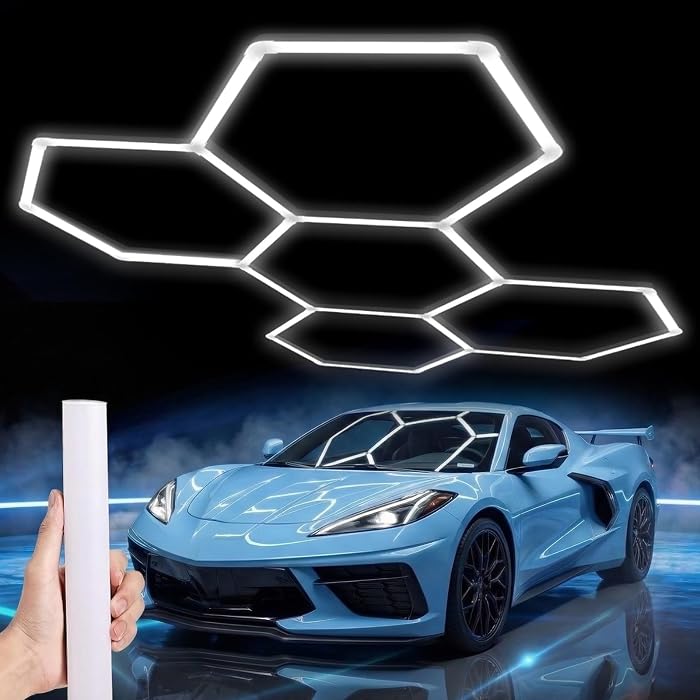
Most garage lighting disappears into the ceiling. This kit is the ceiling. Twenty-five LED tubes click together with Y and V connectors into a honeycomb of five hexagons, roughly 90 by 63 inches of layout, and the tubes are 1.31 inches wide, noticeably broader than the typical hex kit. That width is not a styling choice so much as a lighting one: a wider emitting surface spreads the output instead of dotting it. Total is 26,400 lumens at 5000K, the neutral daylight we like for detail work.

It earns its price on looks first and light second, and both hold up. There are no dark corners between the tubes and no harsh hotspot across the hood of a car, which is why we point to it for a garage that gets photographed: a detailing bay, a home gym, a workshop where the ceiling is part of the design. Assembly is the cost. Twenty-five tubes and twenty-two connectors is an afternoon, and the job goes far better if you lay the grid out on the floor first, then use a square and a level overhead.

The connector pins are the part to handle gently. They are small, they seat one way, and forcing one is how these kits get damaged. Once assembled, the grid is light enough for two people to lift and screw to the ceiling, and the two-year replacement support backs it. On a low ceiling this is the wrong shape, though: the honeycomb reads as a design feature only when there is height to look up into.

Worth Noting

  • Assembly and layout take a full afternoon
  • Connector pins are the fragile part
Our Verdict

The best-looking light here and the most even: a 5000K honeycomb that turns a garage into a showroom, for anyone willing to spend an afternoon building it.

Check Latest Price
5

Lithonia Lighting 4-Foot LED Wraparound Best Hardwired Wraparound

Lithonia Lighting 4' Low-Profile LED Wraparound Light Fixture

Finished ceiling look

Our Score 91/100
Fixture Size
47.5 x 5.5 x 2.6 in
Installation
Hardwired surface mount
Light Output
3,000 lm
Color Temperature
4000K cool white
View on Amazon

This is the only fixture here that does not look like shop equipment. It is a 47.5-inch steel channel with a polycarbonate diffuser over the diodes, 2.6 inches deep, hardwired with no cord and no plug, sitting against the ceiling like the light in a laundry room or a hallway. Under the cover: 3,000 lumens at 4000K, 33 watts, UL and CSA listed, DLC and Energy Star qualified, and rated for damp locations, which is more than the plug-in fixtures can say.

We reach for it when the garage is a room as well as a workshop: over the washer, along a passthrough, above a bench where you will be looking up at your work. The diffuser does two jobs at once. It hides the diodes so the fixture never glares, and it spreads 3,000 lumens into an even wash instead of a bright stripe on the floor. The 4000K color is the most neutral light in this group, and the easiest to live with if the garage shares a wall with the house.

The limits are real and worth naming. Three thousand lumens is one zone's worth of light, not a three-car ceiling; do the room in four of these and the cost climbs fast. It also needs a ceiling junction box and a switched circuit, so if there is no box where you want the light, factor in an electrician. And the diffuser is the delicate piece, fiddly to refit after you make the connections and the part that cracks if you rush it.

Worth Noting

  • Needs a junction box and switched wiring
  • Plastic diffuser is the fragile piece
Our Verdict

The pick when the garage should look finished: diffused, neutral 4000K light from a slim hardwired fixture that reads as part of the room rather than a shop.

Check Latest Price
6

Barrina T5 4FT LED Shop Light 6-Pack

Barrina T5 4FT LED Shop Lights for Garage

Cheap bright coverage

Our Score 90/100
Linkable
Up to 8 tubes
Pack Size
6 tubes
Light Output
2,200 lm per tube
Color Temperature
6500K
View on Amazon

Twenty-two hundred lumens from a four-foot tube that weighs almost nothing and plugs straight into a wall outlet is the cheapest way into a lit garage. Six tubes come with six cords, each with its own on/off switch, and two hardwire adapters sit in the box so the same tube can be wired to a wall switch later. That is a lot of flexibility for the money, and it is why this kit stays on the list despite the smaller number on the box.

Where these make sense is the perimeter. Under a shelf, along the wall above a bench, tucked behind a beam where a 4,400-lumen fixture would be overkill and in the way. At 6500K they are the coolest, whitest light here: fine for task work, unforgiving on anything whose color you are trying to judge. The snap joints clip them to drywall in minutes, the easiest install in this guide, and the tubes are so light that one person can hang a run without help.

What they are not is a long-term fixture. These are the tubes that get replaced, and the honest calculation is that a garage you plan to keep deserves the hykolity or Bbounder fixtures instead. For a rental, a shed you will move out of, or a project that needs light this weekend, the six-pack is hard to argue with. You get a lit garage in an hour for what a single branded fixture costs, and you find out quickly whether the layout works before spending real money on it.

Worth Noting

  • 2,200 lumens per tube is modest
  • Tube life is the weak point
Our Verdict

The cheapest, simplest way to hang four-foot lines of light, right for a rental or a quick fix and not for the garage you plan to keep for twenty years.

Check Latest Price

How We Tested Garage Lights (and What We Looked For)

We started by pulling together every garage fixture we could find across a wide spread of prices, then narrowed the field by comparing listed lumens per fixture, color temperature, length and profile, whether it hangs or mounts flush, whether it links to the next one, and what actually comes in the box. Listings that omitted safety certification, or that shipped without mounting hardware, got cut early — a light you can't hang is a light you'll return.

Every fixture went up on a ladder, solo, with a cordless drill and only the hardware provided. We timed each install and noted where we got stuck: the wraparound panel that went up in about twelve minutes, the hexagon grid that ate most of an hour. Then we lived with them — parking, wrenching, and sweeping under each one for the full seven months.

In use, we took light meter readings at bench height and at floor level in each bay, walked the perimeter looking for hot spots and shadow bands, and worked under each fixture with our hands in the light to see how colors read. We daisy-chained up to five fixtures to check whether the far end dimmed, left them running four-hour stretches and felt the housings for heat, watched for flicker on cold mornings, let sawdust and blower grit settle on the lenses, and slammed the garage door to see if anything rattled loose. Durability showed up in the small stuff — a cord that frayed, a switch that started catching, a panel that drooped — and we counted how many fixtures it took to properly light a two-car bay, because value here is cost per well-lit square foot, not cost per box.

How to Choose Garage Lighting

Do the Math in Lumens, Not Fixtures

A garage wants roughly 50 lumens per square foot for general work light, so a 400-square-foot two-car garage is a 20,000-lumen room. Divide that by the fixture: about five of the 4,400-lumen four-foot shop lights here, or two of the big screw-in panels. That arithmetic is why we lead with output per fixture instead of pack size. Two or three fixtures in a 20-by-20 garage is a start, not a finished job.

The trap is buying the brightest single fixture and hanging it in the middle. One very bright light at twelve feet throws a bright pool on the hood of the car and leaves the corners to the shadows, which is exactly where you end up working.

Pick a Color Temperature You Can Work Under

Only three numbers matter: 4000K, 5000K, and 6500K. The 4000K Lithonia wraparound is the most neutral of the group, close to what goes in a kitchen and easiest to live with if the garage is also a laundry or a hangout. 5000K, on our top pick and the hexagon kit, reads as clean daylight and is what we prefer over a bench.

6500K, on the Bbounder fixtures and the Barrina tubes, is blue-white and industrial: brilliant over a lift, unkind to wood finishes and skin tones. Keep one color temperature per ceiling where you can, because a mixed ceiling looks wrong in a way that is hard to unsee.

Choose the Installation Your Wiring Allows

Three routes, in order of effort. Plug-in fixtures arrive with a cord and a switch, hang from chains or screw to the ceiling, and need only an outlet, which in most garages means the one the door opener occupies. Hardwired fixtures need a ceiling junction box and a switched circuit; with no box in place, that is an electrician's job. Screw-in panels use a socket you already have and take a minute.

Whatever you pick, respect the link limit and count the load. Six fixtures per run for the hykolity, four for the Bbounder, six tubes here and eight there for the Barrina. Add the wattage before you chain a whole ceiling to one plug, and split the run if the total starts climbing.

Match the Shape to the Ceiling and the Job

Linear four-foot fixtures are the default for good reason: they cover a long bay evenly and slip below joists and ductwork. Aimable panels and hexagon grids are for corners, side walls, and rooms where one bulb was never enough. Height drives the rest. At eight feet, chains make a head-banger, so surface-mount it; at twelve feet, chains put light where you need it.

Walk the ceiling with a tape before ordering. Door tracks, opener arms, and the door in its raised position eat more of the plan than most people expect, and a fixture that fouls the track is a fixture you take back down.

Spend on the Housing and the Warranty

LED hour ratings are lab numbers, so treat them as a ceiling rather than a promise. What separates the picks here is the housing: an aluminum heat sink and an open frame run cooler than a sealed plastic shell, and heat is what kills LED fixtures early. We put more faith in a stated five-year warranty than in a 50,000-hour claim, because a warranty is the maker's own estimate of life.

Frequently Asked Questions

Final Verdict

For most garages, the hykolity four-foot fixtures are the ones to buy. Four thousand four hundred lumens at a neutral 5000K, six to a run, and an install that calls for a ladder and a screwdriver rather than an electrician. Two fixtures down the center of a two-car garage is a good start; three staggered across the ceiling is better.

If the ceiling is going to be looked at, the LZHOME hexagon kit does the same job as decoration, and where there is no wiring at all, the TANBABY bulbs screw into what is already there.