Best Frying Pans for Induction Cooktops of 2026

Induction cooktops are precise, but they are also unforgiving: a pan with a warped or undersized base heats in a tight ring, and dinner follows suit. I learned that the hard way with an old skillet that wobbled just enough to leave the edges pale and the center scorched. A good induction frying pan fixes the mismatch—it sits flush, spreads heat across the cooking surface, and releases food without a fight.

Over the past six months, we've cooked with 12 induction-compatible frying pans, from 8-inch egg pans to deep 12-inch skillets with lids, and the differences show up fast. We looked at base flatness and even browning, whether eggs and fish released cleanly, how much scrubbing cleanup took, and whether handles stayed comfortable through a long sear. Size and value mattered, too: a set only earns its cabinet space if you'll use every pan in it. The picks below are the ones that kept earning a spot on the burner.

Our Top Picks

The 8 Best Frying Pans for Induction Cooktops of 2026

1

SENSARTE Deep Frying Pan Best Overall

SENSARTE Nonstick Skillet

Everyday induction cooking

Our Score 96/100
Weight
4 lb
Capacity
3.5 quarts
Diameter
10 inches
Oven Safe To
400 °F
View on Amazon

On an induction zone this pan comes up to heat fast and the base stays flat while it does — no spin when you stir, no hot ring under the middle of the food. That bonded stainless base is the reason it sits at the top of this guide, and the 2.7-inch walls are the reason we kept reaching for it after the eggs were done.

Ten inches across and 3.5 quarts deep is the size that does the most work in a normal kitchen: wide enough to brown chicken thighs in one layer, deep enough to add stock, clamp on the tempered glass lid and finish the same dish without dirtying a pot. The pour spout is the smaller feature we ended up using constantly — tip the pan and the fat or sauce goes where you aimed it instead of down the outside.

The granite-style coating is the easy-release kind rather than ceramic, and eggs, sticky stir-fry sauces and rice all wipe out of it. There are no rivets on the inside, so there's nothing to scrub around. Coating life is the part to look after, since heavy heat and metal utensils are what shorten a nonstick surface, and this is a pan you'll want to keep.

It's the size that fits a standard induction ring and still holds dinner for two, and it has quietly become the pan we leave on the hob between meals. If you're feeding four, the SENSARTE ceramic deep pan below is the same idea with more room.

Worth Noting

  • Hand wash only
  • Oven ceiling of 400 °F
Our Verdict

This is the induction pan we recommend first: a flat, fast-heating base, 3.5 quarts of depth, and a lid that turns fried eggs into dinner.

Check Latest Price
2

CAROTE Classic Granite Frying Pan Best Small Pan

CAROTE Classic Granite Frying Pan

Small servings

Our Score 95/100
Handle
Bakelite
Coating
Nonstick granite
Diameter
8 inches
Max Temperature
482 °F
View on Amazon

Eight inches across and priced at the bottom of this group, the CAROTE is what we use when the job is two eggs, a grilled cheese or one chop for lunch — the small jobs that don't justify heating a wide surface. The granite-style coating is PFOA- and PFOS-free, the base is magnetic stainless steel, and there's no rivet head inside the pan to catch a sponge.

What surprised us at this price is how steadily it holds a low heat and how cool the handle stays while the pan is still working — cheap small pans usually give you one or the other. It browns a grilled sandwich evenly instead of scorching a ring in the middle, and a soft sponge handles the cleanup.

Two things to know before you buy. The handle fixing is the weak point: tighten the screw when it arrives and check it again after a few months of daily use, because a loose handle is the thing to catch early. And eight inches is genuinely small — it feeds one person generously, or two if you're making eggs, and it will not hold a family dinner.

Worth Noting

  • Coating is the first thing to wear
Our Verdict

We treat this as the egg-and-sandwich pan: cheap enough to own alongside a bigger skillet and steady enough on induction to use every morning.

Check Latest Price
3

T-fal Experience Frying Pan Best Large Skillet

T-Fal Experience Nonstick Frying Pan

Batch cooking

Our Score 94/100
Weight
2.5 lb
Capacity
4 quarts
Diameter
12 inches
Oven Safe To
400 °F
View on Amazon

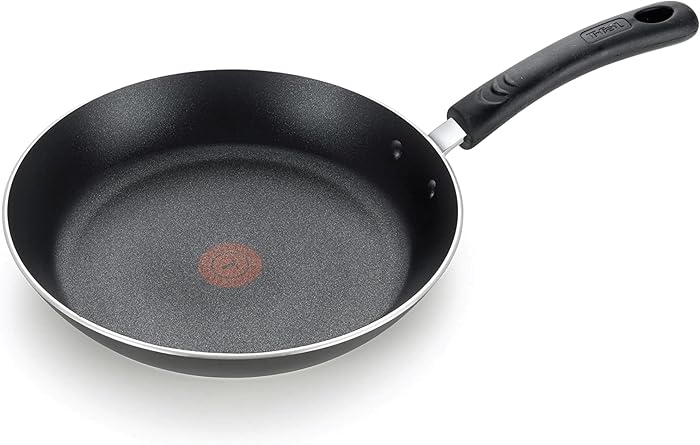
The ring in the middle of this pan's cooking surface turns solid red when it is properly preheated, and on a glass induction top — where there's no flame to read — that's information you can't get any other way. We found it genuinely useful for pancakes and for searing, where the gap between a pan that's ready and one that isn't is the gap between a crust and a stuck mess. It's the most useful 12-inch skillet here for anyone who cooks by feel.

At 12 inches and 4 quarts it's a batch pan: four chops at once, a full pan of stir-fry, enough pancakes for a family. The aluminum body is light for its size at a listed 2.5 pounds, so you can lift it with one hand and toss rather than stir, and the Platinum coating releases better than the budget pans in this guide. It's also dishwasher safe, which is uncommon in this group.

Plan around the 400 °F oven rating: it will finish a frittata or keep a platter warm, but it isn't the pan for a broiler sear, and the coating is happiest below the top of the dial. Used within those limits it's a lot of pan for the money.

Worth Noting

  • Can warp under sustained high heat
Our Verdict

A big, light batch pan with a heat indicator that takes the guesswork out of preheating; we reach for it for pancakes and a full pan of chops.

Check Latest Price
4

All-Clad HA1 Fry Pan Set Best Splurge

All-Clad HA1 Fry Pan Set

Oven finishing

Our Score 93/100
Weight
5 lb
Oven Safe To
500 °F
Set Includes
8-inch and 10-inch fry pans
Dishwasher Safe
Yes
View on Amazon

The All-Clad HA1 set is the most expensive pick here, so it has one question to answer: what do two nonstick fry pans do that one cheaper skillet doesn't? The short answer is a hard-anodized body over a stainless base, a 500 °F oven rating and dishwasher-safe cleaning — a combination nothing else in this guide offers.

The answer, for us, is yes when your cooking regularly moves from the hob into the oven. Most nonstick pans here stop at 400 °F and ask to be hand washed; these don't, and the 8- and 10-inch pair covers everything from a two-egg breakfast to a couple of pork chops finished with a pan sauce. The 10-inch gets the most use from us.

The weight is what you pay for that construction. These are dense pans — the pair is listed at 5 pounds — and the 10-inch takes some wrist when it's full, though the mass is also why the bases sit so flat and stay that way on a glass top.

If you only ever cook on the hob surface, the SENSARTE deep pan does most of this work for far less money, and it's the one we point budget-minded cooks toward. The All-Clad set earns its place when the oven is part of your routine.

Worth Noting

  • Coating wears sooner than the price implies
  • Handles don't suit every grip
Our Verdict

We think it's worth the money if you finish dishes in a 500-degree oven or run pans through the dishwasher; cook only on the hob and a cheaper skillet does the job.

Check Latest Price
5

SENSARTE Ceramic Deep Frying Pan Best for One-Pan Meals

SENSARTE Ceramic Nonstick Frying Pan Skillet with Lid

Family meals

Our Score 92/100
Coating
Ceramic, PTFE-free
Capacity
5 quarts
Diameter
12 inches
Oven Safe To
550 °F
View on Amazon

Five quarts of pan is heavy before you put anything in it, and that's the honest starting point with this one. The helper handle at the front is what makes it work: with a hand on each side you can lift a full pan of braise off the hob and pour without bracing it against the counter.

The ceramic coating is the reason to choose this over the granite-finished pans here. There's no PTFE, PFAS, PFOA or lead in it, it's rated to 550 °F with the handle removed, and it's the deepest pan in this guide — stir-fry, shallow fry, braise and simmer all happen in the same vessel, and the lid lets you walk away from it.

We think of it as the family-dinner pan: it browns and deglazes as well as anything here, the lid turns it into a braiser, and the size means one pan rather than two. It is not the pan for a two-egg breakfast — five quarts of surface around a single egg wastes heat.

Worth Noting

  • Hand wash only
  • Handle fittings can work loose
Our Verdict

We choose it when one pan has to feed four: five quarts, a lid and a helper handle make it a genuine one-pan workhorse.

Check Latest Price
6

Utopia Kitchen 3-Piece Frying Pan Set Best Budget Set

Utopia Kitchen Nonstick Frying Pan Set 3 Piece 8 9.5 11 Inch PFOA Free Grey

Starter kitchens

Our Score 91/100
Sizes
8, 9.5, and 11 inches
Handle
Riveted Bakelite
Pieces
3
Free Of
PFOA, lead, cadmium
View on Amazon

Three pans — 8, 9.5 and 11 inches — for about what one midrange skillet costs. That's the pitch, and for a first induction kitchen it's a good one: a small pan for eggs, a middle pan for two people and a wide one for a family dinner, all with induction bottoms and riveted Bakelite handles.

The pans are aluminum with a nonstick coating free of PFOA, lead and cadmium, and they're light — noticeably lighter in the hand than the deep SENSARTE pans. On the hob they heat quickly and the coating releases eggs and pancakes cleanly, and cleanup is a wipe and a rinse as long as you don't char anything.

The trade-off is mass. Light pans are fussier about which ring they sit on: the 8-inch works best on the small zone, and putting it over a wide one leaves the rim cool while the middle gets busy. Match pan to zone and the set behaves; ignore it and the smallest pan will disappoint.

We keep recommending this set to people who have just bought an induction range and want to re-equip without spending much. The 11-inch does the family cooking, the 8-inch handles breakfast, and the light weight makes all three easy to live with.

Worth Noting

  • No lids with any of the three
Our Verdict

We like it as a first set for a new induction kitchen: three useful sizes, light in the hand, and enough pan for a family dinner.

Check Latest Price
7

Cuisinart Chef's Classic Skillet Best Uncoated Stainless

Cuisinart Chef's Classic 8 In. Stainless Steel Open Skillet

Searing and browning

Our Score 90/100
Weight
1.9 lb
Diameter
8 inches
Oven Safe To
500 °F
Dishwasher Safe
Yes
View on Amazon

There is no coating on this pan to peel, flake or scratch, which is the entire argument for it. The body is stainless steel with an aluminum disc encapsulated in the base, that base is magnetic enough for induction, and the pan is oven safe to 500 °F and dishwasher safe — a combination none of the coated pans here manages together.

What stainless asks in return is technique. You preheat the empty pan for a minute or two, add fat, and let food release itself rather than tearing it off the surface; do that and you get a crust and the browned bits for a pan sauce that a nonstick surface can't give you. It also takes metal utensils, which is more than most of this group can say.

At this size it's the two-egg, one-steak, one-pan-sauce skillet, and the one we point to if you're tired of replacing nonstick pans. The lifetime warranty backs that up, and the mirror finish goes in the dishwasher, though a machine run will dull it.

Worth Noting

  • Eggs stick without enough fat and heat
Our Verdict

This is our pick for a small pan that never needs replacing for coating wear — provided you're willing to learn the preheat.

Check Latest Price
8

Kordisen Nonstick Frying Pan Best for Two-Egg Breakfasts

Kordisen Non Stick Frying Pan Skillet

Two-egg breakfasts

Our Score 89/100
Weight
1.5 lb
Capacity
1.3 quarts
Diameter
8 inches
Pour Spouts
Two
View on Amazon

Two pour spouts, one on each side, is the detail that sets the Kordisen apart from the other small pans here. Tip the pan and the fat from your bacon or the sauce from a single chop goes into the bowl instead of down the outside — a small thing you notice every time you use it.

The rest of the design follows the same logic. There are no screw heads inside the cooking surface, so there's no ring of baked-on residue around the handle, and at 1.3 quarts the pan is a little deeper than a typical 8-inch skillet, which keeps bacon fat and a two-egg scramble where they belong.

On induction it heats quickly and evenly, and the coating releases cleanly with a little fat. The Bakelite handle stays cool enough to move the pan without a towel, which matters more here than on a big pan because your hand is close to the rim.

For one- and two-person kitchens, this is the small pan to get. The pour spouts and the clean interior make it more useful than its size suggests, and it has been the most pleasant surprise in this group.

Worth Noting

  • Hand wash only
  • 8-inch surface suits one or two
Our Verdict

We recommend it for one- and two-person kitchens: pour spouts, a clean interior and steady heat make it the small pan we reach for most.

Check Latest Price

How We Chose and Tested Induction Frying Pans

We started by pulling every induction-compatible frying pan we could find, then narrowed the list by size, surface, and construction: 8-inch egg pans, 10- and 12-inch skillets, deep pans with lids, nonstick and ceramic coatings, stainless steel, singles, and sets. We ended up with 12 pans and cooked with them over six months on both a portable induction burner and a full-size induction range. First, each pan got a flatness check—I set it on the burner, pressed the rim, and watched for wobble—and a magnet test to confirm the base would actually engage. Then we cooked.

For coated pans, most mornings meant eggs: fried without added fat to see where they stuck, then scrambled hard to check cleanup. At dinner, we seared chicken thighs and skin-on fish, watching for pale rings and torn skin, and simmered tomato sauce for 30 minutes before hand-washing each pan. We grabbed handles bare-handed after a long simmer and with a towel during a hot sear, noting which ones turned uncomfortably warm. We also stacked pans in a cabinet with towels between them, ran safe models through the dishwasher, and checked repeatedly for scratches, coating wear, loose handles, and bases that stopped sitting flat.

For sets, I counted only the sizes I actually reached for; unused pans don't count as value. Value came down to how the pan performed after repeat washes, not the number on the shelf. The pans that scored best kept their coating intact, cleaned up with a soft sponge, and moved from a gentle egg to a hard sear without hot spots. We'll keep using them and update if anything changes.

How to Choose Frying Pans for Induction Cooktops

The Base Does the Work

An induction hob only heats what is magnetic and in full contact with the glass. Every pan here bonds a magnetic stainless base to aluminum, which is why they come up to heat quickly — and why a base that flexes under high heat cooks unevenly and can slide around the zone. Look for a bonded base and a genuinely flat bottom rather than a pan that merely says induction on the box.

Then match the base to the ring you'll use. A small pan on a wide zone concentrates heat in the middle, and a wide pan on a small zone heats at the rim and not much else. If you're unsure whether a pan you already own will work, a fridge magnet that clings to the base is the whole test.

Size and Depth, Decided by the Meal

An 8-inch pan is a two-egg, one-sandwich pan. A 10-inch pan with walls around 2.7 inches deep, like our top pick, holds about 3.5 quarts — enough to brown chicken and then simmer it without reaching for a pot. A 12-inch deep pan runs to 5 quarts and feeds four without crowding.

Depth costs weight, so think about lifting before you buy. Deep pans with a helper handle at the front are far easier to move when full, and a lid turns a frying pan into a braiser for the same cupboard space.

Coating, or No Coating

Granite-style nonstick releases eggs with the least fat and tolerates a hot pan; ceramic is the choice when you want a cooking surface with no PTFE or PFAS in it at all. Uncoated stainless has nothing to wear out and gives you the browned bits that make a pan sauce, but it demands a proper preheat and enough fat.

Pick on what you cook most, not on the name printed on the coating. If most of your meals start with eggs, a coated pan is the easier tool; if they start with a steak and end with a pan sauce, stainless earns its keep.

Oven Limits, Handles and Washing Up

Coated pans here top out between 400 and 550 °F, and the highest number tends to come with a condition — one pan in this guide is rated to 550 °F only with its handle removed. Treat any oven rating as a hard ceiling if you finish food under the broiler or in a hot oven.

Hand washing keeps a coating alive longer than the dishwasher, and a pan with no rivets on the inside is faster to clean. On induction, stay-cool handles matter more than they do on gas, because the glass around the pan stays hot long after you turn the zone down.

Frequently Asked Questions

Final Verdict

Our pick for most induction kitchens is the SENSARTE deep frying pan: the base heats quickly and stays flat, and 3.5 quarts of depth plus a lid means it earns its place on the hob at dinner, not just at breakfast.

If you regularly move a pan into a 500-degree oven or want it in the dishwasher, the All-Clad HA1 set is the better buy. And if you want a pan with no coating to lose, add the Cuisinart skillet.