Best Espresso Machines of 2026

A home espresso machine is a small act of faith. You pay up front, then spend the first month finding out whether the shots come out sweet or sour, whether the steam wand textures milk or just blasts hot air into it, and whether the drip tray is quietly leaving a puddle on your counter. The right one turns a six-dollar morning habit into a two-minute ritual you actually control.

I've been pulling shots in my own kitchen for years, and over the past eight months we worked through 12 machines, from bare-bones manuals to compact models with grinders built in. What separated them wasn't looks — it was consistency, shot after shot, and whether anything leaked, rattled, or got annoying to clean by week three.

One spec shoppers overrate is the pressure number on the box; 15 bar or 20 bar is marketing more than measurement, since grind and temperature stability decide what lands in your cup. Whether you want a grinder built in matters more — it saves counter space but limits your upgrade path. Here's what earned a spot.

Our Top Picks

The 7 Best Espresso Machines of 2026

1

Breville Barista Express Best Overall

Breville BES870XL Barista Express Espresso Machine

All-in-one daily brewing

Our Score 91/100
Weight
30.4 lb
Grinder
Built-in conical burr
Footprint
12.5"W x 13.8"D x 15.9"H
Temperature Control
PID
View on Amazon

Just under 16 inches tall and 30.4 pounds, the Barista Express is the price of admission for a grinder, a brew head, and a steam wand in a single body — so measure the gap under your upper cabinets before you commit. We think the bulk is worth it. The conical burr grinder doses straight into the portafilter, which means no second appliance, no bag of pre-ground coffee going stale beside the toaster, and one less thing to plug in.

The internals are why it holds up as a recommendation. Digital temperature regulation holds brew water steady shot to shot, and low-pressure pre-infusion wets the puck before full pressure arrives, cutting the channeling that leaves a shot tasting sharp and thin. The practical effect is responsiveness: change the grind one step and you taste it, which is exactly the feedback loop a new barista needs.

The steam wand is manual, and that is the right call at this level. It has enough power to turn a pitcher of cold whole milk into glossy microfoam quickly once you have the motion down, and the included razor dose tool and integrated tamper take some of the guesswork out of how much coffee is in the basket. Your first several pitchers will be too stiff, and then one will be right.

Two things to plan around: the height rules out some shelf-lined counters, and the grind collar rewards patience — budget a bag of beans for finding where your roast wants to sit. What you get in return is the most repeatable workflow in this group, one where the fourth shot of the morning tastes like the first.

Worth Noting

  • Tall 15.9-inch body needs cabinet clearance
  • First week of shots is a real learning curve
Our Verdict

We recommend the Barista Express to anyone who wants one machine to grind, brew, and steam without a counter full of separate gear.

Check Latest Price
2

Gaggia Classic E24 Best for Espresso Purists

Gaggia RI9380/46 E24 Espresso Machine

Tinkering and repairs

Our Score 90/100
Valve
Three-way solenoid
Weight
20 lb
Portafilter
58 mm commercial
Pump Pressure
9 bar
View on Amazon

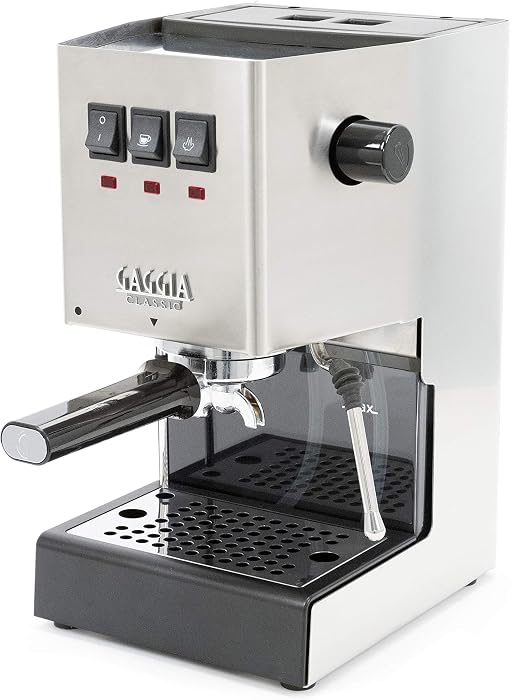
The 58 mm portafilter is the number that matters on the Classic E24. It is the commercial size, so baskets, tampers, and levelers built for café machines drop straight in, and the same dose sits in a wider, deeper bed that forgives a slightly uneven tamp better than a 51 mm basket does.

Under the steel housing sit a three-way solenoid valve, a commercial steam wand, and 9 bar of extraction pressure — café hardware scaled to a countertop. There is no grinder and no PID, so you supply the grind and manage temperature yourself. We think that is a feature for the right buyer: fewer electronics to fail, a machine that comes apart with ordinary tools, and parts you can actually order. Of everything here, it is the one built to be repaired rather than replaced.

It is also the plainest machine in the group, and the wand can drip between uses, so keep a cloth within reach. Budget for a burr grinder before you buy or the 58 mm basket is wasted. Buy it if you want one machine for a decade and do not mind learning its moods; skip it if you want a one-button latte before work.

Worth Noting

  • No grinder or PID included
  • Steam wand can drip between uses
Our Verdict

We point anyone who wants café-grade parts and a machine they can repair themselves to the Classic E24.

Check Latest Price
3

CASABREWS CM5418 Best Budget Pick

CASABREWS CM5418 Compact Espresso Machine with Milk Frothing Steam Wand

Budget dialing-in

Our Score 89/100
Footprint
5.5"W x 12.3"D x 12"H
Water Tank
34 oz
Pump Pressure
20 bar
Pressure Gauge
Built-in
View on Amazon

A pressure gauge is the cheapest education an espresso machine can give you. On the CM5418 the needle moves while the shot pulls, telling you whether the puck is resisting the water the way it should: if it never climbs, grind finer or dose more; if it spikes and the flow sputters, back off. That is faster feedback than any tutorial.

The rest of the package is sensibly small — a 5.5-inch-wide stainless body, a 34-ounce removable tank, a 20-bar pump, 51 mm baskets, and a steam wand with better control than most budget machines manage. One quirk is real: after steaming, the machine has to cool before it will brew, so pull your shots first and steam second rather than working in parallel.

For the money, that is an easy trade. This is the least expensive machine in our group with a gauge, and we rate it above the other budget machines here for anyone still learning, precisely because it tells you what it is doing while you learn. The 51 mm basket is the compromise — fewer precision baskets and levelers fit.

Worth Noting

  • Must cool down between steaming and brewing
  • 51 mm baskets limit accessory choices
Our Verdict

We call this the budget pick because a pressure gauge makes learning cheap and the small body fits almost anywhere.

Check Latest Price
4

De'Longhi Stilosa Best for First-Timers

De'Longhi Stilosa Compact Manual Espresso Machine

First manual machine

Our Score 88/100
Boiler
Stainless steel
Weight
8.6 lb
Water Tank
1000 ml
Pump Pressure
15 bar
View on Amazon

If you have never locked a portafilter into a group head, the Stilosa is the least intimidating espresso maker to start on. One dial on the side switches between brew and steam, the scoop doubles as a tamper, and the single and double baskets take the guesswork out of dose. The stainless steel boiler heats quickly, the body is under 10 inches wide, and the wand is easy to control for a first cappuccino.

Temperature is the weak spot. The Stilosa can run cool, and a lukewarm shot tastes flat no matter how good the beans are — so run a blank shot through the empty portafilter to heat the group and the cup before you dose. Do that and it delivers genuinely solid espresso for the money, with a wand that beats the automatic frothers on similarly priced machines. It will not be the last machine you own, but it is a fine first one.

Cleanup is genuinely easy: the baskets rinse, the wand wipes, and the drip tray lifts out. What it will not do is grow with you — there is no gauge, no PID, and no route to a 58 mm basket.

Worth Noting

  • Steam wand drips during use
Our Verdict

We hand the Stilosa to anyone pulling their first shots: one dial, two baskets, and a wand that behaves.

Check Latest Price
5

AMZCHEF Compact Espresso Machine Best for Tiny Kitchens

AMZCHEF Compact Espresso Machine 20 Bar

Tiny kitchens

Our Score 87/100
Heat-up
30 seconds
Footprint
7"W x 12.5"D x 14.4"H
Pump Pressure
20 bar
Temperature Control
PID
View on Amazon

The least expensive machine here, and it does not apologize for it: a 20-bar Italian pump, a PID temperature controller, a 30-second heat-up, and one-touch buttons for single and double shots. For someone who wants one latte a day without taking up a hobby, that is the correct priority list — heat fast, press a button, steam the milk, get on with the morning.

The plastic body is the trade. At 8.2 pounds it does not plant itself the way a 20-pound steel machine does, so keep a hand on top when you lock the portafilter in. The 360-degree rotating wand is a nice touch in a corner, the housing wipes clean, and at 7 inches wide it slides under a shelf that would stop most machines here. We think of it as a starter machine that does not pretend to be a lifer, and at this price that is a fair bargain.

Worth Noting

  • Light plastic body needs a steadying hand
Our Verdict

We pick it for a small counter and a small budget: fast heat-up, one-touch shots, and a wand that swings into tight corners.

Check Latest Price
6

CASABREWS 3700 Essential Best for Batch Milk Drinks

CASABREWS 3700 Essential Stainless Steel Espresso Machine with Steam Wand

Batch milk drinks

Our Score 86/100
Weight
8.1 lb
Footprint
6.5"W x 13"D x 12.1"H
Water Tank
43.9 oz
Pump Pressure
20 bar
View on Amazon

Same brand, same 20-bar pump, less money, no gauge. The 3700 Essential is the CM5418 with the dial removed and the tank enlarged to 43.9 ounces — the version to pick if you pull four drinks in a row and do not want to refill halfway through.

It is still compact at 6.5 inches wide and 8.1 pounds, and the brushed stainless finish is the same one that draws compliments on its sibling. Losing the gauge costs you something real: without it you read a shot by time and taste rather than pressure, which is a slower way to learn but not a worse one once your grinder is dialed.

For a household that makes milk drinks in batches, the bigger tank makes this the more practical of the two CASABREWS machines, and the wider stance sits more securely while you lock in the portafilter. For a beginner still chasing a grind, pay the difference for the gauge instead.

Worth Noting

  • No pressure gauge for dialing in
  • Wider and deeper than the CM5418
Our Verdict

We recommend the 3700 Essential to anyone making several milk drinks at a time who does not need a gauge to get there.

Check Latest Price
7

AMZCHEF Espresso Machine with Grinder Best for Grinder-First Upgraders

AMZCHEF Espresso Machine with Grinder

Grinder-first upgraders

Our Score 85/100
Weight
13 lb
Grinder
40 settings, conical burr
Water Tank
1.8 L
Portafilter
58 mm
View on Amazon

Three readouts sit on the front panel: grind time, brew time, and temperature. That sounds like decoration until you are three bags into learning a machine and want to know why this shot ran 22 seconds when the last one ran 28.

The hardware behind the screen is the interesting part. A 40 mm conical burr grinder with 40 settings doses in half-second increments, and the portafilter is 58 mm — commercial size, so standard baskets, tampers, and levelers fit. Two-stage pre-infusion and a 20-bar pump handle the brew side, and a pressure relief system gives abnormal pressure somewhere to go.

It also runs hot water, cold brew, and steam from a 1.8-liter tank, inside a 13-pound body 10.4 inches wide. The grinder and steam components come off for cleaning, which matters more on an all-in-one than on any other design: spent grounds sitting in a burr chute are the fastest way to make good beans taste stale.

What we like is the order the money was spent in — a real burr grinder and a commercial-size basket first, the screen second. That ordering is what makes it worth a look when you want the Breville workflow without the Breville bulk, and plastic panels are the trade you accept for the price.

Worth Noting

  • Plastic body panels
  • Touch panel instead of physical knobs
Our Verdict

We like it for anyone who wants a built-in grinder and a 58 mm basket without paying Breville money.

Check Latest Price

How We Tested the Best Espresso Machines

We started with every current model we could get our hands on, then narrowed by footprint — if a machine couldn't sit under a standard upper cabinet with room to fill the tank, it was out — and by what came in the box, since one that ships without a tamper or a decent basket is a hidden cost. We read owner reviews hunting for repeat complaints about leaks, dead pumps, and lukewarm shots, and cut anything showing a pattern. Twelve machines survived, and we ran them for eight months.

They lived on my counter through weekday mornings, when I'm half awake and working one-handed, and through lazier weekend rounds of milk drinks for two. The hardest scene was a dinner party pour of six cappuccinos back to back, which shows how fast a machine recovers between shots and whether the steam wand holds up pitcher after pitcher. Every machine got the same medium-roast beans and the same scale.

We timed switch-on to first shot, then pulled three in a row, tasting each for sourness or bitterness and checking the temperature of the second and third to catch drift. We weighed dose in and yield out so the differences we tasted belonged to the machine, not to us. For milk, we steamed a fixed pitcher and watched how long glossy microfoam took and whether it scorched. Cleaning got its own pass: how many parts come off, whether the drip tray and group head wipe clean, how fiddly a backflush is.

We checked underneath each machine for drips after a week of daily use, slid them across the counter to see whether the feet held, and lived with the housings long enough to know which finishes scratched or felt cheap. Counter presence counted too — these sit out all day, and a few of them look it.

How to Choose an Espresso Machine

Start With the Grinder, Not the Machine

Espresso is a grind problem before it is a machine problem. A built-in burr grinder like the one on the Barista Express saves counter space and a step, but it also means one warranty covers everything. Buying separate lets you upgrade the grinder first and carry it through two machines.

What you cannot do is skip it: pre-ground coffee in a pressurized basket produces something coffee-colored and flat, and you never learn what a grind adjustment does. If the machine has no grinder, price a burr grinder into the total before you buy anything else.

Manual Wand or Automatic Frother

A steam wand gives you microfoam — wet, glossy milk that folds into latte art — and it takes a few weeks to learn. An automatic frother is one button and produces stiffer foam closer to whipped cream.

On most single-boiler machines the wand also costs you time: the machine has to cool after steaming before it will brew again, so shots come first and milk second. If you drink two cappuccinos back to back every morning, weigh the cooldown as heavily as the foam.

Pressure, Baskets, and the Numbers That Matter

Ignore the bar-count arms race. A 20-bar pump is a headline; espresso extracts at roughly 9 bar at the group, and what separates machines is how steadily they hold temperature and how well the basket is made.

Basket diameter is the more useful number. A 58 mm commercial basket takes standard tampers, levelers, and precision baskets; a 51 mm basket works fine but narrows your options. Put the money into temperature control and basket size before pump pressure.

Measure the Counter Before You Fall in Love

Height is the spec that ruins the most purchases. Our tallest machine stands 15.9 inches, which is fine under a typical 18-inch cabinet gap and hopeless under a low shelf or a cabinet that runs close to the counter.

Depth matters too: leave room behind for the plug and above for the tank lid. A 30-pound machine stays where you put it, so plan your cleaning routine around reaching it rather than moving it.

Water, Cleaning, and What It Costs to Keep Running

Tap water is the slow killer. Scale builds in the boiler and on the shower screen and changes the taste long before the machine stops working, so filtered water and a descaling schedule are cheaper than a repair. Backflushing with a blind basket takes a minute a week on machines with a three-way valve.

Whole beans cost less per shot than capsules or café drinks, which is where a machine earns back its price.

Frequently Asked Questions

Final Verdict

The Breville Barista Express is the machine we point most people to: a grinder, a brew head, and a steam wand in one body, with PID control and pre-infusion that shorten the learning curve more than the price suggests.

If you already own a good grinder and want commercial parts you can service yourself, the Gaggia Classic E24 is the better long-term buy. On a tight budget, the CASABREWS CM5418's pressure gauge is worth the small step up from the cheapest machines here.