Best Duvet Inserts of 2026

A duvet insert is the part of the bed nobody looks at and everybody feels. The cover gets all the credit, but the insert sets the temperature — it's the layer that decides whether you sleep through the night or wake up at 3 a.m. kicking everything off. That makes it a strange thing to shop for, because you're buying warmth, softness, and loft from a photograph and a fill-weight number that tells you less than you'd expect. Heavier doesn't automatically mean warmer; how the fill is held in place and how much air it traps matter more.

Over the past eight months, my team and I have slept under 12 of them — in a primary bedroom, a guest room, and a twin bed in a kid's room, with a hot sleeper and a cold sleeper trading sides to compare notes. What separated the good ones turned out to be unglamorous stuff: how soft the shell felt against bare shoulders, whether the fill stayed put along the seams, and whether the whole thing whispered every time someone rolled over. The winners weren't the priciest ones in the stack, either.

One thing I wish someone had told me earlier: corner tabs are not a formality. An insert that ties into all four corners — better yet, eight — is the difference between a cover that stays smooth and one that bunches into a lump at the foot of the bed by morning. The picks below are the ones that held their shape, for hot sleepers, cold sleepers, guest beds, and everything in between.

Our Top Picks

The 10 Best Duvet Inserts of 2026

1

Bedsure Down Alternative Comforter Best Overall

Bedsure Down Alternative Comforter

Everyday all-season use

Our Score 97/100
Fill
Polyester down alternative
Size
88 x 88 in (Queen)
Weight
6 lb
Attachment
8 corner tabs
View on Amazon

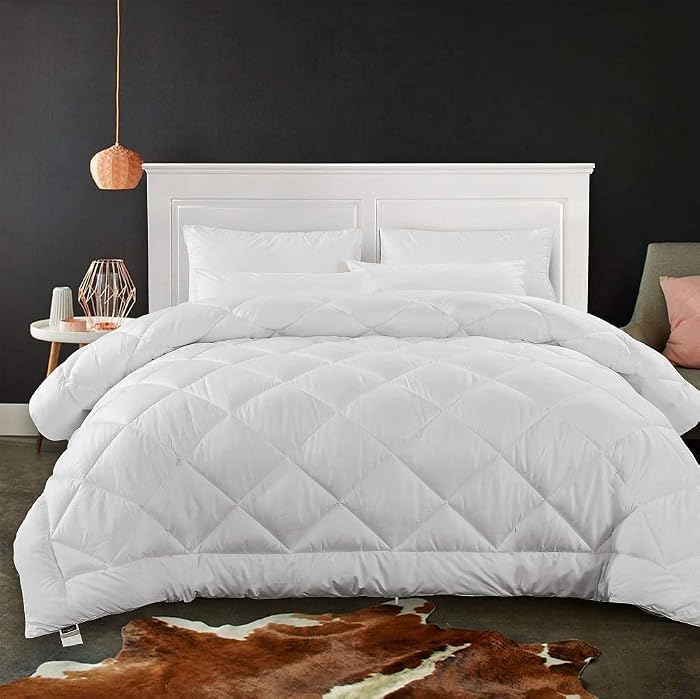
Eight attachment tabs are the reason this one earns the top spot rather than a mention further down. Thread them through the ties inside a duvet cover and the insert stays spread across the bed instead of sliding into a heap at the foot, which is the failure that makes people give up on covers altogether. At 6 pounds for a queen it is light enough to flip one-handed while you are making the bed, and the box stitching keeps the polyester where it belongs instead of drifting into the corners.

We expected an inexpensive insert to sleep hot and this one does not. The fill sits about 1.18 inches thick, so it adds shape under a cover without the trapped-heat feeling of a heavy comforter, and it works from spring through fall in a normal bedroom. What it will not do is give you the deep, puffed-up hotel look: the loft is honest but modest, and under a thin cover you see a flat blanket rather than a cloud.

Care is genuinely low-effort — cold machine wash, low tumble, and it comes out square — though it needs a day or two to decompress after the vacuum pack, so do not judge the loft in the first hour. The queen is a true 88 by 88 inches and drapes properly on a standard mattress; measure your cover as well as your bed before you commit.

Worth Noting

  • King size runs small for a king bed
Our Verdict

This is the insert we point most people to: eight tabs keep it anchored, the loft breathes instead of trapping heat, and it costs less than almost everything else here.

Check Latest Price
2

Cozynight King Comforter Best for King Beds

Cozynight Soft King Size Comforter Duvet Insert-Lightweight Down Alternative

Generous king coverage

Our Score 96/100
Care
Machine wash cold
Fill
250 gsm whole-piece polyfill
Size
106 x 92 in (King)
Weight
6 lb
View on Amazon

At 106 by 92 inches, this is the king insert we reach for when the bed has to look made rather than skimpy. That extra width is the difference between a cover that hangs over the sides and one that stops at the mattress edge and leaves the sheet showing. Plenty of king inserts are generous on paper and barely there in practice; this one measures wider than everything in the guide except the oversized Egyptian Bedding.

The fill is a 250 gsm whole-piece polyfill quilted in a diamond pattern rather than loose clusters, so you do not get the cold spots that appear when filling migrates to the corners. It has stayed even across the bed for us, and the brushed microfiber shell is smooth under the hand while you are wrestling a cover around it.

Washing is cold water and a low tumble, and the diamond quilting comes out of the dryer still square. We also appreciate the size range: nine options, including California king and oversize king, which is usually where this category gets annoying if you have an unusual frame.

Worth Noting

  • Light fill; cold sleepers may want more
Our Verdict

Buy this one if your king bed needs drape at the sides; 106 inches of width fixes the skimpy-cover problem better than anything else here.

Check Latest Price
3

COHOME All-Season Comforter Best Lightweight Pick

COHOME All-Season Comforter – All-Season Queen Size Cooling Comforter Duvet Insert

Light, airy comfort

Our Score 95/100
Care
Machine wash, tumble low
Fill
Whole-piece polyester
Size
88 x 88 in (Queen)
Warmth
Lightweight
View on Amazon

Ignore the cooling in the name. This is a light, breathable insert that most people will sleep comfortably under, but it holds more warmth than the marketing implies, and a hot sleeper who buys it expecting a chill will be disappointed. In a bedroom that already runs cool, that is not a problem — it is the reason it works from fall through spring.

Where it earns its place is inside a cover. The whole-piece polyfill resists the clumping that turns an inexpensive insert lumpy after a few washes, and the box stitching holds the panels square, so the cover does not develop that half-empty, rumpled look. It also washes and dries without losing shape, which counts for more on a light insert than a heavy one — there is less fill to hide a collapsed seam.

The 88-by-88 queen covers a queen mattress with drape at the sides, and the smooth shell lets a cover slide on without a wrestling match. Pair it with something that has a little structure of its own and it reads as a far more expensive insert than it is.

Worth Noting

  • Loft is thinner than the photos suggest
Our Verdict

For a light, airy layer inside a cover that will not clump after washing, we like this one — just do not buy it expecting the cooling its name promises.

Check Latest Price
4

Bare Home Duvet Insert Best for Twin and Twin XL

Bare Home Duvet Insert Comforter (Twin/Twin XL

Twin-size beds

Our Score 94/100
Fill
Polyester microfiber
Size
66 x 92 in (Twin/Twin XL)
Weight
4.9 lb
Attachment
8 duvet loops
View on Amazon

Twin beds get the leftovers in this category, which is why this one is here at all. At 66 by 92 inches it fits both a standard twin and the longer twin XL, so the same insert works on a dorm bed, a bunk, and an adjustable base without a special order — and it comes with eight duvet loops rather than the four corners you otherwise settle for at this size.

The microfiber shell is the silkiest in this group; it is the one we noticed by hand before it ever went on a bed. Warmth is moderate and even, and at 4.9 pounds it is light enough that a kid can drag it around without the whole thing landing on the floor. For a small bed in a guest room or a dorm, that combination is hard to beat.

Care is a gentle cold cycle and air drying or a low tumble, and the 30-night return window takes some of the risk out of buying bedding sight unseen. For a dorm or a first apartment, that is about as low-stakes as bedding gets.

Worth Noting

  • Seams can open after the first wash
Our Verdict

If you are outfitting a twin or twin XL, this is the size to get: one insert covers both, with enough loft to look made.

Check Latest Price
5

Serta Goose Feather & Down Fiber Best Feather-And-Down Fill

Serta Goose Feather Down Fiber Comforter Queen Size

Natural feather fill

Our Score 93/100
Care
Dry clean only
Fill
90% feather fiber, 10% down fiber
Size
90 x 90 in (Queen)
Cover
100% cotton, 233 thread count
View on Amazon

The first thing you notice is the sound. The cotton shell and feather fill rustle when you turn over, and in a quiet bedroom it is genuinely audible — if you are a light sleeper who notices every crinkle, that alone ends the conversation. Everyone else gets the thing polyester cannot imitate: weight and drape that settle over you instead of floating on top.

Under the cover is 90 percent white goose feather fiber and 10 percent goose down fiber, sewn through in a box pattern so the fill does not slide into the corners overnight. It is rated medium warmth, which in practice means it handles a cold January bedroom and does not roast you in April — the balance we want from a year-round insert. The 233-thread-count cotton is the other half of why it feels expensive: it breathes where microfiber sits on your skin.

At 90 by 90 inches the queen is cut more generously than the standard 88-inch square, so there is real drape at the sides even with a cover on. It is the least expensive natural-fill insert in this guide, which is why it is our feather pick rather than the plusher options further down.

Worth Noting

  • Dry clean only
Our Verdict

Choose this when you want the drape and weight of feather and down without a luxury price, and you can live with dry cleaning.

Check Latest Price
6

Utopia Bedding Duvet Insert Best Budget

Utopia Bedding Queen Duvet Insert

Budget guest rooms

Our Score 92/100
Fill
Polyester
Size
88 x 88 in (Queen)
Weight
4.4 lb
Certification
OEKO-TEX
View on Amazon

Two things stand out on an insert this inexpensive: OEKO-TEX certification and corner tabs. The certification is the more meaningful of the two — the fabric and fill have been screened against a list of restricted substances, which is not something every budget insert bothers with. The tabs mean it works inside a cover instead of sliding around loose.

At 4.4 pounds for a queen, it is the lightest insert in this guide. That makes it the easy one to haul to a laundromat, wrestle into a cover alone, or store folded on a closet shelf between guests. It sleeps neutral in warm weather and the shell is soft in a plain, brushed way rather than silky.

It washes and tumbles on no heat, and the price of entry is low enough that keeping a spare in the closet is not absurd. Treat it as a summer and guest-room insert, layer a blanket underneath in January, and it does everything a first apartment asks of it.

Worth Noting

  • Thinner loft than the listing suggests
  • Seams can pull apart with repeated washing
Our Verdict

The one we hand to a first apartment or a guest room: certified, light, and the cheapest way to fill a queen cover here.

Check Latest Price
7

Lavish Comforts Down Alternative Best for Heavy-Cover Sleepers

Lavish Comforts Down Alternative – Down Alternative Comforter King Size

Heavy-cover sleepers

Our Score 91/100
Fill
Polyester
Size
104 x 86 in (King)
Warmth
Medium weight
Weight
7.7 lb
View on Amazon

7.7 pounds of insert is the whole pitch here. This is the heaviest duvet insert in the guide by listed weight, and it drapes like something much denser than the budget picks — the kind of cover that does not slide off when you roll over. If you want that heft without feather, this is the one that delivers it.

The fill is medium weight, closer to a winter comforter than a summer one, and hot sleepers should keep walking — this is for the person who keeps the thermostat low and wants the blanket to feel like something. Loft is not what you are paying for: the fill is dense rather than tall, so expect drape and substance more than a cloud.

The shell takes a cold machine wash and air drying without going stiff, and 104 inches of width gives a king proper drape at the sides. Nothing about it is exotic — it is a polyester insert — but it is the best execution of the heavy-cover idea in this set.

Worth Noting

  • Premium price for a polyester fill
Our Verdict

We recommend it to sleepers who like a heavy cover and will not pay for down; the fill is polyester, but the drape is real.

Check Latest Price
8

Amazon Basics Down Alternative Best for Guest-Room Kings

Amazon Basics White Down Alternative Comforter and Duvet Insert with Corner Tabs

Guest-room kings

Our Score 90/100
Care
Machine wash warm, tumble low
Fill
Polyester down alternative
Size
King
Weight
5.7 lb
View on Amazon

It arrives as a brick. This one is vacuum-sealed hard, and the 24 hours it takes to pull itself back into shape are the most important part of owning it: open the bag, spread it out, and give it a low tumble with a couple of dryer balls before you judge the loft.

What you get after that is a light king insert — 5.7 pounds spread over a very large surface. That is not enough fill for a cold bedroom as your only bedding, but it is exactly right for a guest room, a kid's bed, or a summer cover that needs to look made without sleeping hot. The shell is soft in a plain way and it takes a warm machine wash, which is more than a lot of bedding at this level promises.

Fit is the reason to consider it: king-sized coverage for less than most of the queens in this guide, with corner tabs to hold it inside a cover. For a spare room that sees a handful of guests a year, that math is hard to argue with.

Worth Noting

  • Sheds fiber and can tear in the wash
Our Verdict

A sensible way to cover a guest-room king for very little, as long as you are not asking it to be your only winter bedding.

Check Latest Price
9

EASELAND Down Alternative Comforter Best for Year-Round Main Beds

EASELAND Queen Size Down Alternative Comforter

Year-round main beds

Our Score 89/100
Care
Machine wash cold, tumble low
Fill
300 gsm whole-piece polyester
Size
88 x 88 in (Queen)
Cover
105 gsm brushed polyester
View on Amazon

A 105 gsm brushed cover sounds like a spec-sheet detail until you have slept under a crisp, papery microfiber shell. The brushed face is what makes this one feel warm to the touch when you first get in, rather than cool and slick, and it is the difference we noticed before anything else.

The fill is 300 gsm of whole-piece polyester, which is the all-season middle ground: enough body that a cover looks filled rather than collapsed, not so much that you are sleeping under a winter duvet in October. Box stitching keeps it distributed, and there are corner tabs for a cover's ties.

Nothing here is exotic — a polyester insert with the standard construction done properly. For a main bed or a guest room where you want a straightforward insert and do not want to think about bedding again, that is the appeal.

Our Verdict

We like it as the middle-of-the-road choice: 300 gsm fill and a brushed cover that feels warmer on contact than its price suggests.

Check Latest Price
10

Egyptian Bedding Goose Down Fiber Best for Oversized King Beds

Egyptian Bedding Goose Down Fiber – Luxurious King/Oversized King 108" x 98" Size Goose Down Fiber Waterfowl

Oversized king beds

Our Score 88/100
Fill
80% down fiber, 20% feather fiber
Size
108 x 98 in (Oversized King)
Cover
100% Egyptian cotton
Fill Weight
65 oz
View on Amazon

Sixty-five ounces of fill is a lot for a comforter, and it explains the rest: this is a heavy, lofty insert rather than a thin layer that disappears under a cover. It is also 108 by 98 inches, which means an oversized king finally gets drape at the sides and the foot instead of a cover that stops short.

Under the 100 percent Egyptian cotton shell sits 80 percent goose down fiber and 20 percent waterfowl feather fiber, held in baffle boxes so the fill stays lofty instead of settling into thin panels. We were struck by how much more substantial the cotton feels than the microfiber shells that dominate this list — it is the difference between a cover that feels like fabric and one that feels like brushed plastic.

Eight corner loops and tabs anchor it, which matters on an insert this size, and the price is the obvious hurdle — nothing else here covers an oversized bed this generously.

Worth Noting

  • Feathers can work their way through the shell
Our Verdict

For an oversized king that needs full drape and real loft, this is our pick — if the budget stretches and you can tolerate a stray feather.

Check Latest Price

How We Tested the Duvet Inserts

We started by rounding up the inserts shoppers actually compare — down alternative and feather-and-down fill, sewn-through diamond quilting and baffle box construction, sizes from twin up to oversized king — and filtered for the details that decide whether an insert works inside a cover: corner tabs, a machine-washable shell, and a fill weight that matches the season it's sold for.

Twelve inserts came home with us and stayed for eight months, rotating through a primary bed, a guest room, and a kid's twin. Two sleepers — one who runs hot, one who never warms up — slept under each for at least a week, in every season the calendar handed us, and overnight guests weighed in too.

We shook each one out of its packaging and watched how quickly it recovered its loft, then checked again after a week of sleeping to see whether it had flattened. Along the stitching we pressed for fill migration and cold spots, and we noted whether feathers worked their way through the shell or turned up on the sheets. Each insert got tied into a cover by its tabs, and at the end of every week we checked whether the corners had held.

Every insert went through the wash at least twice in a commercial-size machine, following the care label, and we compared what came out — even fill or clumps, smooth stitching or puckering, the same loft or a flatter version of itself. Noise got its own quiet-room check: we rolled over on purpose and listened. We sized each one on a standard mattress to see how far it hung past the sides, since an insert that's a couple of inches short looks wrong no matter how soft it is, and we only asked about value at the end, once we knew how each one had held up.

How to Choose a Duvet Insert

Polyester or feather: pick by how you sleep

Down-alternative polyester is the practical default. It is machine washable, it does not trigger feather sensitivities, and it holds its shape through a home laundry cycle without much fuss. Feather and down fiber give you weight and drape that polyester cannot copy, plus a cotton shell that breathes better against skin, but the care is often dry-clean only and loose feathers can work their way out over time.

Choose polyester if you want to wash the insert yourself and keep the initial cost down. Choose feather if you want a cover that settles over you rather than floating on top, and you are willing to baby it.

Read the fill weight, not the photo

Fill weight is where marketing and reality part ways. A 250 to 300 gsm polyester fill is the all-season middle ground and fills a cover enough to look made; below that you are buying a summer weight, and well above it you are into winter duvet territory. The listed thickness, usually somewhere between one and two inches, is closer to the truth than the styled photography, which is shot with a much loftier insert than the one in the box.

Match the fill to your bedroom rather than the picture. A cool-sleeping house usually lands on the lighter end of that range.

Measure for drape, not for the mattress label

A queen insert is usually 88 by 88 inches, and a king runs anywhere from 104 to 108 inches wide, so the word king on its own tells you very little. Add roughly 10 to 16 inches to your mattress width if you want the cover to hang over the sides and cover the sheet underneath.

On a deep mattress or an adjustable base, go to the wider or oversized size even when that means buying a size up from your bed. An oversized insert is also the simplest fix for two people who fight over the covers.

Count the tabs before you buy

Tabs are what turn a comforter into an insert. Four corner tabs match a cover with corner ties; eight tabs, or four corners plus side loops, hold the middle of the insert up so it does not sag between the ties.

Check both halves of the pairing. A cover with ties only at the corners cannot use side loops, and an insert with only corner tabs will drift in a generous cover. If you already own the cover, count its ties first and buy to match.

Care and construction decide how long it lasts

Seams fail before fill does. Box stitching or baffle-box construction keeps the filling where it belongs, but the stitching is the first thing to go in an agitator washer, so wash cold on gentle and tumble low or air dry. Natural fills ask for more: dry cleaning on many feather comforters, and a tight-weave cover to contain stray feathers.

Read the care label before you read the price. An inexpensive insert that has to be dry cleaned is not inexpensive.

Frequently Asked Questions

Final Verdict

Nine times out of ten, the Bedsure is the insert we tell people to buy. Eight tabs hold it where you put it, the loft breathes instead of trapping heat, and it costs less than almost everything else in this guide — which makes it the default rather than the compromise.

Covering a king, the Cozynight's 106-inch width earns its extra money. If you want feather drape and can live with the dry cleaner, the Serta is the one.