Best Desk Fans of 2026

A desk fan is a study in trade-offs. The ones that move real air tend to hum loud enough to invade a video call, while the ones quiet enough to disappear barely stir a stuffy room. I've worked next to a fan for years, and over the past four months my team put 14 of them to work in home offices, bedrooms, and kitchens. Get it right and air moves over you without adding another noise to the room.

Box specs are the least useful part of choosing. Decibel ratings rarely hold up in a room with a rug and a bookshelf, and airflow figures get measured on high with nothing in the way. What matters is where the air lands three feet from your face, whether the head holds its angle instead of drooping, and whether the base leaves room for a notebook.

The quieter details surface after a few weeks: a low setting that's genuinely soft, a housing that survives a knock off the desk, a price that feels fair for the shelf space it claims. The picks below answer those questions.

Our Top Picks

The 6 Best Desk Fans of 2026

1

Honeywell TurboForce HT900 Best Overall

Honeywell TurboForce Air Circulator

Focused personal cooling

Our Score 95/100
Tilt
90 degrees
Power
Corded electric
Speeds
3
Airflow
185 cfm
View on Amazon

The Honeywell TurboForce HT900 looks like a small table fan, but its job is air circulation: the 185 cfm rating and turbo-shaped grille push a focused column of air rather than a wide, gentle breeze. The head pivots through 90 degrees, so you can aim it at your face, across a desk, or toward a stuffy corner. At 2.6 pounds and roughly 9 inches wide, it fits on a shelf or nightstand without much fuss.

That combination makes it our top pick. We like a desk fan that can do more than one thing, and this one works as a personal fan at close range and as a small room circulator when you point it across the room. The three speeds are easy to reach, and the low setting is the one we keep coming back to for background air while working. The push-button controls are simple enough to work without looking.

The corded design is the main practical trade-off: you need an outlet, and the fan can also be wall-mounted if desk space is tight. Honeywell backs it with a one-year warranty. We think the HT900 is the strongest first buy for most people because it does the core job with fewer compromises than the budget USB fans here.

Worth Noting

  • Durability can fall short within a year
  • No oscillation, so coverage stays fixed
Our Verdict

We recommend the HT900 as the default desk fan for most people because it pairs serious focused airflow with a compact body and simple controls.

Check Latest Price
2

DREO 12-Inch Air Circulator Best for Whole-Room Circulation

DREO 12-Inch Air Circulator

Whole-room circulation

Our Score 94/100
Noise
25 dB
Speeds
3
Airflow
800 cfm
Air Reach
70 ft
View on Amazon

The DREO 12-inch is the fan here that acts like a room circulator first and a desk fan second. Its WingBoost blades and 70-foot reach are meant to push air across a room, and the 120-degree tilt lets you aim that column up, down, or across. That makes it our pick for whole-room circulation.

The listed 25 dB noise level applies to the quietest setting; higher speeds move more air and make more sound. We like the simple knob because you can find a speed without looking, and the tilt range is wider than most compact fans. The 35-watt motor is efficient for the amount of air it moves, and the wall-mount option is a real plus in a small office. The three speeds are enough to move from a background hum to a strong room breeze.

It is also the fan we reach for when a bedroom or home office feels stuffy but running the air conditioner feels excessive. The airflow is focused enough to feel at a distance, and the 120-degree tilt helps it clear a bed or desk. For a room that needs movement, it is the strongest choice in this set.

Worth Noting

  • Takes up more desk space
  • 25 dB rating only at lowest speed
Our Verdict

We think the DREO 12-inch is the right choice when your desk fan also has to move air across a bedroom or home office.

Check Latest Price
3

TriPole TF01 USB Desk Fan Best Budget USB Fan

TriPole Small Desk Fan USB Powered Mini Portable Fan 360°Rotation

USB desk cooling

Our Score 93/100
Tilt
360 degrees
Power
USB powered
Speeds
3
Weight
6.3 oz
View on Amazon

The TriPole TF01 is the fan you toss in a bag and forget about until a hotel room or office cubicle turns stuffy. Its 5.1-inch head, 6.3-ounce body, and 4.9-foot USB cable make it the most portable pick here, and the 360-degree tilt lets you aim the breeze up or down without moving the base. It is not a room cooler, but it is not trying to be.

USB power is the whole point: it runs from a laptop, power bank, or wall charger. We like that flexibility for a desk with a spare USB port, and the three speeds give you a useful range from a soft breeze to a stronger stream. The five-blade head moves more air than the size suggests, and the base stays put on a smooth desk.

Where it falls short is long-term durability: the housing and motor feel built to a budget, and some units break within a month. That makes it a fan we recommend for a second desk or travel bag rather than the only fan in a household. If you need a compact USB breeze and can accept that risk, it is the best value in this set.

Worth Noting

  • No USB wall adapter included
  • Small head covers a narrow area
Our Verdict

We recommend the TriPole for a spare desk, a dorm room, or a travel bag where a USB port is the only power you have.

Check Latest Price
4

Genesis 6-Inch Convertible Clip Fan Best Clip-On Convertible

Genesis 6-Inch Clip Convertible Table-Top & Clip Fan Two Quiet Speeds

Crowded desks

Our Score 92/100
Mount
Clip or tabletop
Power
Corded electric
Speeds
2
Blade Size
6 inches
View on Amazon

The Genesis A1CLIPFANBLACK solves a different problem than the rest of this list: it gives you a fan where there is no free desk space. The 6-inch head clips to a shelf, headboard, or desk edge, and the included base converts it to a tabletop fan when you want it freestanding. A butterfly screw at the head lets you change the angle and swap mounts without tools. The 5-foot cord gives you some room to reach an outlet.

We like it best for a crowded desk or a dorm room where every inch is spoken for. The clamp has a strong grip, and the two speeds are enough for personal cooling without turning your workspace into a wind tunnel. The low setting is quiet enough for an office, and the high setting moves a surprising amount of air for a 6-inch blade. The head tilts, so you can direct air at your chair or across a keyboard.

It is still the most flexible mounting choice here, and the price is modest relative to the set. For a desk with no spare surface, that flexibility is the whole reason to choose it. We recommend it when the fan has to live above or beside the work rather than on it.

Worth Noting

  • Only two speeds limit control
  • Tilt can slip over time
Our Verdict

We like the Genesis best for a crowded desk or dorm room where you need airflow but cannot spare the surface.

Check Latest Price
5

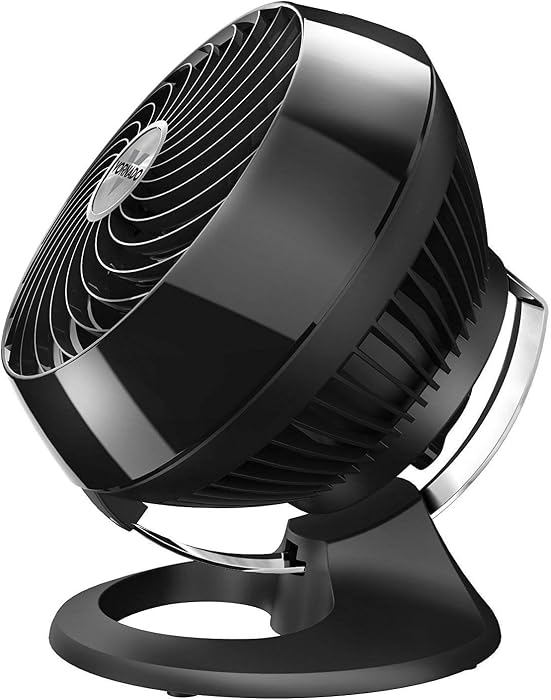
Vornado 460 Desk Fan Best for a Focused Breeze

Vornado 460 Small Desk Fan with 3 Speed Settings

Focused room airflow

Our Score 91/100
Speeds
3
Airflow
320 cfm
Warranty
5 years
Air Reach
70 ft
View on Amazon

The Vornado 460 is the fan for someone who wants a small circulator with a long support window and a focused, powerful stream. Vornado rates it to move air up to 70 feet, and the 320 cfm figure is high for a fan this size. The chrome glide bar lets you tilt the head smoothly, and the three speeds are controlled by a simple dial.

We think the 460 is at its best in a small room where you want air to reach across the space, not just cool your face. It is more concentrated than the DREO 12-inch, so it can sit on a narrower desk while still moving a serious amount of air. The five-year warranty is the longest here, which matters because long-term reliability is the weak spot across this category.

The compromise is noise. On the low setting it is acceptable for background air, but higher speeds are loud enough to interfere with calls or conversation, and the fan is not the quietest choice in this set. We recommend it when airflow and warranty rank above silence. If you need a softer bedside fan, the Honeywell or the VFAN Mini is easier to live with.

Worth Noting

  • Some units stop working over time
Our Verdict

We recommend the Vornado 460 when you want a compact circulator with strong reach and the longest warranty in this group.

Check Latest Price
6

Vornado VFAN Mini Classic Best for Vintage-Style Personal Cooling

Vornado VFAN™ Mini Classic Vintage Metal Desk Fan

Vintage-style personal cooling

Our Score 90/100
Noise
43 dB
Speeds
2
Airflow
105 cfm
Material
Metal
View on Amazon

The Vornado VFAN Mini Classic is the one desk fan here that we choose for how it looks as much as how it blows. The metal housing and vintage green finish make it feel like a small appliance rather than a plastic gadget, and the 4.85-inch blade sits inside a compact 7.1-inch-wide body. It is a two-speed personal fan, not a room circulator, with a 105 cfm rating and a 43 dB noise level.

We like it on a visible desk, a guest-room nightstand, or a reading table where the fan is part of the room rather than something you hide. The tilt head moves air where you point it, and the low setting is the one for close work. The metal body feels sturdier than the plastic budget fans here, and the retro shape is the reason to choose it.

For a bigger room, the DREO 12-inch or the Vornado 460 is the better tool. The VFAN Mini earns its place as a style-led personal fan, and it is the most enjoyable pick here when the fan will sit on a desk you actually look at. That is a narrower job than the top pick handles, but it is one this fan does with more charm.

Worth Noting

  • Two speeds limit fine control
  • High setting is loud for close use
Our Verdict

We think the VFAN Mini is the one to buy when the fan stays visible and you want a personal breeze with vintage style.

Check Latest Price

How We Tested 14 Desk Fans in Real Rooms

We started by reading through listings and customer reviews for several dozen fans, then narrowed the field to 14 tabletop models that could plausibly live on a desk. We kept a mix of sizes and prices and left out anything that needed floor space. Testing ran four months, from late spring into the worst of summer, and the fans moved between a home office desk, a nightstand, a kitchen counter, and a shelf where one clipped on instead of sitting flat.

Airflow was checked with a strip of tissue taped to a chair back three feet away: on low, we noted whether it drifted or fluttered; on high, whether it lifted. We aimed each fan at a seated person and watched whether the head held its angle through a workday or crept downward on its own. Sound got measured with a decibel meter at the lowest and highest setting from three feet out, then checked again mid-call, when a hum matters more than a number.

For reliability, each fan ran a full eight-hour workday on high at least twice, and we checked the housing and motor for heat, new rattles, and dust packed onto the blades. A few took a deliberate tip off the desk edge to see whether the grille or base cracked. Value was the last call: what you get for the footprint, whether the lowest setting is genuinely usable at night, and how the whole thing felt after four months of daily use.

How to Choose a Desk Fan

Match the Airflow to the Job

A desk fan is not one product. A personal fan puts a narrow stream of air on you, while an air circulator uses a deeper-pitched blade and focused grille to push air across a room. The difference matters more than the diameter on the box: a small 185 cfm circulator can feel stronger at your face than a larger fan with a wide, soft breeze, but it will not even out a warm bedroom the way a 70-foot circulator can. If your desk sits in a hot corner, choose reach and an adjustable head; for a keyboard-level breeze, a compact personal fan is easier to place.

Choose the Power Source Before the Features

Corded fans draw more power and usually deliver more airflow, but they need an outlet near the desk. USB fans run from a laptop, power bank, or wall adapter and are easier to move, though many ship without the adapter and their 5-watt motors cannot match a 35- or 63-watt corded fan. Battery models add charging upkeep and eventual battery wear, but they run where no outlet exists. Measure the distance to the nearest outlet, then decide whether a USB port is genuinely available. If you have to unplug your laptop to use the fan, choose corded; for a dorm desk, the TriPole USB fan is more flexible.

Listen at the Speed You Will Actually Use

Noise ratings are easy to misread. A 25 dB figure usually describes the lowest setting, and a fan that is silent at low speed can become distracting at high speed. The desk surface matters too: a hollow table can amplify vibration, while a rubber-footed base keeps the fan steadier. Look for a low setting you can live with, not just a headline number. If the fan runs during calls or sleep, prioritize a usable low speed and a stable base. The Honeywell HT900 is easiest to keep at low speed; the Vornado 460 moves more air but asks you to accept more noise when you turn it up.

Check the Footprint, Tilt, and Cleaning

A desk fan has to fit the surface you have. A 5-inch personal fan can sit beside a monitor; a 12-inch circulator needs a noticeably larger patch of desk. Tilt range matters as much as size: a head that tilts only 30 degrees may not reach your face from a low shelf, while a 90- or 120-degree range gives you more placement options. A removable grille makes dusting the blades much easier. Measure the usable depth and width of the desk, then leave room for cables and the base. If space is tight, a clip-on convertible like the Genesis can move off the desktop entirely.

Plan for Reliability and Support

Small fans live in a harsh spot: dust, long run times, and a motor that is often built to a price. Long-term reliability is the weakest part of this category, and a one-year warranty is common while a five-year warranty is a real advantage. Cleaning the grille and blades helps, but it will not fix a failing bearing or a bad switch. Buy from a maker with a clear warranty and keep the receipt. If the fan starts rattling, screeching, or smelling hot, stop using it and replace it. The Vornado 460's five-year coverage is the strongest support here.

Frequently Asked Questions

Final Verdict

The Honeywell TurboForce HT900 is the desk fan we recommend first because it moves a serious amount of air for its size, aims where you need it, and takes up little room. It is not the quietest or the most durable fan here, but it is the best balance of airflow, simplicity, and value in this set.

Choose the DREO 12-inch if the fan has to cool a whole room, the TriPole if you need USB power, or the Genesis if you have no free desk surface.