Best Cutting Board Oils of 2026

A wooden board will outlast most of what's in your kitchen if you give it twenty minutes a few times a year. Skip that, and it does what my first good board did: goes chalky and pale, then drinks up water until a crack opens along the edge.

Oil is the whole trick. It soaks into the grain and takes the place of the water that swells and splits the wood. My team and I have spent the past four months working through 14 oils and conditioners — thin mineral oils, plant-based ones, waxy conditioners, a citrus-scented bottle — on end-grain boards, a butcher block counter, bamboo boards, wooden spoons, and knife handles.

Worth knowing before you buy: oil and conditioner do two different jobs. A thin oil sinks deep and does the feeding; a waxy conditioner sits near the surface and seals. Most boards want both, in that order, and I counted how many full coats each bottle gave us before calling any of them a good value.

Our Top Picks

The 8 Best Cutting Board Oils of 2026

1

Thirteen Chefs Mineral Oil 128 oz Best Overall

Thirteen Chefs Mineral Oil 128 oz

Multi-board kitchens

Our Score 99/100
Size
128 fl oz
Formula
100% food-grade mineral oil
Application
Push-cap squeeze bottle
Food Safety
Lab-tested food grade
View on Amazon

A gallon of mineral oil sounds like restaurant-supply overkill until you line up a butcher block, two everyday boards, and a drawer of wooden spoons. Then the size makes sense: this is the bottle that keeps the whole kitchen conditioned without a mid-project run to the store. We recommend it first because the oil itself is exactly what a board needs, food-grade, colorless, odorless, and tasteless, so it adds moisture without adding a scent or a flavor to the next thing you chop.

The push-cap squeeze bottle is a small design detail we appreciate. It lets us lay a thin bead along the board instead of glugging oil into a cup, and the oil spreads easily with a rag. On a dry board, apply a generous coat, let it sit until the thirsty spots darken, then wipe away the excess. The point is saturation, not a wet surface; a puddle left behind just attracts dust.

What we like most is how little ceremony this oil requires. There is no scent to get used to, no wax to warm, and no reason to treat a quick maintenance coat as a project. For anyone with several boards, it turns a recurring chore into one you can stop thinking about.

Worth Noting

  • Gallon is more than a one-board kitchen needs
Our Verdict

We recommend this food-grade gallon as the default for anyone maintaining more than one wooden board; it is odorless, easy to apply, and lasts.

Check Latest Price
2

Howard Food Grade Mineral Oil 12 oz Best Small Bottle

Howard Products Food Grade Mineral Oil for Wood Cutting Board

One-board kitchens

Our Score 98/100
Use
Boards and utensils
Size
12 fl oz
Scent
Odorless
Formula
100% USP mineral oil
View on Amazon

The first cutting board does not need a gallon of oil. A 12-ounce bottle is enough to season a board, keep it up for months, and still fit in a small cabinet, which is why this Howard bottle suits a one-board kitchen. The formula is plain 100% USP food-grade mineral oil: no scent, no color, no wax, and no chance of going rancid.

We recommend it for anyone who wants a no-frills first bottle. It sinks into dry wood, darkens the grain, and leaves no sticky film when you wipe off the excess. The narrow bottle is easy to hold over a board, and a little goes further than you might expect on a maintenance coat.

What we keep coming back to is the honesty of the thing: one ingredient, a sensible size, and a bottle that stores without drama. It is the oil for the board you actually use every day, not a finishing product that asks you to buy three more things.

Worth Noting

  • Runs short on a large butcher block
Our Verdict

For a single board and a small kitchen, this is the mineral oil we point to first: pure, unscented, and easy to control.

Check Latest Price
3

Howard Butcher Block Conditioner Best for Water Resistance

Howard Products Butcher Block Conditioner and Food Grade Mineral Oil for Wood

Sealing dry boards

Our Score 97/100
Use
Boards, bowls, utensils
Size
12 fl oz
Finish
Water-resistant
Formula
Mineral oil, beeswax, carnauba wax
View on Amazon

A plain mineral oil soaks in and disappears; Howard's conditioner leaves a little wax behind. That is the whole reason we reach for it on boards that see wet hands, juicy tomatoes, and a quick wipe rather than a full re-oiling. The blend of mineral oil, beeswax, and carnauba wax adds a water-resistant finish, so the surface feels sealed rather than just hydrated.

It goes on thicker than oil, closer to a soft gel, and a little spreads across a board. We apply it by hand or with a rag, let it settle, then buff off the excess. On an already-oiled board, it leaves a smooth, low-sheen finish and makes water bead instead of soaking straight in.

We also like it on wooden spoons, salad bowls, and the kids' wooden toys that live in the kitchen. The wax film is not greasy once buffed, and it does not add a scent to food. It leaves a nice satin touch that makes a cheap bamboo board feel a little more cared for.

Worth Noting

  • Not a substitute for deep initial oiling
Our Verdict

We recommend this as a water-resistant finisher for boards that are already oiled; it is not the deep-soak step.

Check Latest Price
4

John Boos Oil & Cream Set Best Two-Step Kit

John Boos 2-Pc Wood Cutting Board Oil & Cream for Butcher Blocks and Boards

Butcher-block upkeep

Our Score 96/100
Set
16 fl oz oil + 5 oz cream
Use
Butcher blocks and boards
Cream
Unbleached beeswax and mineral oil
Steps
Oil, then cream
View on Amazon

A butcher block is thirsty enough that one product sometimes feels like half a job. The John Boos set answers that with a 16-ounce bottle of food-grade mineral oil and a 5-ounce tube of board cream made with unbleached beeswax and mineral oil. It is a matching two-step routine: oil to replenish the wood, cream to seal and smooth the surface.

We like this set for a block that has gone dry and chalky, or for a new Boos board you want to start right. The oil is plain and unscented, and the cream adds a soft, water-resistant finish that makes the surface feel polished rather than raw. The cream is thick at room temperature, so warm the tube in your hands or a bowl of warm water before squeezing; it spreads better and sinks in instead of sitting on top.

The routine is not a quick wipe-down: you oil, wait, wipe, cream, wait, and buff. The resulting surface has a soft sheen that makes an old block look cared for, and the two products work as a system rather than as random bottles. This is the set we reach for when the board is worth the extra steps.

Worth Noting

  • Costs more than a bottle of plain oil
Our Verdict

For a butcher block that needs both a deep drink and a wax finish, this two-piece Boos set is the thorough choice.

Check Latest Price
5

Walrus Oil Cutting Board Oil Best Oil-And-Wax Blend

Walrus Oil Cutting Board Oil

Satin finish

Our Score 95/100
Size
8 fl oz
Finish
Satin oil-and-wax blend
Food Safety
FDA food-contact safe
Ingredients
Beeswax, Fractionated Coconut Oil, Pure Mineral Oil, and Vitamin E
View on Amazon

The ingredient list reads more like a wood-finishing recipe than a bottle of mineral oil: beeswax, fractionated coconut oil, pure mineral oil, and vitamin E. That is why Walrus behaves differently from the thin, clear oils here. It is a blend, not a plain hydrator, and it leaves a satin sheen rather than a bare-wood look.

We use it on boards that are already in good shape and need a maintenance coat with a little more body. It goes on thicker than straight mineral oil, so a thin coat covers a lot of surface; buff off the excess and the board feels smooth, not tacky. On a new or very dry board, start with a plain mineral oil, then finish with this.

What we like best is the finish: the wax and coconut oil leave a soft glow and a slightly more water-resistant surface, and the board looks finished rather than just fed. It is the bottle we reach for when the board is already healthy and we want it to stay that way.

Worth Noting

  • Eight-ounce bottle is small for big blocks
  • Costs more per ounce than plain oil
Our Verdict

We reach for Walrus when we want a satin, slightly protective finish on a board that is already seasoned.

Check Latest Price
6

Clark's Citrus Cutting Board Oil Best Scented Option

Clark's Citrus Cutting Board Oil – Cutting Board Oil 12 oz

Pleasant application

Our Score 94/100
Size
12 fl oz
Scent
Citrus
Formula
Mineral oil with orange and lemon essential oil
Food Safety
Food grade
View on Amazon

The orange and lemon oils are the first thing you notice when you open Clark's bottle. The base is still food-grade mineral oil, so the citrus is a finishing touch rather than the whole point. It is a pleasant change from the neutral, nothing-smelling oils that dominate the category.

On a dry board, it soaks in like a standard mineral oil, with a push cap that makes it easy to lay a thin line down the center. We let it sit, wiped off the excess, and the board came up with the same deepened grain and smooth feel we expect from a plain oil. The citrus is strongest while you apply it and mostly fades after the oil soaks in.

We like it for the ritual as much as the result: the kitchen smells bright while you work, and the scent does not perfume the next thing you chop. The 12-ounce bottle is a sensible size for one board, and the push cap keeps application neat.

Worth Noting

  • Not for fragrance-sensitive kitchens
Our Verdict

This is the cutting board oil we choose when the job might as well smell good; the citrus is noticeable, but the base is still food-grade mineral oil.

Check Latest Price
7

Kate Naturals Mineral Oil with Applicator

Kate Naturals Mineral Oil for Cutting Board 12oz with Wax Applicator

Mess-free routine

Our Score 93/100
Size
12 fl oz
Scent
Unscented
Formula
USP food-grade mineral oil
Applicator
Wax applicator included
View on Amazon

The wax applicator is the reason this bottle stands out in a crowded shelf of look-alike mineral oils. It turns a simple bottle into a small kit: unscrew the cap, load the applicator, and rub oil into the board without soaking a dish towel or dribbling down the side.

The oil itself is straightforward USP food-grade mineral oil, colorless, odorless, and tasteless, so it does not add anything to the food you prep. It absorbs cleanly and leaves no greasy film when you wipe off the excess. The applicator is especially useful on end grain, where you want to work the oil into the pores rather than paint it across the top.

The 12-ounce bottle is a sensible size for one or two boards, and the screw cap is easy to reopen for monthly upkeep. It stores on a shelf without taking over, which matters in a small kitchen.

What we appreciate most is how much cleaner the applicator makes a first seasoning. There is less waste, less wiping, and less chance of overpouring on a small board. It is a small convenience, but it is the kind that makes you more likely to keep up with the routine.

Worth Noting

  • Seal can leak in transit
Our Verdict

For a neat, first-board routine, we like this kit: the applicator keeps the oil where you want it, and the mineral oil is unscented and food-grade.

Check Latest Price
8

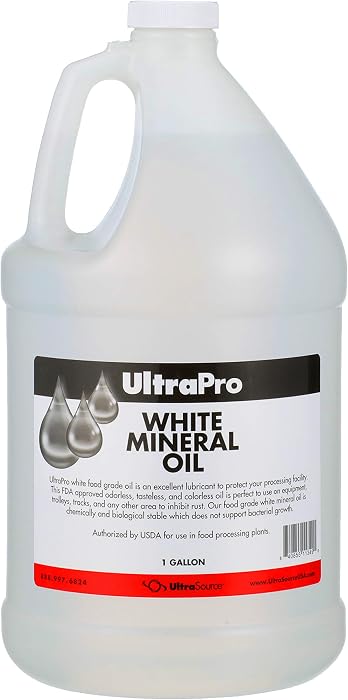
UltraPro Food Grade Mineral Oil Gallon Best for Commercial Kitchens

UltraPro Food Grade Mineral Oil Gallon

Commercial kitchens

Our Score 92/100
Size
128 fl oz
Scent
Odorless
Formula
White mineral oil
Certification
NSF approved
View on Amazon

NSF approval is the detail that separates UltraPro from the other gallon-size mineral oil here. That matters if the board is in a commercial kitchen, a food truck, or a home operation that wants a certified food-contact oil rather than a bottle that simply says food grade.

The oil itself is white mineral oil, colorless, odorless, tasteless, and non-drying, and it behaves like a standard thin mineral oil. It soaks into dry wood, wipes clean, and does not leave a scent behind. The gallon is meant for refilling smaller bottles, treating several boards at once, or keeping a food-service station supplied.

We like the no-frills approach: no scent, no wax, no applicator, just a lot of oil in a jug. Nothing in the bottle calls attention to itself, which is the point when the board is a work surface rather than a display piece.

What sold us is the combination of NSF approval and a genuinely neutral oil. It is the refill supply we keep for smaller bottles, and it behaves the same as the branded oils without asking us to pay for a sprayer or a scent. For a commercial or high-volume kitchen, that is exactly the point.

Worth Noting

  • Overkill for a one-board kitchen
  • Large jug needs storage space
Our Verdict

For food-service kitchens or a serious board-refinishing habit, this NSF-approved gallon is the no-frills bulk choice.

Check Latest Price

How We Tested the Cutting Board Oils

We started with every cutting board oil and conditioner we could find that carries a food-contact claim on the label — FDA, USP, NSF, or plain food grade — then sorted that list by the things that actually separate these products: mineral oil versus plant-based, thin oil versus waxy conditioner, scented versus unscented, small bottle versus gallon. Fourteen made the cut, and we used them for four months.

Every one went on real boards in home kitchens, never scrap wood. I applied each product at night after the dinner dishes were done, left it to sit, and wiped off the excess the next morning. Along the way I noted how much was still pooled on the surface after 20 minutes, since thin oils vanish into the grain while heavy conditioners sit on top, and whether the finish went on evenly or left blotches. I also photographed the same board at the start and the end to compare color and how much the grain opened up.

A week after each application I flicked a few drops of water onto the board to see whether they beaded or sank in, and I kept one neglected, chalky board in rotation to learn whether a product could bring wood back or only maintain what was already there. Oil quality got its own checks: I smelled every bottle on opening, watched for cloudiness or sediment, and noted whether the scented option left anything behind in food cut on that board the next day. For value, I counted how many full coats each bottle gave across the test boards, and I paid attention to how each one poured — whether it glugged, dripped down the side, or went on clean.

How to Choose a Cutting Board Oil

Start with a food-grade base

For a board that touches food, the base oil matters more than the label. Pure food-grade mineral oil is colorless, odorless, and stable; it will not turn rancid the way olive or vegetable oil can. We prefer an unscented mineral oil for the first few coats because it adds moisture without leaving a flavor or fragrance behind. A blend with beeswax or coconut oil can be a fine finisher, but check that the maker labels it food-contact safe. If the bottle does not say food grade, put it back.

Decide between a penetrating oil and a wax conditioner

Plain mineral oil sinks into thirsty wood and is the right first step for a dry board or butcher block. A conditioner with beeswax or carnauba stays closer to the surface, adding water resistance and a soft sheen. Neither is automatically better: oil is for replenishing, wax is for sealing. If your board sees raw meat, wet vegetables, or frequent washing, a wax finish can be worth the extra step. If it mostly holds bread and dry goods, a plain oil is easier to keep up with. Many bottles labeled butcher block oil are simply mineral oil, so read the back before paying extra for a name.

Match the bottle to your board count

A single board does not need a gallon. An 8- to 12-ounce bottle is easier to store, easier to control, and enough for months of monthly upkeep. A gallon makes sense when you have a butcher block island, several boards, wooden utensils, and a habit of refinishing thrift-store finds. Application matters too: a push cap or included applicator keeps oil on the board instead of running down the side. Whichever size you choose, pour onto a cloth or applicator rather than directly onto the wood, and wipe off the excess after it soaks in.

Do not overoil, and do not ignore a thirsty board

Oil when the wood looks dry, feels rough, or stops beading water, not on a rigid calendar. A thin coat is usually enough for maintenance; a very dry board may need several coats, with time between each. Let the oil soak in, then buff away anything that has not absorbed. Too much oil left sitting can turn gummy and attract dust. We keep a rag and a small bottle near the boards so a maintenance coat takes a few minutes instead of becoming a project. If water still beads after a day, the board has enough for now.

Scent is a preference, not a performance feature

Citrus or herbal oils can make board maintenance more pleasant, but the fragrance does not make the oil work better. A scented mineral oil is still mineral oil; the scent may linger during application and mostly fade after soaking in. If you are sensitive to fragrance or the board is used for delicate foods, choose an unscented bottle. If you like the ritual, a citrus oil is a harmless upgrade as long as the label says food grade.

Frequently Asked Questions

Final Verdict

For most kitchens, we recommend the Thirteen Chefs gallon. It is the simplest way to keep several boards, spoons, and a butcher block conditioned without thinking about running out, and the oil itself is odorless and food-grade.

If you own one board, the Howard 12-ounce bottle is the more sensible size; if you want a wax finish in the same routine, the John Boos two-piece set is the thorough choice. Scent, a satin blend, an applicator, or NSF approval are reasons to choose one of the others, not reasons the top pick stops working.