Best Countertop Water Filters of 2026

Few kitchen upgrades are as unglamorous, or as instantly noticeable, as fixing water that tastes off. A countertop filter does that without a plumber, a new faucet, or a hole drilled through your counter — but the category has split in a dozen directions, from fridge pitchers and 40-cup dispensers to stainless steel gravity systems and no-install reverse osmosis machines. What actually separates them is boring and useful in equal measure: how fast the water comes out, how much counter it eats, and whether the filter is certified for the contaminants you're worried about rather than just the easy ones to test for.

I've filled the same two pitchers from the same kitchen tap for years, so I notice when one slows to a trickle by week six. Over the past nine months, my team and I put 12 countertop filters through that same daily grind — coffee in the morning, bottles for the kids, a big pot of pasta on Sunday — and the differences showed up quickly.

The number first-time buyers overlook is the one printed on the replacement filter, not the box. A cheap pitcher you re-filter every two months can cost more per gallon than a gravity system that runs most of a year, and a 40-cup dispenser is only a win if your counter can genuinely spare the real estate. What follows are the models that earned their spot, organized by who they actually suit.

Our Top Picks

The 10 Best Countertop Water Filters of 2026

1

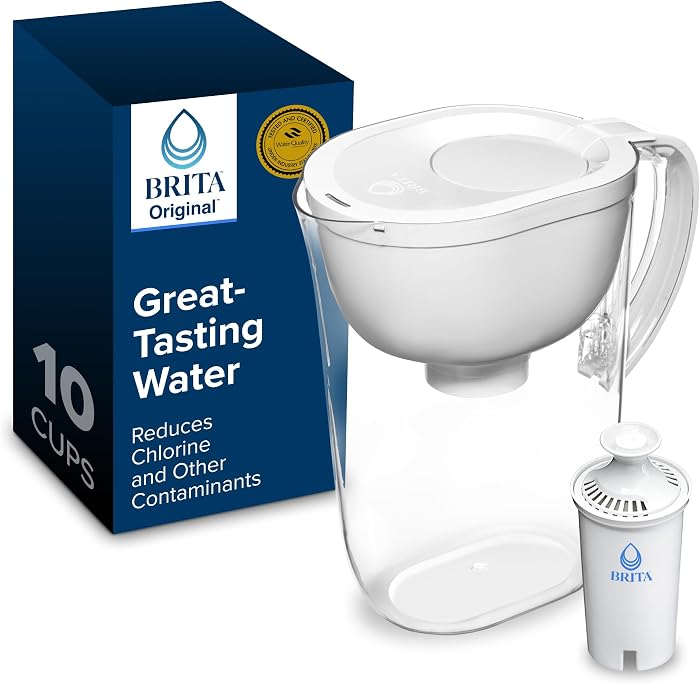
Brita Large 10-Cup Pitcher Best Overall
Brita Large 10 Cup Water Filter Pitcher

Small households

Our Score 95/100
Capacity
10 cups
Dimensions
10.7"L x 5.4"W x 10.1"H
Filter Life
2 months
Certified Reductions
Chlorine, copper, mercury, cadmium
View on Amazon

Ten cups, one filter in the box, and a certified list covering chlorine, copper, mercury, and cadmium: that combination is why this is the pitcher we point most people to first. It is the least expensive complete system here, and nothing about it demands a decision from you — you fill the top, you wait, you pour. The footprint is the quiet advantage. At roughly 10.7 inches deep and 5.4 wide, it takes a corner of a refrigerator shelf rather than most of one.

Flow is the part to plan around. Gravity-fed carbon is not fast, so the habit that works is topping the reservoir off after each pour instead of draining it and standing there. The filter situation is friendlier than most: this pitcher takes both the Standard cartridge, rated for two months or 40 gallons, and the Longlast, which stretches changes out to about six months or 120 gallons.

One thing worth knowing before you buy: the body is plastic, and plastic is what eventually ends these. Handles snap and reservoirs crack, usually after a drop or after the reservoir is levered out while it is still wet. Carry it with two hands, set it down gently, and the pitcher will outlast a drawer full of cartridges. That is the trade at this price tier, and for most kitchens it is a fair one.

Worth Noting

  • Plastic body can crack after a drop
  • Ten cups goes fast for a family
Our Verdict

We recommend it to almost anyone: the lowest-priced complete system here, certified for chlorine and three metals, sized to fit a fridge shelf. Add the Longlast cartridge and you are changing the filter twice a year.

Check Latest Price
2

Waterdrop PT-72W Glass Pitcher Best Glass Pitcher

Waterdrop PT-72W Glass Water Filter Pitcher

Plastic-free kitchens

Our Score 94/100
Capacity
7 cups
Filter Life
100 gallons or 2 months
Body Material
Glass
Certification
NSF/ANSI 42, 53 and 372
View on Amazon

The pitcher is glass, and that one decision changes how it lives in your kitchen. There is no plastic reservoir to cloud or hold onto flavors, nothing to stain, and it looks good enough to put on the table instead of hiding it in the fridge. The filter behind it is the other half of the story: a five-stage cartridge certified to NSF/ANSI 42, 53, and 372, which puts PFAS, chlorine, and metals including mercury and cadmium on the list it reduces.

The pace is what we noticed first. At a listed 8.5 ounces a minute, this is the quickest pitcher in this set, so a top-up is a short wait rather than the ten-minute pause a two-chamber gravity system asks for. The glass also means nothing sits between you and the water but the cartridge itself, which is most of why people pay more for it.

Capacity is the compromise. Seven cups is two big glasses each for two people, so in a household that actually drinks water this is a refill-twice-a-day pitcher, and full it is heavier in the hand than a plastic one of the same size. When you reorder, note that this model takes the PF01A-P cartridge specifically; the standard Waterdrop pitcher filters are a different fit.

Worth Noting

  • Seven cups needs frequent refills
  • Glass is heavier to carry full
Our Verdict

Buy this if you want the plastic out of your drinking water: a glass body, NSF/ANSI 53 filtration that names PFAS and metals, and the fastest pour of any pitcher here.

Check Latest Price
3

Brita UltraMax 27-Cup Dispenser Best for Large Households

Brita X-Large 27 Cup Water Dispenser

Large households

Our Score 93/100
Capacity
27 cups
Dimensions
18"L x 5.67"W x 10.47"H
Filter Life
2 months
Certified Reductions
Chlorine, copper, mercury
View on Amazon

Twenty-seven cups is the entire argument. Where a pitcher gets refilled three times before dinner, this dispenser gets topped off once in the evening, and the front spigot fills a glass or a bottle where it stands, so nobody is lifting a full reservoir over the sink with one hand. It is the same filtration idea as the pitcher, just sized for a household rather than a person.

It is built for a refrigerator shelf: 18 inches long, under 11 inches tall, with a locking lid that lets you carry it full from the tap without a second hand on top. It runs on Brita's Standard filter, the same cartridge family the pitchers use, rated for two months and certified for chlorine, copper, and mercury.

What we appreciate is that nothing here is precious. No glass, no electronics, no plumbing — a lid, a body, and a spigot, which is exactly what you want in something you fill twice a day. The filter reminder is a sticker rather than a light, so put the change on your calendar the day you fill it first. For two or three heavy water drinkers, the extra capacity is worth the shelf.

Worth Noting

  • Takes a full refrigerator shelf
Our Verdict

For two or three people who drain a pitcher before lunch, this is the upgrade: 27 cups, a spigot that fills bottles in place, and a lid that locks down.

Check Latest Price
4

Ninja HydraSense WF1001 Best Fast Dispensing

Ninja HydraSense™ Intelligent Water Filtration System

Hands-free dispensing

Our Score 92/100
Dispensing
One-touch, set volume
Filter Life
6 months
Reservoir Capacity
3 liters
Contaminants Filtered
80+
View on Amazon

Press a button and it fills the glass. That single move is why this machine sits at the front of the counter instead of a pitcher living in the door: the 3-liter reservoir goes on the back, the touchscreen lets you set a volume so it stops on its own, and the water arrives fast enough that nobody in the house bothers with the tap instead.

The filtration is the broadest of the countertop appliances, at 80-plus contaminants including microplastics and forever chemicals, with 40-plus taste-impairing ones pulled out while the minerals stay in. The filter runs six months and a display counts it down, so replacement is an errand twice a year rather than a guess. That is a different ownership rhythm from a pitcher you are swapping every eight weeks.

It needs an outlet and a foot and a half of counter, which rules out the refrigerator and most small kitchens, and it costs more than any pitcher or dispenser here. What you are buying is the end of waiting, and for a household that drinks water all day that is not a small thing. Give the spout a workout in the first week while the return window is open, since a drip is the one issue that would change our mind.

Worth Noting

  • Needs an outlet and permanent counter space
  • Costs far more than a pitcher or dispenser
Our Verdict

Our pick when waiting is the problem: one-touch fills, 80-plus contaminants removed, and a six-month filter with a countdown. Worth it if the outlet and the counter space are already there.

Check Latest Price
5

Big Berkey Gravity System Best Gravity System

Big Berkey 2.25 Gal Gravity Water Filter System with BB9-2 Filters

Off-grid use

Our Score 91/100
Power
None, gravity fed
Capacity
2.25 gallons
Body Material
Polished AISI 304 stainless steel
Filters Included
2 Black Berkey elements
View on Amazon

Two stainless chambers, two carbon elements, and gravity. Water goes in the top, passes through the elements, and comes out the spigot — no electricity, no plumbing, no cartridge housing to crack. That is why this is the system people buy when the water is genuinely bad or the power is unreliable, and it is the only thing here that looks like it belongs in a farmhouse kitchen rather than a dorm room.

We think the body is what you are paying for. Polished 304 stainless, a steel spigot that will not go brittle, and elements covered by a two-year prorated warranty mean the parts that fail on plastic systems simply are not present. Setup is priming the two elements and seating them in the upper chamber, and after that there is nothing to maintain beyond an occasional scrub.

Two things to know before you order. It is slow: the listed maximum flow is 0.03 gallons per minute, so filling the top chamber at night becomes the routine and grabbing a glass on demand does not. And Berkey notes the system cannot ship to California or Iowa, which you want to discover before clearing counter space. Set it on a tray and reseat the upper chamber carefully after cleaning — that seam is where a slow drip starts.

Worth Noting

  • Very slow gravity flow
  • Cannot ship to California or Iowa
Our Verdict

If your water is genuinely bad or your power is not reliable, we choose this: stainless chambers, gravity, no electrics, and elements covered for two years. Budget counter space and patience for the flow.

Check Latest Price
6

Bluevua RO100ROPOT Best Countertop RO

Bluevua RO100ROPOT Countertop Reverse Osmosis Water Filter System

Renters wanting RO

Our Score 90/100
Included
Glass carafe and mineral filter
Filter Life
12 to 24 months
Power Source
Corded electric
Purification
5-stage RO with remineralization
View on Amazon

Reverse osmosis usually means a plumber, a tank under the sink, and a drain line. This one plugs in, sits on the counter, and fills a glass carafe. Five stages take the water down through an RO membrane, then a remineralization filter adds back some of what RO strips out, which is the difference between flat water and water you actually want to drink.

The carafe is the smart part of the design. You fill it, carry it to the table, and keep a second one cold in the refrigerator, so there is no tank of yesterday's water sitting inside the machine. Filter life changes the arithmetic too: the elements are rated at 12 to 24 months depending on use, with a display tracking what is left, which is a different world from a pitcher cartridge every eight weeks.

We think it earns its price for a specific buyer: someone on a well, in an older building, or anywhere the water report lists things carbon cannot touch. The membrane removes dissolved solids, and doing that without drilling a hole in a rental kitchen is the entire point. The trade is pace. It makes water a carafe at a time, and RO sends some water to waste, so plan to catch the runoff in a jug for the plants.

Worth Noting

  • Makes water one carafe at a time
Our Verdict

The RO system we recommend when you want dissolved solids gone without a plumber: carafe-based, remineralized, and rated for one to two years per filter set.

Check Latest Price
7

DREO RO Water Filter 113 Best Value RO

DREO Reverse Osmosis Water Filter Countertop System

Small kitchens

Our Score 89/100
Capacity
5 liters
Included
2 autofill pitchers
Filter Life
6 months
Purification
7-in-1 reverse osmosis
View on Amazon

Five liters is the reservoir, and that is the first thing to understand about this machine: it will not keep a family in cold water all day. It makes very clean water on demand, and it makes it twice over, because two autofill pitchers come in the box — one parks under the spout while the other goes in the refrigerator.

The filtration is a 7-in-1 RO stack claiming 99.9% of contaminants including PFOA and PFOS, and the built-in meter reads raw and finished TDS side by side. That readout is the most honest feedback loop on this list; watching the number move is what makes a water filter feel like it is doing something rather than just sitting there.

It is slim, under 7 inches wide, so it slots between the sink and the coffee maker where a two-chamber gravity system will not go, and the 3:1 pure-to-drain ratio sends less water down the drain than older RO designs. The six-month filter and the display between them take most of the guesswork out of maintenance.

What we like most is that it removes the intimidation from reverse osmosis: no plumbing, no drain line, a footprint that fits a normal counter, and pitchers that go straight into the refrigerator. What it will not do is keep up with four thirsty people, so plan on refilling the tank once or twice a day and giving it a rinse when the display tells you to.

Worth Noting

  • Five-liter tank needs daily refills
  • Premium price compared with pitchers
Our Verdict

Our value pick for reverse osmosis: slim, plug-in, two autofill pitchers, and a TDS meter that shows the difference. Buy it for one or two people, not a crowd.

Check Latest Price
8

Waterdrop WFD-22L Dispenser Best for Big Families

Waterdrop WFD-22L Large Water Filter Dispenser

Big families

Our Score 88/100
Capacity
40 cups
Lowers TDS
No
Filter Life
200 gallons
Certification
NSF/ANSI 42 and 372
View on Amazon

Forty cups makes this the largest dispenser in this set, and it does it at about the same money as the Brita UltraMax. Twenty-one of those cups sit in the body once it is filled, so a refill is a real top-up rather than a splash, and the shape still slides onto a refrigerator shelf.

The cartridge is the selling point: carbon fiber rated for 200 gallons, certified to NSF/ANSI 42 and 372 for chlorine, taste, and odor. That is five times the gallons behind a two-month pitcher cartridge, which is the difference between a new filter every couple of months and one roughly once a year. Waterdrop is also blunt that this model does not lower TDS, so if you are chasing a zero reading, look elsewhere.

Where it wobbles is flow. The carbon fiber moves quickly when it is fresh, but the top reservoir fills slowly enough that a full 40 cups is a project, and the lid and upper section feel lighter in the hand than the Brita's. We treat the 200-gallon rating as a ceiling rather than a promise and change early the moment taste shifts.

So the case for it is volume and filter life, and the case against it is feel. If you want a big dispenser that gets a family through a day and asks for a cartridge about once a year, this is the better of the two large plastic dispensers here. If you want something that feels solid when you carry it full, spend the same money on the Brita.

Worth Noting

  • Top reservoir fills slowly
  • Thin plastic feels less solid full
Our Verdict

The biggest dispenser here, with a filter rated for five times the gallons of a pitcher cartridge. Buy it for volume, and accept that the plastic feels lighter than it should.

Check Latest Price
9

Purewell 3-Stage Gravity System Best for Budget Gravity Setups

Purewell 3-Stage 0.01μm Ultra-Filtration Gravity Water Filter System

Budget gravity setups

Our Score 87/100
Capacity
2.25 gallons
Pore Size
0.01 microns
Certification
NSF/ANSI 42 and 372
Filters Included
2 carbon filters
View on Amazon

Stainless gravity filtration for well under half what the Berkey costs, with two carbon elements, a stand, and a steel spigot in the box. That is the pitch, and for plenty of buyers it is enough: the same two-chamber, no-electricity idea in a 2.25-gallon body that tucks under a cabinet and asks for nothing but a refill.

The filter stack ends in a 0.01-micron hollow-fiber membrane, certified to NSF/ANSI 42 and 372, with each element rated for 3,000 gallons. For cloudy or sediment-heavy water, the pore size is what makes this the one we choose over a carbon-only pitcher — it is the reason the water comes out clear even when the tap does not.

Two habits to build. The spigot is the weak point, and a drip that will not stop is how these usually end, so keep a tray underneath and check the seal every time you reassemble it after cleaning. It is also slow: a full upper chamber takes a while to pass through, so fill it before bed rather than before dinner. Neither is a dealbreaker at this price tier, and the stainless body is the part that will not go brittle on you.

Worth Noting

  • Slow to filter a full chamber
Our Verdict

Gravity filtration for well under the Berkey's price: stainless chambers, a 0.01-micron membrane, and 3,000 gallons per element. We point budget-minded buyers here.

Check Latest Price
10

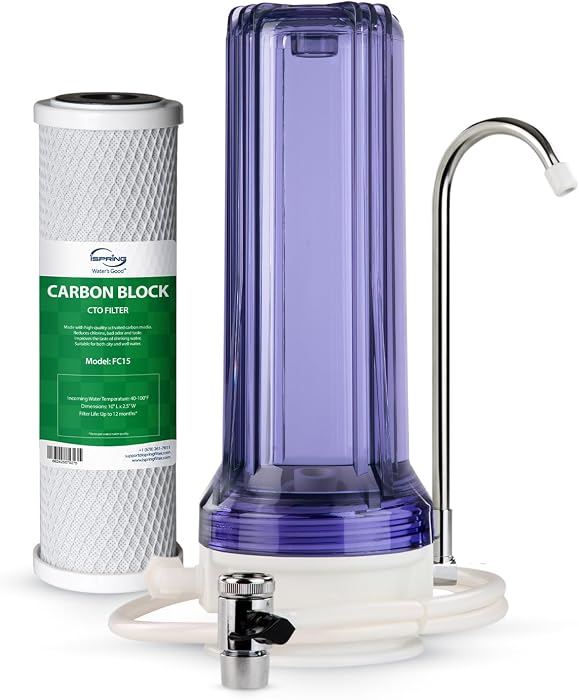
iSpring CKC1C Countertop System

iSpring CKC1C Chlorine Removal Countertop Water Filter System

Unlimited tap water

Our Score 86/100
Filtration
5-micron carbon block
Filter Life
10,000 gallons
Faucet Connection
Diverter valve included
Chlorine Reduction
95%
View on Amazon

No reservoir, no pitcher, no refilling. A clear canister sits on the counter, a diverter valve clips onto your kitchen faucet, and flipping the lever sends tap water through a 5-micron carbon block and out the spout. The cartridge is rated for 10,000 gallons, which makes this the cheapest water per gallon of anything in this set.

The clear housing is the detail we keep coming back to. You can watch the cartridge darken and know when it is spent instead of guessing from taste, and because it takes standard 10-inch filters, replacements are cheap and easy to track down. It suits renters, RV owners, and anyone who drinks enough water that filling a pitcher has become a chore.

The catch is your faucet. The diverter needs a standard screw-off aerator, so pull-down and one-piece sprayer faucets will not take it, and the included adapter fits nothing else, which makes this a check-before-you-order purchase. Install it with the wrench, hand-tight plus a quarter turn, and watch the diverter joint for a weep over the first few uses. And be clear on what it does: chlorine, sediment, and odor come out, dissolved solids stay in.

Worth Noting

  • Needs a standard aerator faucet
  • Leaves dissolved solids in the water
Our Verdict

For unlimited filtered water with no reservoir to fill, this is our pick, as long as your faucet takes a standard aerator and you do not need dissolved solids removed.

Check Latest Price

How We Tested (and Lived With) 12 Countertop Water Filters

We started by gathering every countertop filter sold at major retailers, then sorted them into four formats: fridge pitchers, large dispensers, gravity-fed stainless steel systems, and no-install reverse osmosis units. We cross-checked each one's certification listings against the claims on its packaging, and we cut anything we couldn't verify, anything whose replacement filters pushed the cost per gallon above bottled water, and anything too tall or wide to fit under a standard upper cabinet. That left 12 units, which we used for nine months.

Testing happened in real kitchens during real meals rather than on a bench. We timed how long each took to filter a quart for morning coffee, counted how many glasses a full reservoir poured before needing a refill during a dinner with eight people, and had kids fill their own bottles to see whether a spigot or a lid was easier to manage one-handed. We also noted how much counter space each claimed and whether it blocked the cabinet door.

For leakage and durability, we filled every unit to its max line, set it on a paper towel overnight, then tipped each one half-full over the sink to see what spilled. We watched plastic bodies for scratches and trapped odors, glass for weight and chipping, and stainless steel for dents, and we tracked flow rate week by week to catch filters that clogged long before their rated life. Units with filter-life indicators got marked on whether the reminder matched what we were actually tasting.

Taste was judged blind: three of us sampled coded glasses against the same tap water and noted chlorine smell, flatness, and any mineral aftertaste. Finally, we did the cost math — filter price divided by rated gallons, checked against how long the filter really lasted — because value here is a running number, not a sticker price.

How to Choose a Countertop Water Filter

Start With What You Want Removed

The certification list is the most useful thing on any box, because it names the substances the filter was actually tested against. A standard carbon pitcher is certified for chlorine, taste, and odor plus a few metals, which is a real improvement if your complaint is chlorinated city water. If lead, PFAS, or well-water sediment is the worry, you need a filter whose certification names those things: NSF/ANSI 53 for metals and PFAS, or a reverse osmosis membrane, which takes out dissolved solids that carbon cannot touch.

Pull your utility's water report before you shop. It is free, it takes a minute, and it tells you whether you are solving a chlorine problem or a lead one, which is the difference between a pitcher and an RO machine.

Size It to Your Refill Patience

Ten cups is a one-or-two-person pitcher. Twenty-seven to forty cups is a dispenser that gets a family through a day. Two and a quarter gallons of gravity capacity is a household's water with one evening refill, and a countertop RO unit makes a carafe or a pitcher at a time, so a thirsty family runs it repeatedly. Buy for the spot where the purifier will live: the fridge door, the counter beside the sink, the table. A dispenser that does not fit the shelf ends up in the garage.

Price the Filters, Not the System

The purchase price is the smallest part of what you will spend. Compare the gallons behind each cartridge: Brita's Standard filter covers about 40 gallons, the Waterdrop dispenser's carbon fiber is rated to 200, and the Bluevua RO elements are rated in years rather than months. A long interval is only worth paying for if the cartridges are easy to buy and cheap enough to change early, because hard water exhausts any TDS-reducing filter well before its rating.

Check the Joints Before You Trust the Counter

Spouts, spigots, and the seam between upper and lower chambers are where these systems fail, and a slow drip under a full reservoir becomes a counter-sized problem. Set a gravity system or a dispenser on a tray for its first week, and inspect the spigot seal every time you reassemble it after cleaning.

If you are considering a diverter unit that connects to your tap, confirm your faucet has a standard screw-off aerator first. Pull-down and one-piece sprayer faucets usually will not take one, and the adapter in the box fits nothing else.

Frequently Asked Questions

Final Verdict

If you want one answer, buy the Brita 10-cup pitcher. It is the least expensive complete system here, it fits a fridge shelf without rearranging anything, and both filter options are on the shelf at any grocery store, which matters more than any single spec when you are two weeks from a change and out of cartridges. Switch to the Longlast cartridge and you are changing it twice a year.

Spend more only when you know why. A household that drains a pitcher before noon should take the Brita UltraMax dispenser; anyone who wants plastic out of the drinking water should take the Waterdrop glass pitcher. And if your water report lists lead, PFAS, or a TDS reading in the hundreds, skip carbon entirely and buy the DREO RO 113 for one or two people, or the Bluevua ROPOT if you want the carafe and the longer filter interval.