Best Containers for Freezing Soup of 2026

A pot of soup is a promise to your future self — dinner on a Wednesday, lunch in February. The trouble is what happens in between. I've pulled too many frost-fuzzed bricks out of the freezer, unable to tell the minestrone from the chili, behind lids that needed a screwdriver to pry off. The right container decides whether your stash actually gets eaten or chipped out with a knife.

I've been freezing soup for years, and over the past six months my team and I worked through 14 containers — silicone molds, twist-top quarts, snap-lid boxes, and the deli pints restaurants buy by the sleeve. Lid fit and durability matter most: one that cracks or seeps isn't a bargain at any price. Size comes next, since single portions thaw and reheat faster while quarts hold a family batch.

Here's what nobody tells you: soup expands as it freezes, so leave an inch of headroom, and freeze containers flat on a sheet pan before stacking. Below, the picks divide by how you cook — some for portioning out a big Sunday batch, some for sending leftovers home with someone else.

Our Top Picks

The 8 Best Containers for Freezing Soup of 2026

1

Souper Cubes 1-Cup Freezer Molds Best Overall

Souper Cubes 1 Cup Silicone Freezer Molds with Lids

Everyday soup portions

Our Score 99/100
Lid
Included plastic lid
Material
Platinum-cured silicone
Portion Size
1 cup (half-cup fill line)
Total Capacity
8 cups (2 trays)
View on Amazon

A pot of soup ladled into an unmarked container is a guess, and a guess freezes into a block you have to chisel. The Souper Cubes trays carry half-cup and full-cup fill lines in standard and metric, so a batch of minestrone goes in as the portions we actually eat: one cup for lunch, half a cup when the soup is only the opener.

The steel-reinforced rim is what settled it for us. Plain silicone flops when it's full, and carrying a brimming tray to the freezer is exactly the moment you don't want a floppy mold; this one holds its shape in the hand and still peels back far enough that a frozen block lifts out whole. Thick walls and a rigid lid keep the frame square while it freezes, so the blocks come out the same size instead of bulging in the middle.

Eight cups fit across the two trays, and each comes with its own plastic lid, so one batch can set while the other is still on the counter. The platinum-cured silicone goes in the dishwasher and ours hasn't picked up color from chili or borscht, which is not something we can say for every plastic tub on this list.

The working rhythm is freeze, pop the blocks into a bag or a rigid tub, and reuse the tray, which means a tray sits occupied until you do that second step. Buy the two-pack if you want a rotation going. It's also the only container here rated for the oven, so a dense stew can go from frozen to a low oven without a second dish.

Worth Noting

  • Premium price for two trays
Our Verdict

We tell anyone who freezes soup more than once a month to start here: the portions come out even, labeled, and intact.

Check Latest Price
2

Reditainer Extreme Freeze 32 oz Best Bulk Quart Set

Reditainer Extreme Freeze 32 oz – GUSTO 32 oz Plastic Deli Containers with Lids [24 Sets] Food Storage

Big-batch freezing

Our Score 98/100
Lid
Snap-on
Count
24 containers with lids
Capacity
32 fl oz
Freezer Rating
Rated to -40°F
View on Amazon

Next to the Reditainer quarts, these are the softer tub. The sides give when you press them, the lids seat with less force, and the cost per container comes in a little lower, which for most kitchens makes this the easier everyday quart to live with.

At 32 fluid ounces they hold a full batch of broth or a quart of stew, and the airtight snap lid keeps the contents from picking up the smell of everything else on the shelf. Freezer, microwave, and dishwasher are all covered in the listing, and the plastic has stayed clear through tomato sauce in our use, which is more than we expected at this price.

Worth Noting

  • Only comes in 32 oz
Our Verdict

We point readers to the GUSTO quarts for an everyday, forgiving tub that goes from freezer to microwave without fuss.

Check Latest Price
3

Ziploc Twist N Loc Containers Best Leak-Resistant Lid

Ziploc Twist N Loc Leak-Proof Food Storage Containers

Traveling with soup

Our Score 97/100
Care
Freezer, microwave, dishwasher safe
Count
6 containers
Lid Type
Twist-to-seal
View on Amazon

Threads do the work here. The Twist N Loc lid screws down over the rim instead of snapping over a lip, so the seal doesn't rest on a thin plastic tab surviving twenty freeze-thaw cycles, and it opens with a quarter turn rather than a fingernail. That's the whole reason these are our pick for soup that leaves the kitchen, whether it's headed to a potluck, a sick friend, or a lunch bag.

They're medium round tubs, six to a pack, reusable, and cleared for the freezer, microwave, and dishwasher. The round shape stacks with the lid facing up so you can read the label from above, and six is a small enough start to test the twist lid on your own soup before you commit to a bigger set. Ziploc calls the design leak resistant rather than leakproof, and that's the honest reading.

Worth Noting

  • Leak resistant, not fully leakproof
Our Verdict

We hand these to anyone whose soup has to survive a commute, because the screw lid doesn't depend on a snap tab staying whole.

Check Latest Price
4

JoyServe 48-Set Deli Containers Best Mixed-Size Set

JoyServe 48-Set Deli Containers – 48 Sets Plastic Food Storage Deli Containers w/ Lids 16oz Pint & 32oz Quart

Mixed portion sizes

Our Score 96/100
Care
Lid off for microwave
Lids
One size fits both
Sizes
24 × 16 oz, 24 × 32 oz
Material
Polypropylene, BPA-free
View on Amazon

Every container in this set takes the same lid. Twenty-four pints, twenty-four quarts, one lid, which sounds like a small thing until you've spent ten minutes matching lids to tubs with a freezer door open.

For a household freezing two different portion sizes, this is the set we point to. The lids snap on with a firm press and hold: ours have gone into the freezer full of stock and chili and come back out with nothing leaked and no freezer burn on the quarts left for months. The polypropylene runs through the dishwasher and stays clear enough to see what's inside without opening it.

Two practical notes. The lids aren't microwave safe, so reheat with the lid off or under a paper towel, and the quart half of the set is a lot of capacity if you usually eat soup one bowl at a time. Ours get used for broth and big-batch chili, with the pints doing the weekday work.

Our Verdict

We recommend this set to households that freeze single bowls and family portions, since one lid covers both sizes.

Check Latest Price
5

Freshware 16 oz Soup Containers Best Bulk Pint Set

Freshware Food Storage Containers with Lids 16 oz [50 Set] Soup Containers

Bulk pint freezing

Our Score 95/100
Lid
Leakproof snap-on
Count
50 containers with lids
Capacity
16 fl oz (2 cups)
Material
BPA-free polypropylene
View on Amazon

Fifty pints is the arithmetic that makes these the cheapest container here per portion, and if soup goes into the freezer most weekends, that number does more work than any single design detail. A pint is two cups, one big bowl or two small ones.

The snap lid is leakproof and sits flat, which gives you a clean surface for a marker, and the round tub stacks neatly whether it's full in the freezer or empty in a cabinet. Clear polypropylene means you can see the split pea from the minestrone without lifting anything out.

These are the containers that leave the house. Soup for a neighbor, chili for a potluck, leftovers for whoever hosted: at this price nobody has to remember whose tub is whose, and a Sunday batch turns into ten labeled pints in under half an hour.

That's the case for them, and it's a good one for bulk freezers. Pair them with a rigid tub or two for anything you plan to reheat in the container, since a snap lid is the part of this system that sees the most wear.

Worth Noting

  • Lids crack and don't always seat
Our Verdict

We recommend the Freshware pints to cooks who freeze soup in volume and want containers cheap enough to give away without a chase.

Check Latest Price
6

Reditainer Extreme Freeze 32 oz Best Bulk Quart Set

Reditainer Extreme Freeze 32 oz – GUSTO 32 oz Plastic Deli Containers with Lids [24 Sets] Food Storage

Big-batch freezing

Our Score 94/100
Lid
Snap-on
Count
24 containers with lids
Capacity
32 fl oz
Freezer Rating
Rated to -40°F
View on Amazon

Next to the Reditainer quarts, these are the softer tub. The sides give when you press them, the lids seat with less force, and the cost per container comes in a little lower, which for most kitchens makes this the easier everyday quart to live with.

At 32 fluid ounces they hold a full batch of broth or a quart of stew, and the airtight snap lid keeps the contents from picking up the smell of everything else on the shelf. Freezer, microwave, and dishwasher are all covered in the listing, and the plastic has stayed clear through tomato sauce in our use, which is more than we expected at this price.

Worth Noting

  • Only comes in 32 oz
Our Verdict

We point readers to the GUSTO quarts for an everyday, forgiving tub that goes from freezer to microwave without fuss.

Check Latest Price
7

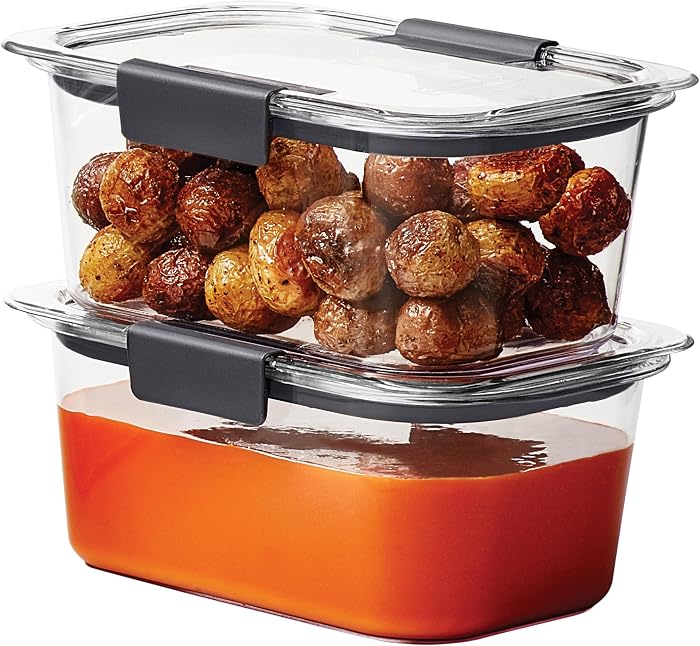
Rubbermaid Brilliance 4.7-Cup Best for Fridge and Reheating

Rubbermaid Brilliance Plastic Food Storage Containers

Fridge and reheating

Our Score 93/100
Lid
Leakproof latches with vents
Count
2 containers
Capacity
4.7 cups each
Material
Tritan plastic
View on Amazon

At 4.7 cups, this is not a single-serving soup container. It's the one you fill with the batch you'll eat over three nights, or freeze as one block and thaw for the whole table. Worth saying plainly, because the size is the entire decision here: pick it for family portions, not for weekday lunches.

The Brilliance latches are why it's worth the shelf space. The Tritan is clear like glass without the weight, the seal is genuinely airtight, and the built-in vents under the latches let you microwave soup with the lid on and the latches flipped up, so nothing spatters. Tomato sauce washes off without staining, which is unusual for a clear container that sees a microwave this often.

In practice it's a fridge container that happens to be freezer safe, and that's how we use it: leftover soup in the refrigerator, frozen only when a batch is bigger than the week. Leave an inch of headspace if you do freeze it, because a full 4.7 cups of liquid has nowhere to go.

Worth Noting

  • Bases and latches can crack
Our Verdict

We keep this one for the soup already in the fridge, since it reheats with the lid on and nothing else here does that.

Check Latest Price
8

Stock Your Home 32 oz Twist-Top Best for Small-Batch Quarts

Stock Your Home 32oz Plastic Thanksgiving leftover Containers with Twist Top

Small-batch quarts

Our Score 92/100
Lid
Twist-on
Care
Microwave and dishwasher safe
Count
6 containers
Capacity
32 fl oz
View on Amazon

Six containers is a small commitment. If you've never frozen soup in quarts, this is the pack to find out whether you like the size, and if you already know you do, six is enough to keep a week of lunches rotating through the freezer.

The lid screws down in about two turns and comes off the same way, which matters more in February than it does in November. There's no tab to pry at with a thumbnail and no lip to bend back into place.

The blue tint is the detail we ended up liking most. A quart of frozen stock in a chest freezer looks like a quart of everything else, and the color takes care of it before you start lifting lids. The containers are microwave and dishwasher safe and stack without wobbling.

Where they sit in the lineup is straightforward: a small kitchen, a batch of soup headed for a neighbor, or anyone who wants reusable quarts without turning the pantry into a supply closet. That's the whole case, and it's a solid one.

Worth Noting

  • Costs more per container than bulk sets
Our Verdict

We recommend this six-pack to anyone who wants a few reusable quart tubs without committing to a restaurant supply order.

Check Latest Price

How We Tested the Best Containers for Freezing Soup

We started by combing through what's actually sold in multi-packs and single units — deli pints and quarts, silicone molds with lids, and the heavier snap-lid and twist-lid boxes people buy once and keep — then narrowed to 14 based on capacity, lid style, and price per container. Value was part of the filter, not an afterthought: some sets work out to pennies apiece and some to nearly a dollar, and I wanted to know whether the difference showed up in the freezer.

Then we cooked. Over six months I made three recurring batches — a thin brothy chicken soup, a chunky minestrone, and a thick split pea — and portioned each one across the entire lineup, leaving the headspace the maker recommended and freezing everything flat on a sheet pan before it went on the shelf. Two days in, I checked every lid for frost and seepage, then turned each filled container upside down over the sink for a full 30 seconds.

Ease of use showed up where I expected it to: whether a ladle of soup went in without dribbling down the outside, and whether the frozen block came out in one piece. The rigid containers needed a warm-water dip around the base; the silicone molds released with a push. Storage capacity got measured the boring way — I stacked a week's worth in a standard freezer drawer and noted how much floor space a family's soup supply took, and whether lids held their shape under the weight.

Durability came last and took the longest. Each container ran through 20 dishwasher cycles and a drop from counter height onto tile, and the ones that cracked went into a shame pile on the counter. Reheating followed — an overnight thaw in the fridge, then the microwave, watching for blowouts and splatter.

How to Choose Containers for Freezing Soup

Match the Portion to the Bowl

One cup is a lunch with bread on the side. A pint, two cups, is one big bowl. A quart is two or three servings, which means thawing a quart commits you to eating soup twice, whether you wanted to or not. That single mismatch explains most of the disappointment people have with frozen soup: the container was fine, the portion was wrong.

Count the bowls you get from your usual pot before you buy anything. A tray with half-cup and one-cup lines covers the most ground because it lets you freeze a starter portion and a main-course portion from the same batch, while rigid tubs lock you into whatever size you ordered.

Silicone Molds vs. Rigid Tubs

Flexible silicone molds do the one thing rigid plastic can't: they release a frozen block in one piece, so you can freeze eight cups, bag the blocks, and reuse the tray for the next pot. The trade is a two-stage workflow. A full tray is a two-hand carry to a level freezer shelf, and it stays occupied until you bag the cubes.

Rigid tubs skip the transfer entirely. You fill, lid, freeze, and later reheat in the same container, which is why they win for lunches and for soup that leaves the house. Buy molds for volume you'll repackage, and tubs for portions that stay in the container until they're eaten.

Lids, Headspace, and Freezer Burn

Freezer burn comes from air, and air gets in at the lid. "Freezer safe" on a tub tells you nothing about the lid, which is the part that cracks at the rim, warps in the dishwasher, or stops seating squarely after a season of use. Twist lids put the seal on threads that survive a knock; snap lids are faster but depend on a thin plastic lip staying intact.

Leave an inch of headspace for expansion, press the lid down evenly rather than one corner at a time, and check whether the maker allows the lid in the microwave. Two tubs in a pack is a cheap way to test a lid design before you commit to fifty of them.

What a Bulk Set Really Costs

Fifty pints for the price of a few reusable containers looks like the obvious value, and per portion it usually is. The catch is that the empty tubs take up a shelf, half of them may be the size you rarely use, and the lids are the first thing to go. A set is only cheap if you'll still have lids for it in a year.

Buy the count you'll fill in a month or two, not the count that gets you the best unit price. Six or eight good containers that survive a winter beat two dozen that leave you hunting for a matching lid in March.

Frequently Asked Questions

Final Verdict

We recommend the Souper Cubes 1-cup molds as the default, because portioned blocks solve the problem every other container leaves you to guess at: how much soup is one dinner. The steel-reinforced rim and the fill lines are what make that guesswork disappear.

If your freezer fills by the stockpot, the Reditainer quarts hold a whole batch in two-bowl portions and are rated for the cold. For soup that has to arrive somewhere unspilled, the Ziploc Twist N Loc's screw lid is the one we hand over.