Best Compact Espresso Machines with Grinders of 2026

A built-in grinder is supposed to be the shortcut: beans in the hopper, a fresh shot in under a minute, one appliance instead of two. The catch: packing a grinder and an espresso machine into one compact frame forces compromises, and they show up in the cup. Steady water temperature and an even grind are what let you dial in a dose without burning through a bag of beans — and that's what separates a keeper from a cabinet ornament.

I've pulled shots at home for years, and specs still lie to me. A machine advertising dozens of grind settings can be less useful than one with a dozen that hold their position. My team spent the past eight months with 10 compact machines that grind on board, pulling doubles before work and steaming milk on Sunday mornings.

We cared about the unglamorous stuff too: how loud the grinder is at 6 a.m., whether the machine still pulls the same shot in month six, and whether it earns its square footage on a counter you also cook on. The picks below are the ones I'd plug in again.

Our Top Picks

The 4 Best Compact Espresso Machines with Grinders of 2026

1

Breville Barista Express Best Overall

Breville BES870XL Barista Express Espresso Machine

Hands-on daily espresso

Our Score 89/100
Weight
30.4 lb
Grinder
Integrated conical burr, doses on demand
Dimensions
13.8"D x 12.5"W x 15.9"H
Temperature Control
PID-controlled
View on Amazon

Buying a grinder and an espresso machine separately means two appliances, two outlets, and a stretch of counter that never comes back. The Barista Express collapses that into one 12.5-inch-wide machine, with a conical burr grinder sitting above the portafilter and dosing straight into it on demand, timed to the shot rather than to a guess.

That dosing is why it is our top pick. You grind, tamp and pull without moving the basket, so a shot takes about as long as grinding the beans for it. PID-controlled temperature and low-pressure pre-infusion do the work that keeps a light roast from turning sharp, and the steam wand is a proper one — the difference between milk you can pour a shape into and milk that sits on top like dish foam.

Nothing about it is small except the width. There is a hopper to fill and a portafilter to swing, so you want clearance above the machine rather than a cabinet that clips the lid. Longevity is the honest question mark: these either run for years or give up early, which makes the one-year warranty worth registering the day the box arrives.

Budget a couple of bags of beans, a scale and a few weeks of mediocre shots. Nobody's first week with a semi-automatic is good, and this machine does not hide that. What it does give you is grind, dose and temperature that all adjust and repeat, which is why the second month is better than the first.

Worth Noting

  • Learning curve before shots turn consistent
  • 30.4 pounds is heavy to shift for cleaning
Our Verdict

For a compact setup that still pulls real espresso, we recommend the Barista Express: one machine that grinds, doses and steams in 12.5 inches of width.

Check Latest Price
2

AMZCHEF Espresso Machine Best Budget

AMZCHEF Espresso Machine with Grinder

Small kitchens

Our Score 88/100
Dimensions
12.5"D x 10.4"W x 14.75"H
Water Tank
1.8 liters, removable
Portafilter
58mm
Grind Settings
40
View on Amazon

Ten and a half inches is the number that matters here. The AMZCHEF is the narrowest machine in this group and, at 13 pounds, the easiest to move when the counter needs clearing — enough on its own to decide a purchase in a kitchen where the toaster already has opinions about the space.

The surprise at this price is a 58mm portafilter. That is the diameter cafe machines use, and it gives you more surface to spread the grounds across than the small baskets on most budget espresso makers, which means an easier, more even puck to build while you are learning. Add 40 grind settings with half-second dosing steps, a touch display showing grind and brew time, a 1.8-liter removable tank and a claimed 30-second warm-up, and it reads well past its price.

It also handles cold brew and hot water, so iced drinks and Americanos come from the same machine. The body is matte plastic and it feels like it — nothing creaks, but it will not be mistaken for the brushed steel on the Breville. Where it gives ground is milk: the wand builds foam more slowly than the Breville's, which matters if you steam a pitcher every morning and barely registers for a weekend cappuccino.

Worth Noting

  • Plastic body rather than steel
Our Verdict

If your counter has only ten inches to give, we recommend this one: the smallest and least expensive machine here, with a full-size 58mm basket.

Check Latest Price
3

Philips 5500 LatteGo Best Fully Automatic

PHILIPS 5500 Series Fully Automatic Espresso Machine

One-touch milk drinks

Our Score 84/100
Grinder
Ceramic burr
Presets
20 hot and iced
Dimensions
9.69"D x 14.61"W x 17.05"H
Milk System
LatteGo, three parts
View on Amazon

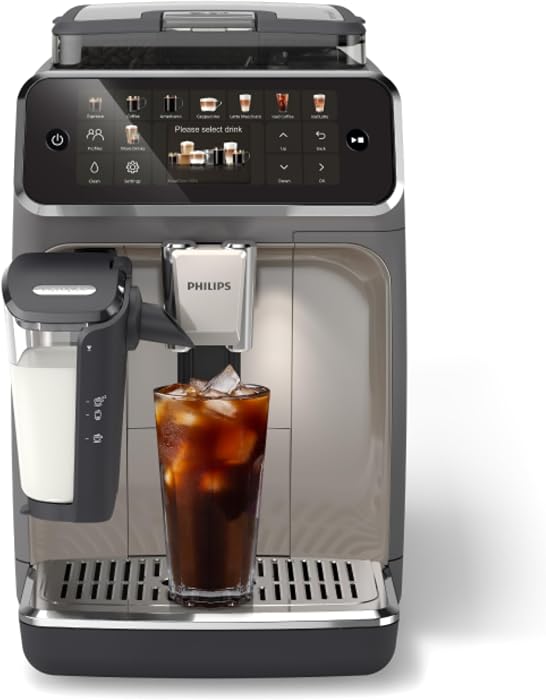
There is a version of this purchase where you never learn what a puck is. The Philips 5500 is built for that person: beans in the hopper, a drink tapped on the color display, and a finished latte without a tamper, a scale or a stopwatch.

It is the machine we suggest when someone says they want the coffee, not the hobby. The ceramic grinder grinds and tamps on its own, QuickStart claims three seconds to ready, and the 20 presets cover espresso, cappuccino, iced coffee and plain hot water — useful in July, when the idea of standing over a hot group head loses its charm.

LatteGo is the part worth understanding. The milk carafe is three pieces with no internal tubes, so it rinses under the tap in the time it takes to put the milk away, and that is the difference between a milk system you use daily and one that quietly stops getting used. Milk texture here comes from the carafe rather than from a wand you learn to steer.

The footprint is the trade. At 14.61 inches it is the widest machine in this group, though only 9.69 inches deep, so it suits a shallow run of counter better than a narrow gap between appliances. If your only free space is a slot beside the fridge, measure before you fall for the preset menu.

Worth Noting

  • Widest machine here at 14.61 inches
Our Verdict

We recommend the 5500 to anyone who wants a latte without learning espresso — it grinds, brews and handles milk from a preset, and nothing else here is this hands-off.

Check Latest Price
4

Electactic Espresso Machine Best for Less Refilling

Electactic Espresso Machine – Espresso Machine with Grinder

Less refilling

Our Score 83/100
Pressure
15 bar
Dimensions
11.5"D x 13.03"W x 16.1"H
Water Tank
78 ounces, removable
Grind Settings
30
View on Amazon

Seventy-eight ounces is a big tank for a machine this size, and it is the first thing we point at. That capacity turns a daily top-up into a weekly errand, which in a small kitchen is worth more than a chrome finish, and the tank lifts out so you can fill it at the sink instead of aiming a pitcher at it.

The rest of the spec sheet holds up. Thirty grind settings, a 58mm portafilter, 15 bar, a cup warmer on the roof and a 1500W heater claiming 45 seconds to ready. The grind path is what they engineered: a wider polished chute and a reinforced helical auger that ejects grounds instead of letting them pack in, and a packed chute is the jam that takes cheap built-in grinders out of service.

Eighteen pounds of machine also means it stays put when you lock the portafilter in, and the drip tray lifts out for a rinse without the whole unit moving. Buy it for the tank, the cup warmer and the 58mm basket, and set it up where you can get at the back of it.

Worth Noting

  • Can stop working within months
Our Verdict

We recommend the Electactic if refilling is what annoys you most — the biggest tank here, a full-size basket and a cup warmer, for a budget price.

Check Latest Price

How We Tested Compact Espresso Machines With Grinders

We started with a shortlist of about two dozen machines that grind on board, then cut anything whose footprint wouldn't clear a standard upper cabinet, anything without a removable water tank, and anything whose replacement parts were hard to source. Ten made it through. Each one lived on a real kitchen counter for eight months, and two also spent a month in a much smaller kitchen.

Every machine got the same weekday-morning shift: two double shots pulled back to back before work, then a milk drink. I weighed the dose in and the yield out on a scale, timed the first shot from a cold start, and read the water temperature at the group head across three consecutive shots to see whether it drifted. I also counted how many of the grind settings were actually usable — most dials have a narrow sweet spot, and some have click stops so coarse that half the range is decoration.

Milk came next: six ounces of whole milk and eight ounces of oat milk, steamed and timed, then judged on whether the foam poured or bled. I measured grinder noise at arm's length and noted whether it carried into the next room, since a 6 a.m. grind is a household decision. Footprint got tape-measured, including the clearance needed to lift the hopper and tank off, and the machines that offer cold or iced settings got brewed over ice so I could tell whether the shot tasted diluted or simply cold.

Over the months I tracked what only shows up with use: leaks at the group gasket, grinder settings that wandered, descaling cycles that ran long or threw errors, fingerprints on the finish. The last question was the honest one — would I spend my own money, and which machine was still on my counter a month after testing ended.

How to Choose a Compact Espresso Machine with a Grinder

Measure the footprint, then measure the air above it

Width alone separates the machines here: they run from 10.31 to 14.61 inches wide and 9.69 to 13.8 inches deep. The dimension shoppers forget is height. Every machine in this group stands between 14.75 and 17.05 inches tall, and you need room above the hopper to lift the lid plus room in front to swing the portafilter handle.

Measure the gap between the counter and the upper cabinets, then take off a couple of inches for your hand and the lid. A machine that has to be dragged out to fill is a machine that stops getting filled, and that matters more than an inch of width either way.

Built-in grinder, or two boxes

Every pick here grinds on board, which saves an outlet and means the dose falls straight into the basket instead of into a bin you have to pour from. The trade is that a dead grinder takes the whole machine with it — the grinder is usually the part that goes first — while a bundled pair lets you replace half the setup. That is why we read durability and warranty length as buying criteria, not reviewer trivia.

The number of grind steps matters less than whether a step repeats. Thirty or forty settings are plenty if setting 12 gives the same grind next week. Keep one thing in mind: a single hopper means emptying it every time you switch to decaf.

Decide how much of the barista work you want to keep

A semi-automatic espresso maker asks you to grind, dose, tamp and judge the shot, and it hands you a wand to texture milk yourself. That is more work per drink and more control per drink: you can chase a particular bean, and you can push the milk wetter or drier for a specific drink.

A fully automatic machine turns the whole sequence into a preset. We think the split comes down to what is in your cup. Straight espresso and the occasional cappuccino reward the manual machine; two milk drinks before work is a job for one-touch. Neither is better — they are different purchases.

Heat-up, cleanup and the parts you actually touch

Fast heat-up is quoted at 30 to 45 seconds on the small machines, which matters most if you pull one shot and head out. Past that, the friction is maintenance. A milk carafe that comes apart into three pieces gets rinsed; a wand with dried milk on it gets ignored, and then the foam suffers.

A removable tank you can carry to the sink beats a bigger one you top up with a pitcher. Put the machine where you can reach the tank, the drip tray and the grinder chute without sliding it out from under the cabinet.

Frequently Asked Questions

Final Verdict

The Barista Express is the one we recommend. Grinder, dose and steam in 12.5 inches of width, with the temperature control that makes the results repeatable — that combination is why it is the default here, and why the extra money buys something you can taste.

If the ritual is what you want to skip rather than master, buy the Philips 5500 instead. It costs more and asks for a wider slot of counter, but it turns the entire sequence into a preset, which is a different purchase from the one the Breville is selling.