Best Closet Shelving Systems of 2026

Closet systems are one of the few home upgrades that can go wrong in a way you notice every single morning: a rod that bows under winter coats, a shelf that leaves dents in your sweaters, a tower that doesn't quite clear the door trim. The fix usually isn't the fanciest kit — it's the one whose width, depth, and hardware actually match your closet and the stuff in it. Most of that decision comes down to wire versus solid shelving, and whether you want something mounted to the wall or standing on its own.

I've lived with wire shelving that flaked onto my shirts and a freestanding rack that wobbled every time I pulled a jacket off it, so I came to this with opinions. Over eight months, we installed and lived with 12 closet systems — expandable wire kits, modular steel racks, wood starter towers — in reach-in closets, walk-ins, a laundry room, and a mudroom that had no business holding coats. What I wanted was simple: something that goes up without a fight and still feels solid the hundredth time you drag a tote off the top shelf. The picks below are the ones that did, sorted by how much closet you're actually outfitting.

Our Top Picks

The 4 Best Closet Shelving Systems of 2026

1

Rubbermaid Configurations Deluxe Best Overall
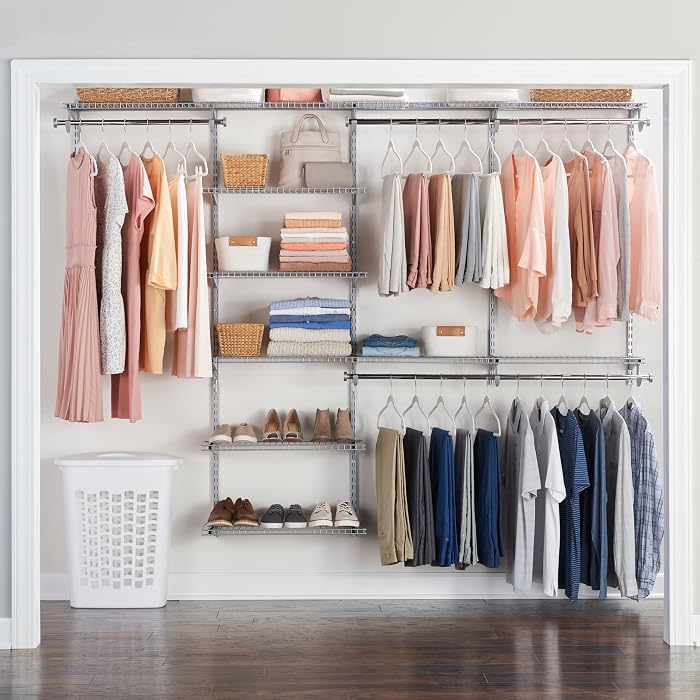
Rubbermaid Configurations Deluxe Custom Closet Kit 4-8 Ft. Adjustable Metal

Standard reach-in closets

Our Score 95/100
Mounting
Wall-mounted
Shelf Type
Adjustable wire
Fits Closets
4–8 ft wide
Installation
No cutting required
View on Amazon

Four feet to eight feet, and not a single cut. The rods telescope, the shelves expand, and the mounting hardware comes in the box, so the same kit that fits a five-foot reach-in still works when you move it to a seven-foot wall. That tolerance is the reason this is our top pick: the gap between the width you measure and the width you actually get is where most closet projects stall, and this kit absorbs it.

Better than the fit is how little of the decision is permanent. The kit assembles in several configurations and can be taken apart and rebuilt in another one later, and individual shelves move up and down, so the shelf that held sweaters in November can hold boots in February. You are not committing to a layout the first time you pick up a screwdriver.

The finish is a titanium-colored epoxy rated to resist snag points and rust, which counts for more than it sounds when the closet backs onto a bathroom wall. Wire has a second advantage: light and air move through it, so a small closet with one bulb does not turn into a cave. It has a disadvantage too, and it is why we suggest adding shelf liners to the order — small items tip through the gaps, and a folded sweater will take the shape of the wire if it sits there long enough.

Installation is a drill, a level, and an afternoon. No cutting removes the step most likely to go wrong, but the top track still has to land level and the brackets still have to find studs. Do that once and the kit is genuinely maintenance-free. What you give up for it is portability: this one is screwed to the wall, and it stays when you move.

Worth Noting

  • Caps at 8 feet; wider walls need another system
  • Wire shelves need liners for small items
Our Verdict

For a standard reach-in closet, the Configurations Deluxe fits four to eight feet of wall without cutting a rod, and its shelves and rods rebuild into a new layout whenever you need one.

Check Latest Price
2

VIPEK V5 Closet System Best for Renters

VIPEK V5 Heavy Duty Clothes Rack

Rentals and apartments

Our Score 94/100
Depth
15.7 in.
Width
68.9 in.
Mounting
Freestanding
Load Capacity
890 lb
View on Amazon

If the wall is not yours to drill, this is where the search ends. The V5 is a freestanding frame — no brackets, no studs, no spackle — standing 76.4 inches tall and 68.9 inches wide, with four hanging rods and eight shelves in a layout you choose at assembly. Assembly needs no tools, and the pieces arrive labeled, which matters more on a frame this size than on a small one.

The frame is rated for 890 pounds, and each rod carries up to 60, which is the number that actually decides whether the winter coats share a bar with the t-shirts. That is what 33 pounds of powder-coated carbon steel buys you. We also like that it does not look like a temporary fix: loaded up, it reads as furniture rather than a folding rack, which is not something you can say about most no-drill storage.

The quieter advantage is that it travels. The frame breaks down into labeled pieces, so it survives a move, and VIPEK sells add-on accessories as the wardrobe grows. What it does not do is hide anything — every shelf is open, so it rewards the folding and exposes the pile.

Worth Noting

  • Needs a wall's worth of floor space
  • Only two of the eight shelves adjust
Our Verdict

If the wall is not yours to drill, this is the one: the V5 carries 890 pounds of clothes on a freestanding frame and comes apart when you move.

Check Latest Price
3

ClosetMaid ShelfTrack Best for Adjustable Storage

ClosetMaid ShelfTrack Wire Closet Organizer System

Closets you rearrange

Our Score 91/100
Mounting
Wall-mounted
Shelf Depth
12 in.
Fits Closets
5–8 ft wide
Hanging Space
Up to 144 in.
View on Amazon

The detail worth knowing about the ShelfTrack is the rod. ClosetMaid's SuperSlide hardware carries the hanger rod past the shelf brackets instead of stopping at each one, so hangers travel the full run without catching on anything. It is a small thing until you have spent a winter wrestling a coat past a bracket, and it is the feature we noticed every time we reached into the closet.

The rest of the system is built to move. A hang track crosses the wall, standards drop from it, and shelf brackets clip in wherever you want them, so raising one shelf does not disturb its neighbors. The kit yields up to 144 inches of hanging space and 168 inches of shelf space across a five- to eight-foot wall, on shelves 12 inches deep — standard closet depth, wide enough for a folded stack and a row of shoes.

Vinyl-coated steel resists rusting and chipping, and the shelving is certified for at least 90 percent recycled content, which is not a reason to buy on its own but is a pleasant thing to find on the box. Installation is the honest cost. The long hang track wants two people, one holding it level while the other drives screws, and that is the step to plan around.

Get the track square and the rest is brackets and clips, and you end up with a closet that changes shape without a trip to the store.

Worth Noting

  • Shelf, track, or rod cutting may be needed
Our Verdict

For a closet you reorganize more than once a year, the ShelfTrack is worth it: shelves ride a wall track and hangers slide past the brackets instead of catching.

Check Latest Price
4

ClosetMaid SuiteSymphony

ClosetMaid SuiteSymphony Wood Closet Organizer System

Built-in wood look

Our Score 90/100
Shelves
5 interior, 2 adjustable
Material
Engineered wood
Fits Closets
5–10 ft wide
Weight Capacity
175 lb
View on Amazon

The SuiteSymphony is engineered wood with a laminate skin, and that is the fact to make peace with before you order. It is a 25-inch starter tower with five interior shelves, two of them adjustable, plus three rods that extend from 30 to 48 inches to either side. The panels are heavy and the white finish is clean and glossy, but edges can chip if you are rough with a screwdriver, and the tower is steadier once it is anchored to the wall.

What you get for that compromise is the only genuinely built-in look in this group. A wire kit disappears behind clothes; this one does not. The tower gives you a top shelf and solid sides, the rods carry full-length hanging on both sides of it, and the doors and drawers sold as add-ons are the difference between a closet that is organized and one that looks finished.

The kit spans walls from five to ten feet, the widest reach here, and the rods can be trimmed or run on one side only if your closet is smaller than that. At 74 pounds in the box, plan on two people to walk the tower upright and hold it against the wall while the first screws go in.

Worth Noting

  • 175-pound capacity is modest for heavy bins
Our Verdict

Buy this one if the closet door stays open: it is the only wood system here, and the tower and rods read as cabinetry rather than storage hardware.

Check Latest Price

How We Tested Closet Shelving Systems

We started by pulling every system a homeowner could realistically install themselves, then narrowed by width range, mounting style, and whether shelves and rods could be moved after the fact. Anything that locked you into proprietary bins or a single closet depth got cut. That left 12 systems over eight months: expandable wire kits, freestanding modular racks, and wood starter towers, spread across reach-in closets, walk-ins, a laundry room, and a mudroom.

Assembly was timed, solo, with whatever tools the box called for. We counted trips back to the hardware store, noted whether wall anchors came included, and watched whether the instructions matched the parts in front of us. A system did well if one person could hold a shelf level and drive a screw at the same time; it lost ground if a bracket had to come back off because a rod sat an inch out of place.

Sturdiness got the ugly test. We hung a full winter's worth of coats on each rod and stacked bins on every shelf, then checked for bowing a week later. We pulled a loaded tote off the top shelf 20 times in a row to see whether the whole unit shifted, and we mounted systems both into studs and into drywall with the supplied anchors to find out which ones felt solid and which ones flexed.

Then we just lived with them. Folded knits went onto wire and solid shelves to see which left marks, adjustable shelves were moved twice to see how much had to come apart first, and we priced out the accessories each system needs to finish a closet properly. Every unit stayed up for the full eight months, so we could watch the finish for scuffs and the hardware for loosening.

How to Choose a Closet Shelving System

Start With the Wall, Not the Kit

The numbers in these listings — 4 to 8 feet, 5 to 10 feet — describe the span a kit expands across, not a promise that it fills your wall exactly. A kit that tops out at 8 feet leaves a gap on a 9-foot wall, and one that starts at 5 feet has to be trimmed in a 4-foot closet. Measure between the side walls at the widest point, then measure depth and check which way the door swings.

Write the number down before you order anything. A quarter inch of optimism at the measuring stage is how a Saturday disappears.

Wall-Mounted or Freestanding

A wall-mounted system carries its load into studs and leaves the floor clear, which is what you want in a reach-in closet you stand inside. A freestanding unit needs no drill, no studs, and no landlord's permission, but it occupies floor space and reads as furniture — the VIPEK V5 is nearly six feet wide, so plan on giving it a wall rather than a corner.

If you rent, or the wall is plaster or tile, freestanding is the lower-risk call. If the closet is yours for the long haul, mount it and get the floor back.

Telescoping Kits vs. Standards and Brackets

Two wire systems can look identical and behave nothing alike. An expanding kit fixes its shelf heights when you assemble it, so changing your mind means taking the run apart. A standards-and-brackets system, like the ClosetMaid ShelfTrack, hangs each shelf on a wall track so you can move one without touching its neighbors.

If your closet holds coats in January and shorts in July, pay for the track. If you want to build it once and leave it, a simpler kit does the job with fewer pieces to keep track of.

Wire, Wood, and What a Weight Rating Means

Wire shelving is lighter and lets air and light through, which matters in a small closet with one bulb; it also lets small items tip through the gaps, so add liners to the order. Laminate and wood systems look built in and feel more finished, but the panels are engineered board — heavy, and prone to chipping at the edges.

Read the weight rating closely. A total capacity figure tells you less than a per-shelf number when you are stacking bins, and neither one means anything if the track is not screwed into studs.

Frequently Asked Questions

Final Verdict

For a standard reach-in closet, buy the Rubbermaid Configurations Deluxe. It covers four to eight feet of wall without cutting a rod, installs with the hardware in the box, and lets you move shelves as the wardrobe changes — the three things that separate a closet that works from one that merely holds clothes.

If you cannot drill, the VIPEK V5 puts a full wardrobe on a freestanding frame for about the same money. And if the look is the point, the ClosetMaid SuiteSymphony is the only pick here that makes a closet read as built-in; anchor it well and keep the load reasonable.