Best Ceiling Fans of 2026

A ceiling fan has to do two things that pull against each other: move a lot of air, and do it without a sound. The third thing — how it looks hanging over the room — is the one you notice every day and the one no spec sheet ever mentions. My team installed 12 fans over the past eight months, in bedrooms, a living room, a kitchen, and a covered porch, and the ones that earned their keep were quiet, steady, and easy to put up. A good one solves the sticky-room problem without adding a noise you have to talk over.

Two specs decide more than the finish does. Span and mount come first: a 42-inch fan disappears in a big room, and a fan on a downrod won't clear a low ceiling, which is exactly why flush mounts exist. Then the motor — a DC motor lets a fan turn slowly and stay nearly silent, and all the app and voice control in the world won't save a fan that hums while you sleep. Below you'll find simple pull-chain fans, smart ones, low-profile models for tight rooms, and a big damp-rated fan for a porch.

Our Top Picks

The 8 Best Ceiling Fans of 2026

1

Hunter Builder Deluxe 52-Inch Best Overall

Hunter Builder Deluxe 52-Inch

Living rooms

Our Score 93/100
Light
LED bulbs included
Airflow
5,102 CFM
Control
Pull chain, 3 speeds
Blade Span
52 inches
View on Amazon

The number worth starting with is 5,102 CFM, the air this fan moves at its top speed, and it is why the Builder Deluxe is the fan we recommend first for a living room or a large bedroom. There is more airflow in this set — the DREO and the Sofucor both claim a few hundred CFM more — but neither pairs it with a pull chain and a five-blade bronze body that disappears into a traditional room. What we cared about in use was the middle of the range: at low and medium it moves enough air to feel across a sofa without the motor becoming the loudest thing in the room.

Installation is the standard three-wire job, and Hunter's instructions are the kind you can follow on a ladder without rereading them twice. The five blades went on balanced and stayed that way, with no wobble at any of the three speeds. At 12.7 inches of drop and 20 pounds it wants two people for the final lift, and it wants a normal-height ceiling — put this in an eight-foot room and the blades start to feel close.

The light is the part to plan around. The kit takes two standard bulbs, which we count as a real advantage over a sealed LED panel, but the bulbs Hunter ships with are dim enough that a room can feel underlit after dark. Buy a brighter pair along with the fan and keep the originals as spares. That fixes the one real weakness on an otherwise very solid fan.

Hunter's warranty runs a limited lifetime on the motor and a year on parts, glass, and bulbs, which is the coverage that matters on a fixture you will not touch again for a decade. And nothing about running it needs a battery, a hub, or a phone: pull the chain and the air moves. That simplicity is a large part of why it holds the top spot over smarter fans that technically do more.

Worth Noting

  • No remote or app control
Our Verdict

We recommend the Builder Deluxe as the default for a standard bedroom or living room: 5,102 CFM of airflow, a quiet motor, and a light kit you can re-bulb yourself.

Check Latest Price
2

DREO Smart 52-Inch Best Smart Fan

DREO Smart Ceiling Fan with Lights

Smart homes

Our Score 92/100
Light
Dimmable LED, adjustable white
Airflow
5,673 CFM
Control
Remote, app, Alexa, Google
Blade Span
52 inches
View on Amazon

Where our top pick gives you a pull chain, the DREO gives you a phone. It is a 52-inch fan on a brushless DC motor with four ways in — the included remote, the DREO app, Alexa, and Google Home — plus an LED panel that dims and shifts color temperature without a second wall switch.

The speed range is what won us over. Instead of three steps you get a long ladder of them, so there is a setting between off and noticeable for sleeping, and a timer that drops the fan to low at one, four, or eight hours. Voice control sounds like a gimmick until the remote is across the room and you are already under a blanket.

The light is the compromise: DREO rates the panel at roughly the equivalent of a 24-watt bulb, which is plenty for a bedroom and thin for a kitchen or an open living space. Installation is manageable at 15.2 pounds, but the 13.66-inch drop rules out a low ceiling. If your house already talks to a speaker, this is the fan that fits how you live; if you want the simplest possible fixture, the Hunter is still the better buy.

Worth Noting

  • LED is modest for a large room
Our Verdict

We point app-first households to the DREO: a quiet 52-inch DC fan you can dim, schedule, and speed up from your phone or by voice.

Check Latest Price
3

Hunter Builder 42-Inch Low Profile Best for Low Ceilings

Hunter Builder 42-Inch Low Profile

Low ceilings

Our Score 91/100
Light
Three E26 sockets
Height
8.8 inches
Control
Pull chain
Blade Span
42 inches
View on Amazon

Eight-foot ceilings are the reason this fan exists. At 8.8 inches from ceiling to the bottom of the light, the Builder 42 clears headroom that a standard downrod fan eats, and it does it without the basement look some low-profile fixtures have. This is the fan we point people toward for a bedroom, a small kitchen, or a den where a 52-inch span would crowd the walls.

The trade is airflow. A 42-inch fan sweeps less air than a 52, and the top speed here reads gentle rather than dramatic. For a bedroom that is exactly right: it is quiet enough on low to sleep under, it runs without a wobble, and it circulates a whole room instead of blasting one corner of it.

The light kit is the detail we like most. Hunter uses three standard E26 sockets behind the glass, so you can fit brighter bulbs, warm bulbs, or smart bulbs, and replace them when they die — none of which you can do with the sealed LED panels on most fans this size. It is a small thing that decides a lot five years in.

Worth Noting

  • 42-inch span leaves big rooms uneven
  • Pull chain only, no remote
Our Verdict

For a ceiling under nine feet, this is the fan we hand people: an 8.8-inch hugger that still moves air and takes bulbs you can upgrade.

Check Latest Price
4

ZMISHIBO 72-Inch Best for Large Rooms

ZMISHIBO 72" Ceiling Fans with Lights for Patio

Great rooms

Our Score 90/100
Light
24W LED, 3 color temperatures
Downrods
4, 8, and 24 inches
Blade Span
72 inches
Outdoor Use
Damp rated
View on Amazon

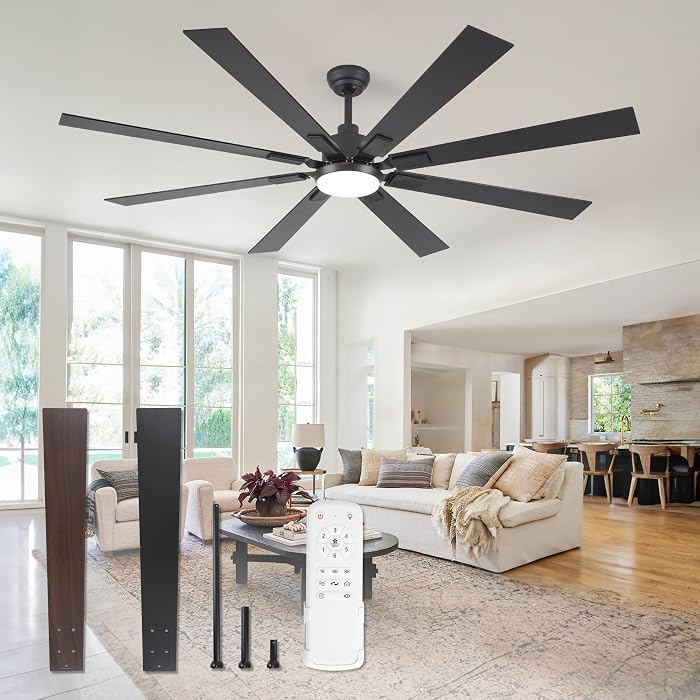
At 72 inches across, this fan does not so much cool a room as change its weather. It is the widest thing here by a foot and a half, with eight blades and enough swept area to move air through a great room, a vaulted living space, or a covered porch that a 52-inch fan cannot reach.

The kit is more thoughtful than the size suggests: three downrods at 4, 8, and 24 inches, so it works on an eight-foot ceiling or a two-story one, blades finished black on one side and walnut on the other, and a DC motor rated at 35 dB. The 24-watt LED carries three color temperatures and enough output for a big space, and the fan is damp rated for covered outdoor use.

What we do not like is how completely the remote owns it. There is no pull chain, and the receiver is the only way in, so a lost remote or a failed receiver turns the fan into a very large light fixture. Mount the holder next to the switch and keep the remote where you can find it. We also wish the light dimmed — it changes color temperature but not brightness, which is the one place this fan feels cheaper than its size suggests.

Worth Noting

  • Light changes color but does not dim
Our Verdict

For a great room, a vaulted ceiling, or a covered porch, the 72-inch ZMISHIBO is the one here with the span to actually fill the space.

Check Latest Price
5

Sofucor 52-Inch Smart Best Wood-Blade Fan

Sofucor 52 Inch Smart Ceiling Fans with Lights

Styled living rooms

Our Score 89/100
Blades
Three solid wood
Airflow
5,500 CFM
Control
Voice, app, remote
Blade Span
52 inches
View on Amazon

Three solid wood blades on a flat, flush-mount body is a look most fans ruin by adding a light kit that fights it. The Sofucor gets it right: 52 inches of walnut-and-black blade on a low body, and in a room with furniture worth looking at it reads as part of the room rather than an appliance bolted to the ceiling.

The looks do not cost you performance, which is the part we did not expect. It claims 5,500 CFM from a quiet DC motor, the light shifts across three color temperatures and dims to 10 percent, and a memory function holds your brightness setting after the switch is flipped. Alexa, the app, and the remote all reach it, and the 1, 4, and 8-hour timer handles the falling-asleep part.

Two things to know before you buy. It hangs 11.8 inches, so it is a flush mount but not a true hugger — fine at eight feet, tight at seven and a half. And the app picks up work the remote sometimes fumbles, which is more backup than the remote-only fans here can offer.

Worth Noting

  • Remote is the weak link in the controls
Our Verdict

If the fan is going to be looked at as much as used, the Sofucor's solid wood blades and 5,500 CFM make it our pick for a living room you style.

Check Latest Price
6

LEDIARY 20-Inch Fandelier Best for Small Rooms

LEDIARY 20" Modern Ceiling Fans with Lights and Remote

Small bedrooms

Our Score 88/100
Control
Remote and app
Diameter
19.7 inches
Brightness
3,570 lumens
Color Temperature
3,000K-6,500K
View on Amazon

Twenty inches across and 5.1 inches deep, this is a fandelier in the literal sense: a light fixture with a fan tucked inside it. In a small bedroom, a kitchen, or a rental with a low ceiling, that is a better answer than a full-size fan that would dominate the room and still leave the lighting to a separate fixture.

The light is the reason to pick this one. At 3,570 lumens it is the brightest of the small fixtures here by a wide margin, and it dims to 10 percent and shifts from 3,000K to 6,500K, so it can be a night light or a work light. The fan underneath is more capable than it looks: seven blades, six speeds, reversible, and quiet enough to sleep under.

Where it stops is room size. The air stays in the zone under the fixture — you feel it at the counter or in bed, not across a 300-square-foot living room, and that is the honest boundary of a 20-inch fan. Installation wants a second pair of hands for the final lift while the wiring is tucked up. For a small room, nothing else here lights it this well while moving this much air.

Worth Noting

  • Air movement stays under the fixture
  • Remote feels cheap next to the fan
Our Verdict

For a small bedroom, a kitchen, or a rental where a full-size fan would overwhelm the ceiling, this 20-inch fandelier is the one we reach for.

Check Latest Price
7

Depuley 42-Inch Best Budget Fan

Depuley Modern Ceiling Fan with Light: 42-Inch Black Small Fans for Bedroom

Budget bedrooms

Our Score 87/100
Light
Dimmable LED, adjustable color
Height
9.25 inches
Speeds
6
Blade Span
42 inches
View on Amazon

It is the least expensive full-size fan in this group, and the spec sheet does not read like a corner was cut: 42 inches, five blades, six speeds, a dimmable LED with adjustable color temperature, a timer, and a remote.

What you give up is material, not function. The blades are plastic, the body is light enough to hang without help, and it looks better from standing height than it does in your hands. Air movement is the strongest part of the case for it — even on the low speeds it pushes a breeze across a bedroom — and the installation is about as simple as a ceiling fan gets.

Two limitations belong to the design rather than to this unit. The LED is a sealed strip, so when it dims for good you are replacing a fixture, not a bulb. And Depuley labels the fan indoor/outdoor while the same spec sheet says it is not water resistant — a covered porch, yes; open sky, no.

For a rental bedroom, a kid's room, or a patio under a roof, that trade is easy to take. You get a full-size fan with a dimmable light and a remote for less than any other 42-inch option here, and nothing about how it runs feels like a budget compromise. If it is going in a room you will look at every day for twenty years, spend more.

Worth Noting

  • Integrated LED cannot be re-bulbed
  • Listed for outdoors but not water resistant
Our Verdict

The least expensive full-size fan here, and the one we suggest for a rental bedroom or a covered patio where value beats finish.

Check Latest Price
8

addlon 24-Inch Fandelier Best for Decor-First Rooms

addlon 24" Low Profile Fandelier Ceiling Fans with Lights and Remote

Decor-first rooms

Our Score 86/100
Control
Remote and app
Diameter
24 inches
Brightness
2,090 lumens
Light Colors
3 color temperatures
View on Amazon

A 24-inch fan under a crystal shade is an odd idea until you see one in a small room, where the light does the decorating and the blades do just enough. This is the wider version of addlon's 20-inch fixture, and the extra span is the point: it spreads air over more of the room than the smaller model it replaces.

The light is genuinely good. 2,090 lumens across three color temperatures, dimmable from 10 percent, with a memory function that returns to your setting and a one- or two-hour timer. The DC motor is quiet enough to leave running overnight, and six speeds plus reversible airflow cover summer and winter. On paper it is a well-rounded fixture.

The reason it is not ranked higher is reliability. Some of these units quit within weeks of going up, and a hardwired fixture that fails is a ladder, a breaker, and a return rather than a phone call. That is a real risk on something installed over a bed or a dining table.

If the crystal look is what the room needs, buy it and run it hard during the first week while a return is still easy. If you want the same small-fixture idea with a steadier record and a brighter light, the LEDIARY costs less and is the safer call.

Worth Noting

  • Some units quit within weeks of installation
  • Air movement is local to the fixture
Our Verdict

Buy the addlon if the crystal look is what the room needs, but test it hard in the first week and keep the box.

Check Latest Price

How We Tested Ceiling Fans

We started with about 60 models and narrowed by blade span, mount type, motor, control options, damp rating, and price, then bought 12. Two of us installed every one ourselves on a ladder, working solo and timing it, and we noted how heavy the motor was to hold overhead, whether the canopy actually covered the ceiling box, whether the remote receiver fit inside the housing, and whether the hardware matched the instructions.

Airflow we checked rather than assumed. A handheld anemometer gave readings directly under the blades and across the room, and we taped a strip of tissue to the far wall to watch how much it lifted on low and high. Noise got measured from directly below and again from the bed at night, because a fan that sounds fine in the afternoon can be the thing that keeps you up at 2 a.m.

For appearance, we photographed each fan in daylight and after dark and asked whoever lived in that room whether the light kit read as a fixture or an afterthought. We also ran every fan on its slowest setting for a week to see whether the glass shook or the blades wobbled, reversed them for the shoulder season, paired the smart models to an app and a voice assistant and counted the taps it took to dim and shift color temperature, and noted which ones made us climb a ladder to flip a switch. Value came down to whether the extras worked without a hub and whether the bulbs were in the box.

How to Choose a Ceiling Fan

Match the blade span to the room

A 52-inch fan is the workhorse for a living room or a large bedroom, a 42-inch suits a bedroom or small kitchen, and a 20-inch fixture belongs in a tight room where a full fan would crowd the ceiling. Our picks run from 19.7 to 72 inches, and the 72-inch ZMISHIBO is the only one here built for a great room or a vaulted space. The trap is buying big and expecting control: a 52-inch fan on high in a 10-by-10 bedroom is a wind tunnel.

Airflow figures help you compare fans of the same size — 5,102 CFM for the Hunter Builder Deluxe, 5,673 for the DREO — but they are measured at top speed. A large fan turning slowly moves the same air more quietly than a small fan at full tilt, which is why span comes first and CFM second.

Let ceiling height pick the mount

Blades need roughly seven feet of clearance, and an eight-foot ceiling leaves very little room for a fan that hangs on a downrod. Under nine feet, buy a hugger: the Hunter Builder 42 hangs 8.8 inches and the LEDIARY 20 sits 5.1 inches off the ceiling. Over nine feet, a downrod fan drops the blades into the air where they belong, and the ZMISHIBO 72 ships with 4-, 8-, and 24-inch downrods for that reason.

The trap is the phrase low profile. It does not always mean short — the Sofucor is a flush mount but hangs 11.8 inches, which is fine at eight feet and wrong at seven and a half. Read the height figure rather than the label.

Decide how you want to control it

Pull chains are dull and nearly unbreakable: no pairing, no battery, no receiver to fail. That is why our top pick still uses them. A remote adds convenience and one more thing to lose, and on a fan with no chain backup, like the ZMISHIBO 72, a dead remote takes the fan out of service completely — mount the holder by the door. App and voice control earn their price when the fan is somewhere you would rather not walk to, which is most of the case for the DREO.

One wiring note: a fan with a remote receiver wants a plain on/off wall switch. Put it on a dimmer and the receiver can behave badly.

Check what the light actually delivers

Two fans that both say LED light included can differ by more than a thousand lumens, and that is the difference between a reading light and a night light. The LEDIARY 20 puts out 3,570 lumens; the addlon 24 puts out 2,090. Color temperature matters too — being able to move from warm to daylight is worth having in a kitchen.

The second question is whether you can change the light. The Hunter Builder 42 uses standard E26 bulbs you can swap for brighter ones or smart bulbs, while the Depuley seals its LED strips inside, so the light is fixed for the life of the fan.

Weigh the motor and the noise

DC motors give finer speed steps and draw less power than AC, which is why most of the fans here use one. What you notice is the low end: a DC fan can idle at a speed that moves air without sound. Noise at the top end is mostly balance and installation rather than motor type, so a fan hung slightly crooked on a loose box will hum whatever is inside it.

Every fan here reverses, by remote or a switch on the housing. Running it upward in winter pushes warm air off the ceiling, and that is the free half of the feature.

Frequently Asked Questions

Final Verdict

If you want one recommendation, take the Hunter Builder Deluxe. It moves more air than most 52-inch rooms need, it stays quiet at the speeds you will actually use, and its light takes bulbs you can replace — which is more than several fans here can say.

Buy the DREO instead if you would rather run the fan from your phone than from a chain, or step down to the Hunter Builder 42 if your ceiling is eight feet and the blades would otherwise be in your way.