Best Butcher Knives of 2026

The first time I broke down a whole chicken I used a chef's knife, and it went about as well as you'd expect: hacked joints, torn skin, bone chips in the sink. A chef's knife is a wedge, and a wedge won't follow a bone. A butcher knife is shaped for the job — thin along the spine so it slides into a joint, long enough to make one clean pass down a loin, heavy at the front when you need it to be.

My team and I have spent the past six months breaking down birds, trimming briskets, and splitting pork shoulders with 14 of these knives, and the differences show up fast. Two things are worth knowing. Blade flex is a preference, not a grade: a stiff boning blade gives you control on poultry, a flexible one curves around a rib cage, and semistiff splits the difference if you're only buying one. And full tang matters most on the heaviest knives — the handle is where cheap ones let go, especially with greasy hands. What follows are the ones that held an edge, felt balanced, and earned their price.

Our Top Picks

The 8 Best Butcher Knives of 2026

1

Cutluxe Butcher Knife Set Best Overall

Cutluxe Butcher Knife Set

Whole-cut breakdown

Our Score 98/100
Pieces
3
Handles
Full-tang pakkawood
Blade Steel
High-carbon stainless steel
Blade Lengths
12, 10, and 6 inches
View on Amazon

Three blades, three jobs, and no filler. The Cutluxe set pairs a 12-inch slicer for brisket and roasts with a 10-inch breaking knife — a cimeter, if you learned the trade name — for taking a primal down into pieces you can lift, and a 6-inch boning knife for the close work around bone and silverskin. A lot of what gets sold as a butcher knife set is carving knives with a story attached; this one is built around the three kinds of work that actually come up when you buy a big piece of meat.

That split is why it's our top pick. Most people shopping for butcher knives are trying to break down a whole loin or a packer brisket without buying blades one at a time, and this set gives them the sizes that do it, in forged high-carbon stainless with full-tang pakkawood handles. Nothing in the box is a knife you'll only use at Thanksgiving.

In the hand, the pakkawood is the part we keep noticing: warm, substantial, with a swell that keeps your fingers behind the edge when your hands are slick with fat. Every blade came sharp enough to draw through a brisket in one pass, and the boning knife has become the one we grab for chicken thighs and pork shoulder. The slicer only comes out when there's a big roast on the board, which is exactly how it should work.

If your projects run to chicken thighs and the occasional steak, this is more knife than you need, and the Victorinox boning knife below covers that ground for a fraction of the money. What you're paying for here is the third and fourth time you buy a whole loin because you finally can.

Worth Noting

  • No blade guards or storage sleeve included
  • 12-inch slicer is long for small cuts
Our Verdict

For anyone breaking down whole cuts at home, this is the set we hand over without a hedge: three blades that split the work cleanly and hold an edge through a long session.

Check Latest Price

2

Victorinox Fibrox Pro Boning Knife Best for Boning and Trimming

Victorinox Victorinox swiss army cutlery fibrox pro curved boning knife

Boning and trimming

Our Score 97/100
Handle
Fibrox Pro non-slip
Weight
4.2 oz
Blade Type
Curved, semi-stiff
Blade Steel
Stainless steel
View on Amazon

If we had to hand someone one butcher knife and nothing else, it would be this one. The blade is narrow and curved and sits in that useful middle between flexible and stiff: stiff enough to steer where you point it, curved enough that the tip rides along a bone instead of fighting it, narrow enough to slide between a shoulder blade and the meat without sawing. A fully flexible blade is a specialist's tool; this one you can put in the hand of someone who has never boned a chicken.

The Fibrox handle is the other half of the argument. It's a textured rubber that stays grippy when your hands are covered in chicken fat, it carries NSF approval, and it shrugs off the dishwasher, which makes this the least fussy knife in this guide. At 4.2 ounces it's light enough to trim with for twenty minutes without your wrist filing a complaint.

Trimming a brisket, taking the chain off a tenderloin, boning thighs, cleaning up a pork shoulder: it does all of it without the ache that comes from forcing a chef's knife around a curve. Pair it with a breaking knife once your cuts get bigger than a chicken, and it will still be the knife you reach for first.

Our Verdict

The boning knife we recommend first: a semi-stiff curve that follows a bone without wandering, and a textured handle that hangs on to a greasy hand.

Check Latest Price
3

Victorinox Fibrox Breaking Knife Best for Portioning Loins

Victorinox Fibrox 8-Inch Curved Breaking Knife

Portioning loins

Our Score 96/100
Handle
Fibrox Pro non-slip
Weight
4.16 oz
Blade Edge
Curved
Blade Length
8 inches
View on Amazon

A boning knife trims; a breaking knife portions. That's the gap this fills: a wider blade with a deep curve and enough heft behind it to carry through a loin in one draw, so your chops and steaks come out the same thickness instead of tapering at the end. At 8 inches it splits the difference between the short boning blades and the 10-inch cimeters the pros keep on the rail.

It's stamped high-carbon stainless rather than forged, and we don't mind that here. It weighs 4.16 ounces, steers easily around a curve, and came sharp and stayed that way through a session of breaking down pork loins. The handle is the same non-slip Fibrox rubber as the boning knife above, NSF approved and tolerant of the dishwasher.

Where it earns its place is the everyday middle: for a pork loin headed for chops or a beef loin headed for steaks, the 8-inch blade is easier to control than a big cimeter and still makes an even cut. Step up to the 10-inch if you break whole primals every month; if you mostly bone, this is more knife than the job needs.

Worth Noting

  • Curve is clumsy for fine detail work
Our Verdict

The breaking knife we point to for loins and roasts: enough curve to carry through a big cut, light enough to steer, and priced to be used rather than admired.

Check Latest Price
4

Mercer Ultimate White Boning Knife Best Budget

Mercer Ultimate White Boning Knife

First boning knife

Our Score 95/100
Handle
Textured polypropylene
Weight
4.6 oz
Blade Steel
High-carbon steel
Blade Length
6 inches
View on Amazon

This is the cheapest way into real boning work, and it doesn't feel like a placeholder in the hand. A 6-inch curved blade in high-carbon steel, a textured polypropylene handle with finger points, and 4.6 ounces of knife — it arrived razor sharp, and it comes back to a working edge in a few passes on a steel. The maker asks you to wash it by hand; do that, dry it, and it's ready for the next chicken.

It's the knife for someone testing whether they like boning before committing to a Victorinox, and the one to keep in a camp kit or a hunting bag where a good knife might sit wet in the rain. It won't be the last boning knife you buy — nothing at this price is — but the money lets you keep one in the kitchen and one in the toolbox and stop worrying about either.

Worth Noting

  • Stiffer blade than a flexible boning knife
  • Handle gets slick with fatty hands
Our Verdict

The knife we point to when you want to try boning without spending much: sharp out of the box, light in the hand, and cheap enough to keep a second one in a camp kit.

Check Latest Price
5

HOSHANHO 8-Piece Butcher Knife Set Best Complete Set

HOSHANHO 8-Piece Butcher Knife Set

Whole-animal projects

Our Score 94/100
Pieces
8
Storage
Roll bag
Blade Steel
High-carbon stainless steel
Blade Lengths
5.5 to 6.7 inches
View on Amazon

Eight knives, and the odd ones are the reason to look: a 6-inch bone chopper, a 6-inch meat cleaver, a smaller 5.5-inch cleaver, a 6.7-inch fillet knife, a 6-inch dividing knife, and a 5.9-inch viking-profile blade among them. That's not a drawer of duplicates. It's a working kit for someone who takes an animal apart in stages rather than buying two knives and improvising with the rest.

The build justifies some of the money. The blades are forged high-carbon stainless with a stonewashed, hammered finish and a 16-degree edge per side, the walnut handles are full tang and pinned, and the whole kit rolls into a bag with individual slots so the edges don't knock together in the back of a truck.

Everything arrived sharp, and the heavier blades carry enough weight that bone and dense muscle don't need much help from you. The fillet knife is the piece the other sets here don't cover: long and flexible enough for fish, slim enough for trimming silverskin. The dividing knife got the most use from us on boneless cuts, where its length does the work of two shorter blades.

It's the most expensive pick in this guide, and it's a great deal of knife for a household that cooks chicken breasts and the occasional roast. Buy it if you're doing whole-animal projects, feeding a crowd at camp, or want one case that covers everything. Otherwise the three-piece Cutluxe set solves the same problem with less to store.

Worth Noting

  • Handles run large for smaller hands
Our Verdict

A complete butchering kit in a roll bag: the pick for whole-animal projects, camp cooking, and anyone who wants every blade in one case.

Check Latest Price
6

Utopia Kitchen Meat Cleaver Best for Bone and Joints

Utopia Kitchen Meat Cleaver Knife 7 Inch Bone Chopper Stainless Steel

Bone and joints

Our Score 93/100
Handle
Stainless steel and ABS
Weight
14.1 oz
Blade Steel
Stainless steel
Blade Length
7 inches
View on Amazon

Fourteen ounces of stainless behind a 7-inch blade is the entire idea: you lift it, let it drop, and chicken wings separate at the joint without a second swing. It arrived sharp and has stayed useful through bone and cartilage, and the blade is thick enough that it doesn't flex or chatter when it lands.

The balance is the part that surprised us. A cleaver this inexpensive could easily be handle-heavy, and this one isn't — the weight sits close to the middle, and it works in small hands as well as large ones, which is not something every cleaver manages.

It's the least expensive cleaver here, and the one that makes the fewest demands: stamped stainless, a plain black handle, no ceremony. Expect to steel it regularly, because a blade at this price is not the one to leave dull for a month, and know that what you're buying is weight and steel rather than polish.

Worth Noting

  • No sheath or edge guard included
Our Verdict

The cleaver we recommend for joints and bone: heavy enough to do the chopping for you, balanced enough to steer, and the cheapest way into real cleaver work.

Check Latest Price
7

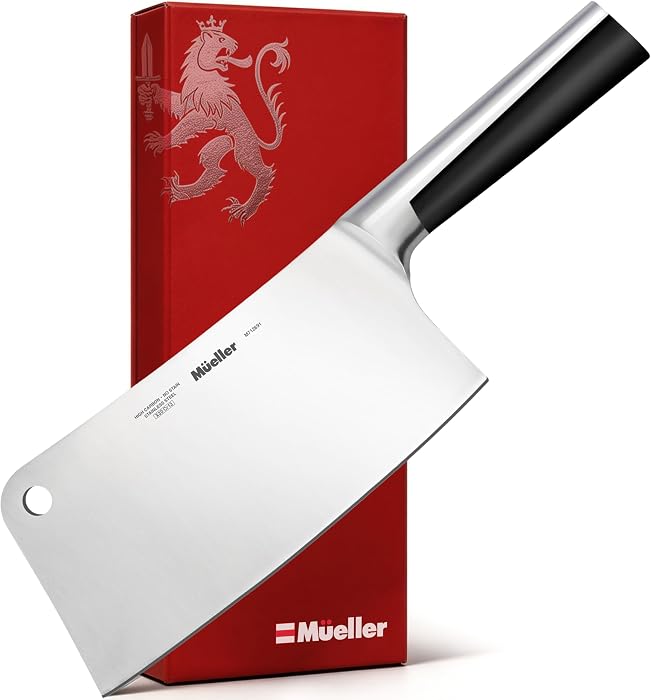
Mueller Meat Cleaver Best for Everyday Chopping

Mueller 7-inch Meat Cleaver Knife

Everyday chopping

Our Score 92/100
Handle
Stainless steel
Weight
1.1 lb
Blade Steel
Stainless steel
Blade Length
7 inches
View on Amazon

A 7-inch stainless blade on a stainless handle, 13 inches overall and a little over a pound: the Mueller is the plainest cleaver in this guide, and the plainness is the pitch. The maker claims resistance to rust, corrosion, and discoloration, plus a blade that comes back quickly on a steel.

We like it for a kitchen where the cleaver lives by the board and gets wiped down rather than coddled. There's no wood to swell, split, or oil, so it's the one you can leave wet on the rack for an hour without a second thought, and the one-piece look means there are no gaps for raw meat to work into.

At 1.1 pounds it has real heft — you feel it after ten minutes of chopping, and you appreciate it on a joint that needs one clean blow. Buy it if you want a single heavy chopper for chicken bones, ribs, and squash and don't want a maintenance ritual attached to it.

Worth Noting

  • Smooth metal handle gives less grip when wet
Our Verdict

A heavy, plain, all-steel cleaver for cooks who want to chop through joints and never think about a wooden handle.

Check Latest Price
8

imarku Cleaver Knife Best for Meat and Vegetables

imarku Cleaver Knife 7 Inch

Meat and vegetables

Our Score 91/100
Handle
Pakkawood
Hardness
57+1 HRC
Edge Angle
15 degrees per side
Blade Length
7 inches
View on Amazon

Fifty-seven on the Rockwell scale and a 15-degree edge per side: this is built like a slicing knife that happens to be cleaver-shaped. That fine, hard edge is why it moves through meat, onions, and tomatoes so cleanly — the geometry does the work rather than brute force.

It's also the best-looking cleaver here, with a pakkawood handle that is comfortable in hand and doesn't slip, and at 11.84 ounces it's balanced enough to carry through a whole prep session. It arrived sharp and held its edge through ordinary board work, which is what we ask of a knife at this price.

Where it fits is the home kitchen that cooks a lot of protein and vegetables and doesn't take apart whole animals. It's a slicing cleaver, and a good one; if your week includes splitting ribs and wings, that work belongs to the Utopia or the Mueller instead.

Of the three cleavers here, this is the one with the keenest edge and the nicest handle, and it's the one we reach for when dinner is vegetables and a couple of chicken breasts. It costs more than the Utopia and less than a full set, and it earns the difference in feel.

Worth Noting

  • Fine edge chips if you chop bone
  • Handle can work loose under heavy chopping
Our Verdict

Sharp, balanced, and good-looking: the cleaver we recommend for slicing meat and vegetables, and not the one to hand someone headed for bone.

Check Latest Price

How We Tested the Best Butcher Knives

We started by sorting the category into its working shapes — boning knives, breaking knives, cleavers, and a couple of boxed sets that came with a roll bag — then filtered on steel, handle material, forged versus stamped construction, and whether full tang was actually claimed. Everything was bought at retail, and anything whose specs contradicted its own product photos came off the list. We also priced each knife against the work it could do, because a set with a bag and a honing rod isn't a bargain if half of it never leaves the drawer.

Fourteen knives came into the kitchen for six months. Most weekends that meant breaking down a case of whole chickens, trimming packer briskets, and splitting pork shoulders — cleavers through backbones and rib racks, boning knives along the seams. A few traveled to a backyard barbecue and a camping trip, where they were washed in a cooler and spent the night in a bag.

Out of the box, we counted how many passes on a honing rod it took to bring an edge back, then noted the moment each blade started skipping across chicken skin instead of biting. We weighed every knife and found its balance point, since a cleaver that puts all its mass behind the edge is a pleasure for ten minutes and a chore for thirty. Handles got tested with greasy hands and wet hands, which is where grip actually fails.

Durability checks meant looking for chips and rolled edges after deliberate contact with bone, then checking for wiggle at the bolster and any gap where the handle meets the tang. Flex got its own test: press the tip into a cutting board and see how far it gives. Anything sold as dishwasher safe went through a cycle.

How to Choose Butcher Knives

Match the Blade to the Job

A boning knife is narrow, curved, and short, built to follow a bone and slip under silverskin. A breaking knife — a cimeter, in the trade — is wider, longer, and deeply curved, made for taking a primal down into roasts and steaks. A cleaver trades finesse for weight so joints give way. A long slicer is for brisket and prime rib, not for breaking anything down. Buy the knife that matches what you actually bring home: whole chickens and pork shoulders point to a boning knife first, and a breaking knife is the next addition once you start buying loins.

The trap is the boxed set. Plenty of sets sold as butcher knives are carving knives with a brisket slicer thrown in — fine at the holiday table and useless for taking apart a shoulder. Before you count the pieces, check that the set includes a curved breaking blade and a narrow boning blade.

Length, Curve, and Stiffness

Longer blades make fewer strokes on big cuts and give you less control on small ones. An 8-inch breaking knife handles most home loins; a 10-inch cimeter only pays off on whole primals. Curve matters as much as length: a deeply curved edge rocks through meat, while a straight edge is for drawing clean slices. For boning, semi-stiff is the practical middle on beef and pork because it steers where you point it, while a flexible blade suits fish and poultry, where the cut follows a fine bone.

A 12-inch slicer looks impressive and is awkward on a chicken breast. Match length to the biggest cut you buy regularly and let the small work fall to the boning knife.

Handles, Grip, and Wash-Up

Your hands are wet and greasy for most of this work, so grip outranks looks. Textured synthetic handles such as Victorinox's Fibrox stay grippy through fat and water, tolerate the dishwasher, and carry NSF approval. Wood and pakkawood handles feel warmer and balance nicely, but they need washing by hand and drying straight away, because heat and soaking degrade the scales and pull moisture in at the tang. If you know a knife will sit in the sink overnight, buy synthetic.

Dishwasher-safe on the box usually means the blade survives, not the handle. Check which part the maker is talking about before you load it.

Steel, Edge, and Upkeep

Stamped blades are cut from sheet steel; forged blades are shaped from a single billet. Both cut well, and forged knives generally carry more weight and a thicker spine, which suits cleavers and heavy breaking work. Hardness matters more than the marketing: a hard, thin, acutely ground edge slices beautifully and chips on bone, while a softer, thicker edge takes abuse and wants steeling more often. Hone before each session and sharpen only when honing stops bringing the bite back — a knife that slides across a tomato skin instead of catching it is telling you something.

Frequently Asked Questions

Final Verdict

Start with the Cutluxe set if you break down whole cuts at home: three forged blades cover the breaking, boning, and slicing a big piece of meat actually asks for, and the boning knife alone earns its place in the drawer. If you want one knife rather than a set, the Victorinox Fibrox Pro boning knife is the one we recommend — grippy, dishwasher tolerant, and comfortable doing the work most people actually do.

And if bones are the point, the Utopia cleaver splits joints on weight alone and costs less than the other cleavers here. Buy that one first and add the slicing blade when a brisket shows up.