Best Blenders for Salsa

Restaurant salsa has texture: some of the tomato still holds its shape, the onion and chile show up in flecks, and a spoon leaves a dent. Make it at home and a lot of blenders hand you cold tomato juice — three seconds past the pulse button, your pico de gallo is a smoothie. The blender that wins for salsa isn't the most powerful one on the shelf; it's the one you can pulse in short bursts, with a pitcher shaped so the blade actually reaches the tomatoes.

I make salsa most weeks, and over eight months my team and I put 12 blenders through pico de gallo, roasted tomato salsa, and salsa verde, plus the smoothies and crushed ice most people actually buy a blender for. We also watched for problems that only show up over time: cracked jars, lids that stopped sealing, motors that started to smell hot.

Wattage gets all the attention, but pitcher shape and control matter more here — a tall narrow jar leaves chunks sitting on top while the bottom turns to puree. The picks below get both right.

Our Top Picks

The 4 Best Blenders for Salsa

1

Ninja Blender Pro+ BL660 Best Overall

Ninja Blender Pro+ BL660

Full-size salsa batches

Our Score 95/100
Power
1100 watts
Capacity
72 oz
Controls
3 speeds + pulse
Jar Material
Plastic
View on Amazon

The feature that settles the BL660 for us is the pulse button. It sits beside three manual speeds on a 1100-watt base, and it lets you run the blades in short taps instead of committing to a full cycle. For salsa, that is the whole game: tomatoes go from chopped to watery in a hurry, and the BL660 gives you a way to stop before that happens.

The 72-ounce pitcher is the other half of the recommendation. It is marked to 64 ounces of liquid, which leaves enough room for a family batch of tomatoes, onions, chiles, and lime without filling the jar to the brim. The stacked Total Crushing blades are aggressive, so we keep the batches below the max line and pulse rather than hold. A coarse, spoonable salsa is easy to reach; a restaurant-style dice is not, because a blender is still a blender.

Compared with the BN701, the BL660 gives up some peak power and adds a simpler, more tactile control layout. The two 16-ounce to-go cups are a bonus for smoothies, not a reason to buy it for salsa. We also like that the pitcher, lid, and blade assembly are dishwasher-safe, which matters when fresh chiles and garlic leave a film on plastic.

At high speed, the BL660 is loud enough that we plan salsa before the house wakes up. That is the trade for a motor that does not bog down in a full jar.

Worth Noting

  • Plastic pitcher and lid can crack
Our Verdict

We recommend the BL660 for salsa because its 72-ounce jar and true pulse control let you stop at chunky instead of tomato sauce.

Check Latest Price
2

Ninja Professional Plus BN701 Best Value Full-Size

Ninja Professional Plus Blender

High-power everyday blending

Our Score 94/100
Power
1400 peak watts
Capacity
72 oz
Controls
Auto-iQ + 4 speeds
Jar Material
Plastic
View on Amazon

The BN701 is the full-size Ninja we point to when the BL660 feels like more money than you want to spend. You get the same 72-ounce pitcher, a 1400-peak-watt motor, and Auto-iQ presets that take over the timing for smoothies and frozen drinks.

More peak power does not automatically make better salsa. The Auto-iQ presets are built for drinks and frozen blends, so we switch to manual control and stop the blend early when we want texture. The BN701 has the muscle to pull tomatoes and peppers down fast; the challenge is not letting it run long enough to turn them into sauce. That makes it a better fit for smooth salsa, enchilada sauce, or a house salsa you want puréed.

Where it beats the top pick is straightforward: same jar size, more peak watts, lower price. Where it gives ground is finesse. If you make chunky salsa often, the BL660's pulse-first layout is easier to live with. If your salsa tends toward smooth and you also want a blender for frozen drinks, the BN701 is the value call. The pitcher is marked to 64 ounces max liquid, so a party batch still fits with headroom.

Worth Noting

  • Loud at high speed
Our Verdict

We point value-minded shoppers to the BN701: 1400 peak watts and a 72-ounce jar for noticeably less than our top pick.

Check Latest Price
3

Magic Bullet Combo MBF50200 Best for Small Salsa Batches

Magic Bullet Combo MBF50200

Small salsa batches

Our Score 87/100
Power
600 watts
Capacity
48 oz
Controls
3 speeds + pulse
Jar Material
Plastic
View on Amazon

The Magic Bullet Combo is the smallest blender here, and that is the point. The 48-ounce pitcher handles a two-person batch of salsa without taking over the counter, and the 16-ounce cup is there for a single serving of sauce or a quick smoothie. We appreciate that it does not pretend to be a party-size machine.

For salsa, the 600-watt motor and three speeds with pulse are enough for soft tomatoes, onions, and peppers as long as you cut them down first. It is not the blender for frozen fruit or ice; those jobs need more torque and a different blade action. The pitcher lid has a removable cap that doubles as a 2-ounce measure, which is a small detail we like for adding lime juice or vinegar without dirtying another spoon.

The compact footprint is the reason to choose it over the full-size Ninjas: it tucks into a cabinet and rinses out quickly. For everyday salsa for two, that trade is easy to live with.

Worth Noting

  • 48-ounce jar is small for a crowd
Our Verdict

We recommend the Magic Bullet Combo for small kitchens and two-person salsa batches, where its compact jar and pulse control make sense.

Check Latest Price
4

Oster Classic Series Heritage

Oster Classic Series Heritage Blender

Glass-jar simplicity

Our Score 86/100
Power
1000 watts
Capacity
6 cups
Controls
2 speeds
Jar Material
Glass
View on Amazon

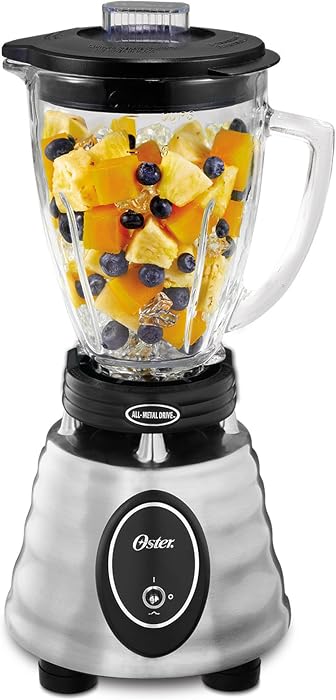
The Oster Classic Series Heritage is the glass-jar option here, and that changes how it feels to use. The 6-cup Boroclass jar is glass, so it is heavier than the plastic pitchers, with no plastic to cloud over or hold onto the smell of garlic and chiles. The brushed stainless base is a nice counterpoint to the black plastic that dominates this group.

The trade-off is control. The Oster has just two speeds, high and low, so there is no separate pulse setting to lean on. We found that tapping the low switch on and off in short bursts works for salsa, but it takes more attention than the BL660's pulse control. The 1000-watt motor has enough strength for tomatoes and peppers, and the 2-ounce filler cap is marked for measuring lime juice or vinegar while the jar stays covered.

If you want a simple blender that looks good on the counter and avoids plastic in the jar, the Oster earns its place. The all-metal drive is the durability feature we trust most here, and the glass jar is dishwasher-safe.

Worth Noting

  • Loud at high speed
Our Verdict

We recommend the Oster for cooks who want a glass jar and simple controls; its 1000-watt motor handles a family batch of salsa.

Check Latest Price

How We Tested 12 Blenders for Salsa

We started with research, reading specs and owner reviews for close to two dozen machines before narrowing to 12 on pitcher shape and material, control type, whether the jar and lid are dishwasher safe, and price. Then they went into real kitchens — mine and two colleagues' — for eight months.

Salsa came first. We diced tomatoes, onion, chile, and cilantro by hand, pulsed in one-second bursts, and counted how many pulses it took before the texture collapsed into puree. We noted whether tomato skins and seeds stayed intact or got shredded, and whether solids sat above the blade and needed scraping down. Roasted tomato and salsa verde went in warm, which is where a cheap jar shows its limits.

After that we used them the way most people do: kale and frozen strawberry smoothies before work, ice for frozen drinks, the occasional batch of nut butter. We poured each result through a mesh sieve to see what got left behind, held a decibel meter at arm's length while they ran, and did three batches back to back to check whether the base got hot or started to smell.

To-go cups and lids got their own scrutiny: we filled each one, screwed the lid on, and turned it upside down over the sink, then ran the parts through the dishwasher week after week to see if the seals held. Across eight months we logged cracked jars, clouded plastic, and buttons that stopped responding. Value was the last word — each machine had to earn its place on what it could do beyond salsa.

How to Choose a Blender for Salsa

Put Pulse Control First

A dedicated pulse button or a very controllable low speed is the most useful salsa feature. Tomatoes release water as soon as the blades hit them, and a steady high-speed run turns a chunky salsa into a smooth sauce in seconds. Pulse in short bursts, stop, and scrape down the jar. If you want a restaurant-style coarse salsa, a blender will still give you a more fluid result than a food processor; that is the trade-off for a single machine that also makes smoothies and frozen drinks. Our top pick, the Ninja BL660, has the clearest pulse control of the full-size blenders here.

Size the Jar to the Batch

A 72-ounce pitcher is the family-and-party size, but the usable liquid capacity is usually lower: the Ninja BL660 and BN701 are both marked to 64 ounces max. For salsa, leave headroom because chunky vegetables and tomato juice expand as the blades spin. A 48-ounce jar like the Magic Bullet Combo is easier to store and plenty for two people, while the Oster's 6-cup glass jar sits in the same middle range. Do not choose the largest jar if it will live on the counter and you only make a cup or two at a time.

Match Power to the Job

For full jars of dense vegetables, 1000 watts and up is the comfort zone; the BL660's 1100 watts and the BN701's 1400 peak watts give you headroom. The Magic Bullet's 600 watts is fine for soft tomatoes and peppers in a small jar, but it is not the tool for frozen fruit or ice. Blade design matters too: tall stacked blades are built to crush ice and can overwork salsa if you hold the button, while a simple four-point blade is easier to control. Use power as a reserve, not a reason to blend longer.

Decide How Much Jar Material and Cleaning Matter

Glass jars like the Oster's resist staining and hold onto fewer strong odors from chiles and garlic, but they are heavier and need careful handling. Plastic pitchers are lighter and less expensive; choose one with dishwasher-safe parts and a lid you can scrub clean. Removable blade assemblies make salsa cleanup much easier. Rinsing the jar with warm water and a drop of soap right after use saves scraping later. If you make salsa weekly, put cleanup and replacement-part availability ahead of a decorative base.

Know When a Food Processor Is the Better Tool

A blender makes a blended salsa; a food processor makes a chopped one. If you want distinct pieces of onion and pepper, a processor bowl gives you more control. A blender with pulse can get close, especially if you add the firm vegetables first and pulse briefly. If salsa is the main job and smoothies are secondary, consider whether a blender-and-processor combo earns counter space; for most buyers, a full-size blender with good pulse control is the more useful single appliance.

Frequently Asked Questions

Final Verdict

We recommend the Ninja Blender Pro+ BL660 for most salsa makers. Its pulse control is the difference between a salsa with texture and a jar of tomato sauce, and the 72-ounce pitcher has room for a family batch.

The Ninja Professional Plus BN701 is the value alternative: same jar size, more peak power, and presets that suit smooth blends more than chunky ones. If a glass jar matters, the Oster Classic Series Heritage is the one to consider.